Market Overview: Sustainable Packaging and Industrial Demand Fuel Growth
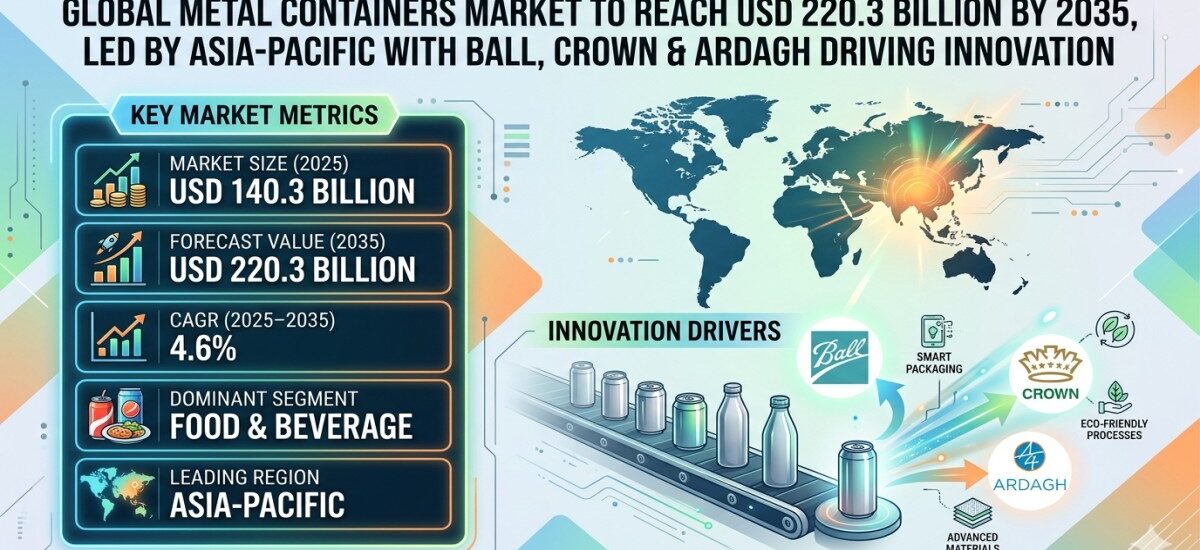
The global metal containers market is poised for steady expansion, projected to grow from USD 140.3 billion in 2025 to USD 220.3 billion by 2035, registering a CAGR of 4.6% during the forecast period. With 2024 sales reaching USD 134.2 billion, the market reflects consistent upward momentum driven by increasing demand for durable, recyclable, and high-performance packaging solutions.
Metal containers, widely used across food & beverage, pharmaceuticals, chemicals, and personal care industries, are gaining traction due to their strength, extended shelf life, and environmental benefits. As sustainability becomes a central focus globally, metal packaging offers a compelling alternative to plastic, aligning with circular economy goals and regulatory mandates.
Key Market Metrics
- Market Size (2025): USD 140.3 Billion
- Forecast Value (2035): USD 220.3 Billion
- CAGR (2025–2035): 4.6%
- Dominant Segment: Food & Beverage
- Leading Region: Asia-Pacific
Get detailed market forecasts, competitive benchmarking, and pricing trends:
https://www.futuremarketinsights.com/reports/sample/rep-gb-9432
Key Demand Drivers
- Rising Demand for Sustainable Packaging
Growing environmental awareness and strict regulations are accelerating the shift toward recyclable and reusable packaging. Metal containers, particularly steel and aluminum, are infinitely recyclable, making them highly attractive for eco-conscious industries.
- Expansion of Food & Beverage Industry
The food and beverage sector remains the largest consumer, accounting for nearly 38.9% of the market share. Metal containers provide airtight sealing, extended shelf life, and contamination protection critical for global distribution and food security.
- Growth of E-commerce and Global Supply Chains
With expanding e-commerce networks, there is a heightened need for durable packaging that can withstand long transit times. Metal containers offer superior strength and product safety during transportation.
- Technological Advancements and Automation
Manufacturers are increasingly adopting AI-powered quality control, automated fabrication systems, and smart packaging technologies to enhance production efficiency and reduce waste.
Supply Chain Analysis: Who Supplies Whom
The metal containers market operates through a well-integrated value chain:
- Raw Material Suppliers: Steel, aluminum, and tin producers provide base materials
- Coating & Technology Providers: Supply corrosion-resistant coatings, BPA-free linings, and smart tracking technologies
- Container Manufacturers: Companies like Ball Corporation, Crown Holdings, and Ardagh Group produce finished containers
- End Users: Food processors, beverage companies, pharmaceutical firms, and industrial manufacturers
- Recycling Ecosystem: Closed-loop systems recover and reuse metal, supporting sustainability
Pricing Trends & Cost Dynamics
- Raw Material Volatility: Fluctuations in steel and aluminum prices impact production costs
- Lightweighting Trends: Manufacturers reduce material usage to optimize costs
- Premium for Smart Packaging: RFID-enabled and digitally printed containers command higher margins
- Regional Cost Advantages: Asia-Pacific benefits from lower production costs and large-scale manufacturing
Segmentation Insights
By Material: Steel Dominates
Steel containers are expected to account for approximately 48.6% of the market by 2025 due to their durability, corrosion resistance, and recyclability. Their use in hermetically sealed cans and drums ensures long-term storage and product safety.
By Product Type
- Cans (largest segment)
- Drums
- Aerosol Containers
- Pails and Intermediate Bulk Containers
By End Use
- Food & Beverage (Leading Segment)
- Pharmaceuticals & Healthcare
- Chemicals and Industrial Applications
- Personal Care & Cosmetics
Regional Analysis
Asia-Pacific: The Growth Engine
Asia-Pacific dominates the global market, driven by rapid urbanization, increasing disposable income, and expanding food and beverage consumption. Countries like India, China, and Southeast Asian nations are witnessing strong demand supported by industrial growth and export-oriented manufacturing.
North America: Innovation and Regulation-Driven Market
The United States leads with a CAGR of 6.4%, driven by stringent FDA regulations, sustainability initiatives, and advanced manufacturing technologies. AI-driven automation and corrosion-resistant coatings are key innovation areas.
Europe: Sustainability and Circular Economy Leadership
The UK and broader European region are focusing on plastic-free packaging solutions, supported by policies like the UK Plastic Packaging Tax. Lightweight metals and recyclable alloys are gaining prominence.
East Asia: Precision and Smart Packaging
Japan and South Korea are emphasizing high-performance, lightweight, and smart metal containers. Innovations include antimicrobial coatings, RFID-enabled tracking, and ultra-thin aluminum packaging.
Unlock 360° insights for strategic decision making and investment planning: https://www.futuremarketinsights.com/checkout/9432
Competitive Landscape
The market is moderately consolidated, with key players focusing on sustainability, innovation, and automation.
Key Players and Market Share:
- Ball Corporation (12–16%)
- Crown Holdings, Inc. (8–12%)
- Ardagh Group S.A. (6–10%)
- Silgan Holdings Inc. (4–8%)
- Can-Pack S.A. (3–7%)
- Other players (45–55%)
Strategic Focus Areas:
- Development of recyclable and lightweight containers
- Integration of AI and automation in manufacturing
- Smart packaging solutions with RFID and IoT
- Expansion through mergers and acquisitions
Notably, Silgan Holdings’ acquisition of Weener Plastics highlights a strategic move to expand dispensing and specialty closures, reinforcing its global packaging footprint.
Technology & Innovation Trends
- AI-powered defect detection systems
- RFID-enabled smart packaging for tracking and authentication
- Lightweight and ultra-thin metal containers
- Bio-based and BPA-free coatings
- Digital printing for enhanced branding and consumer engagement
Challenges
- Raw Material Price Volatility: Impacts margins and pricing strategies
- Regulatory Pressure: Restrictions on certain coatings and materials
- Competition from Alternative Packaging: Plastics and flexible packaging solutions
- Recycling Complexities: Multi-layer coatings can hinder recyclability
Opportunities & Investment Outlook
- Reusable and Refillable Packaging: Growing demand for zero-waste solutions
- Smart Packaging Integration: High ROI through IoT and blockchain tracking
- Emerging Markets Expansion: Asia-Pacific and Latin America offer strong growth potential
- Premium Packaging Solutions: Customized metal containers for luxury and niche brands
- Automation & AI: Enhancing production efficiency and reducing operational costs
Speak to Analyst: Customize insights for your business strategy: https://www.futuremarketinsights.com/customization-available/rep-gb-9432
Future Outlook (2025–2035)
The metal containers market is transitioning from traditional packaging to a technology-driven, sustainable solution. Over the next decade, the industry will witness:
- Increased adoption of circular economy practices
- Expansion of smart and connected packaging
- Rising demand from food security and global trade sectors
- Greater collaboration between manufacturers and end-use industries
By 2035, success in the market will depend on innovation in sustainable materials, smart technologies, and scalable production capabilities. Companies that align with environmental goals while delivering high-performance packaging solutions will lead the next phase of growth in the global metal containers market.
Why FMI: https://www.futuremarketinsights.com/why-fmi
About Future Market Insights (FMI)
Future Market Insights, Inc. (FMI) is an ESOMAR-certified, ISO 9001:2015 market research and consulting organization, trusted by Fortune 500 clients and global enterprises. With operations in the U.S., UK, India, and Dubai, FMI provides data-backed insights and strategic intelligence across 30+ industries and 1200 markets worldwide.
Contact Us:
Future Market Insights Inc., Christiana Corporate, 200 Continental Drive, Suite 401, Newark, Delaware – 19713, USA
T: +1-347-918-3531
For Sales Enquiries: sales@futuremarketinsights.com
Website: https://www.futuremarketinsights.com
LinkedIn| Twitter| Blogs | YouTube