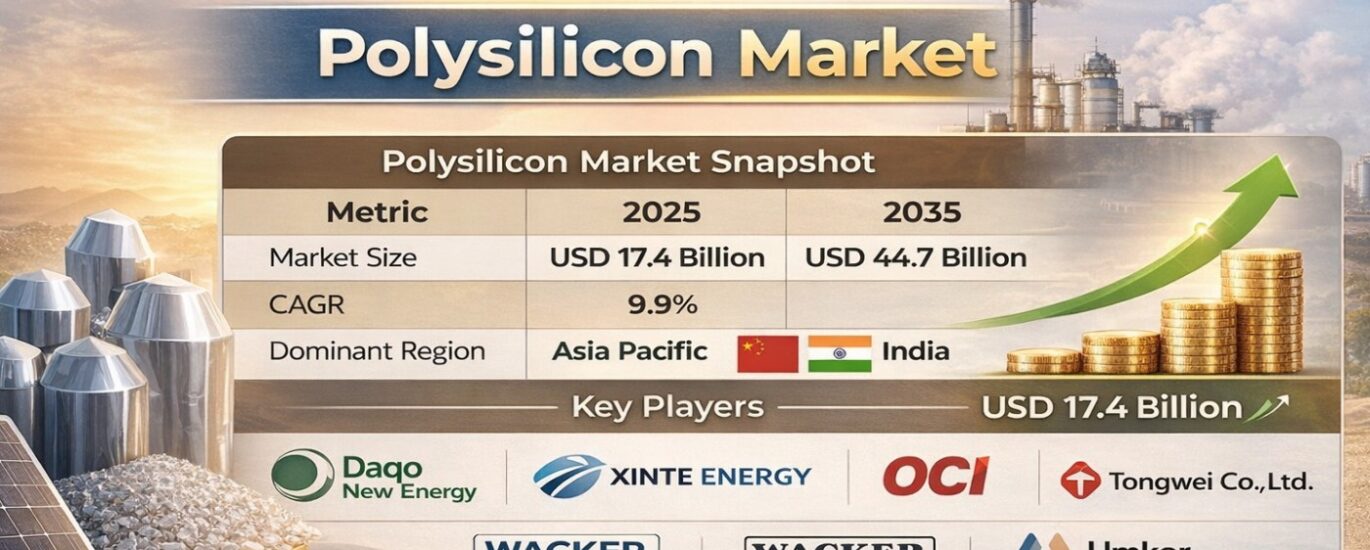
The global polysilicon market is poised for sustained long-term expansion, projected to grow from USD 17.4 billion in 2025 to USD 44.7 billion by 2035, registering a CAGR of 9.9%. This growth trajectory is underpinned by accelerating solar photovoltaic (PV) deployment, rapid adoption of high-efficiency n-type cell technologies, and expanding semiconductor manufacturing capacity worldwide.
Market Size, Forecast & Growth Dynamics
Between 2025 and 2030, the market is expected to reach USD 29.8 billion, accounting for 44% of total decade growth, driven by large-scale solar installations and transition toward advanced polysilicon grades.
From 2030 to 2035, the market will add USD 15.8 billion, representing 56% of total growth, supported by:
- Ultra-high purity material adoption
- Integration with fully automated solar manufacturing ecosystems
- Expansion of next-generation PV architectures (HJT, TOPCon, IBC)
Request For Sample Report | Customize Report |purchase Full Report – https://www.futuremarketinsights.com/reports/sample/rep-gb-6439
Key Market Segments & Share Analysis
By Grade
- Solar Grade (79%) – Dominant segment driven by PV module demand
- Electronics Grade (21%) – High-growth segment fueled by semiconductor fabs
By End Use
- Solar PV Cells/Modules (86%) – Primary demand driver
- Semiconductors (12%) – Driven by logic, memory, and power devices
- Others (2%)
By Production Technology
- Siemens Process (72%) – Industry standard for high purity
- Fluidized Bed Reactor (22%) – Cost-efficient scaling
- UMG Silicon (6%) – Emerging low-cost alternative
Demand Drivers
- Solar Industry Expansion
Polysilicon remains the foundational material for crystalline silicon solar cells. Rising investments in:
- Utility-scale solar farms
- Commercial rooftop installations
- Residential solar systems
are significantly increasing consumption.
- Shift to High-Efficiency N-Type Cells
Technologies such as TOPCon and HJT are driving demand for ultra-high purity polysilicon with superior electrical performance.
- Semiconductor Industry Growth
Demand for electronics-grade polysilicon is rising due to:
- 300mm wafer fabrication
- Advanced node chip manufacturing
- AI, EV, and data center expansion
Supply Chain Analysis (Who Supplies Whom)
The polysilicon value chain is increasingly vertically integrated:
Upstream:
- Silicon metal producers → supply feedstock
Midstream:
- Polysilicon manufacturers → refine into solar/electronics-grade material
Downstream:
- Wafer manufacturers → convert into silicon wafers
- Cell manufacturers → produce solar cells
- Module manufacturers → deliver PV modules to EPCs/utilities
Key Trend:
Leading players are integrating across the value chain (polysilicon → wafer → cell → module) to secure margins and supply stability.
Pricing Trends & Cost Dynamics
- Price volatility remains a defining characteristic due to:
- Raw material fluctuations (silicon metal)
- Energy-intensive production costs
- Downward cost pressure expected long-term due to:
- Economies of scale
- Process innovation (FBR, energy efficiency)
- Premium pricing sustained for:
- Electronics-grade polysilicon
- Low-carbon / ESG-compliant production
Competitive Landscape
The market is moderately consolidated, with top 5 players controlling ~70–75% share.
Leading Companies
- Tongwei Co., Ltd.
- Wacker Chemie AG
- GCL Technology Holdings
- Daqo New Energy
- Xinte Energy
Other Key Players
- OCI Company Ltd.
- Hemlock Semiconductor
- REC Silicon
- Tokuyama Corporation
- Asia Silicon
Competitive Focus Areas:
- Product purity and consistency
- Cost efficiency and scale
- Sustainability and carbon reduction
- Vertical integration strategies
Regional Analysis
Asia Pacific (Market Leader)
- Dominates global production and consumption
- Strong growth in China (10.5% CAGR) and India (14.2% CAGR)
- Integrated solar manufacturing ecosystems
North America
- Growth driven by domestic manufacturing incentives
- Semiconductor demand and supply chain localization
Europe
- Focus on sustainability and premium-grade polysilicon
- Strong adoption in Germany and Spain
Middle East & Emerging Markets
- Rapid growth due to mega solar projects (Saudi Arabia)
- Increasing localization and energy diversification strategies
Key Trends Shaping the Market
- Transition to n-type solar cell technologies
- Rise of ultra-high purity polysilicon (6N and above)
- Expansion of solar manufacturing ecosystems
- Increasing focus on low-carbon production
- Growing vertical integration across the value chain
Risks & Challenges
- Supply-demand imbalance and overcapacity cycles
- Energy-intensive production and carbon footprint concerns
- Raw material price volatility
- Emerging competition from alternative PV technologies (e.g., perovskites)
- Geopolitical risks affecting global supply chains
Investment Opportunities
- Expansion of solar-grade production capacity
- Electronics-grade polysilicon for semiconductor fabs
- Low-carbon and renewable-powered production facilities
- Emerging markets (India, Middle East, Southeast Asia)
- Technology innovation (FBR, advanced purification systems)
Future Outlook
The polysilicon market is transitioning from a commodity-driven sector to a strategic enabler of the global energy transition and semiconductor ecosystem. With solar PV expected to dominate new power capacity additions and semiconductor demand accelerating, polysilicon will remain a critical material at the intersection of clean energy and digital infrastructure.
Long-term growth will be defined by:
- Efficiency-driven material innovation
- Sustainable production practices
- Regional supply chain diversification
- Deep integration across solar and semiconductor value chains
About Future Market Insights (FMI)
Future Market Insights, Inc. (ESOMAR certified, recipient of the Stevie Award, and a member of the Greater New York Chamber of Commerce) offers profound insights into the driving factors that are boosting demand in the market. FMI stands as the leading global provider of market intelligence, advisory services, consulting, and events for the Packaging, Food and Beverage, Consumer Technology, Healthcare, Industrial, and Chemicals markets. With a vast team of over 400 analysts worldwide, FMI provides global, regional, and local expertise on diverse domains and industry trends across more than 110 countries.
Contact Us:
Future Market Insights Inc.
Christiana Corporate, 200 Continental Drive,
Suite 401, Newark, Delaware – 19713, USA
T: +1-347-918-3531
For Sales Enquiries: sales@futuremarketinsights.com
Website: https://www.futuremarketinsights.com
LinkedIn| Twitter| Blogs | YouTube