

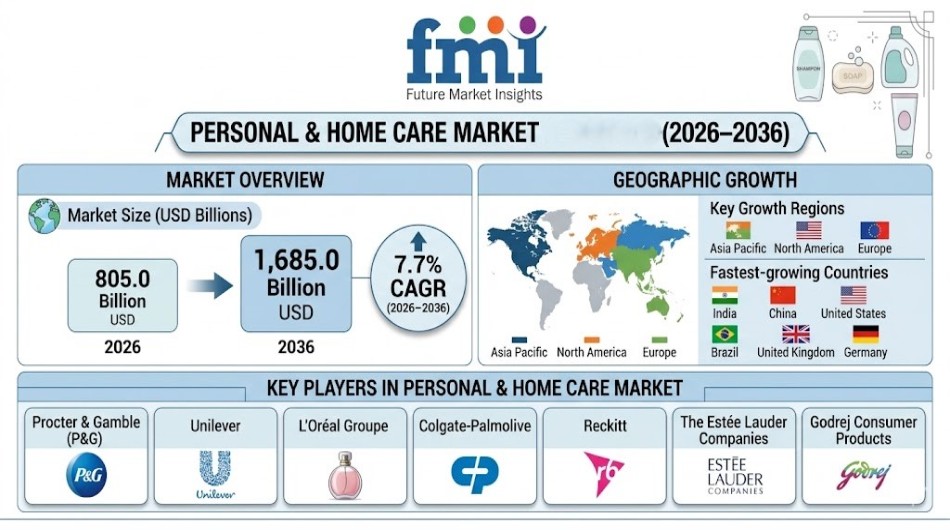
The global personal & home care market is set for robust expansion over the next decade, growing from USD 805.0 billion in 2026 to USD 1,685.0 billion by 2036, registering a CAGR of 7.7%, according to the latest analysis by Future Market Insights (FMI). Growth is driven by demographic shifts, rising hygiene awareness, and increasing consumer preference for sustainable and high-performance formulations across personal and household care categories.
Traditional product models are evolving rapidly as consumers shift toward eco-friendly, bio-based, and clinically validated solutions. Manufacturers are responding by innovating across product formulations, packaging formats, and omnichannel distribution strategies, positioning the industry for long-term structural growth.
Personal & Home Care Market Snapshot (2026–2036)
- Market size in 2026: USD 805.0 billion
- Market size in 2036: USD 1,685.0 billion
- CAGR (2026–2036): 7.7%
- Leading product segment: Skin care (~28% share)
- Dominant distribution channel: Supermarkets & hypermarkets (~37% share)
- Key growth regions: Asia Pacific, North America, Europe
- Fastest-growing countries: India, China, United States, Brazil, United Kingdom, Germany
Discover Growth Opportunities in the Market – Get Your Sample Report Now – https://www.futuremarketinsights.com/reports/sample/rep-gb-32153
Market Momentum
The personal & home care market begins at USD 805.0 billion in 2026 and demonstrates strong upward momentum throughout the forecast period. By 2031, increasing consumer spending on hygiene, beauty, and home maintenance products pushes the market well beyond USD 1.2 trillion.
Between 2031 and 2036, growth accelerates significantly, driven by premiumization, sustainability mandates, and expansion of digital retail ecosystems. The market ultimately reaches USD 1,685.0 billion by 2036, supported by consistent demand across both emerging and developed economies.
Why the Market Is Growing
Demand for personal & home care products is rising due to a combination of demographic, economic, and behavioral factors. Aging populations are driving demand for specialized hygiene and skin care products, while younger consumers are adopting preventive and multi-step beauty routines.
Increased disposable incomes, particularly in emerging economies, are enabling consumers to shift toward premium and branded products. At the same time, heightened awareness around hygiene is embedding household cleaning and sanitization into everyday routines.
Manufacturers are also aligning with sustainability trends by introducing recyclable packaging, bio-based ingredients, and concentrated formulations that reduce environmental impact and logistics costs.
Segment Spotlight
Product Type: Skin Care Leads with ~28% Share
Skin care dominates the market, driven by rising demand for anti-aging, dermatologically tested, and multifunctional products. Hair care, oral care, bath & shower, deodorants, and household cleaners follow as key segments supporting volume growth.
Distribution Channel: Supermarkets & Hypermarkets Lead with ~37% Share
Large retail formats dominate distribution due to their extensive reach and strong pricing power. However, online and e-commerce channels are rapidly expanding, offering convenience, wider product selection, and direct-to-consumer engagement.
Regional Growth: Asia Pacific, North America, and Europe Drive Expansion
Asia Pacific remains the fastest-growing region, led by India and China, where urbanization, rising incomes, and expanding retail infrastructure are accelerating demand.
North America shows strong value-driven growth supported by premiumization and organic product adoption, while Europe maintains steady expansion under strict regulatory frameworks promoting sustainability and product safety.
Drivers, Opportunities, Trends, Challenges
Drivers:
- Rising hygiene awareness and aging populations
- Increasing disposable income in emerging markets
- Expansion of beauty and home care product portfolios
Opportunities:
- Sustainable packaging and bio-based formulations
- Premium and clinically validated personal care products
- Growth of e-commerce and direct-to-consumer channels
Trends:
- Shift toward recyclable and mono-material packaging
- Increasing demand for natural and organic ingredients
- Integration of omnichannel retail strategies
Challenges:
- Raw material price volatility
- Stringent environmental regulations
- Margin pressure due to private-label competition
Country Growth Outlook (CAGR 2026–2036)
- India – 9.8% CAGR
Strong growth driven by rising middle-class income, urbanization, and increasing adoption of branded personal and home care products. - China – 9.4% CAGR
Expansion supported by advanced e-commerce ecosystems, rapid product innovation, and high digital consumer engagement. - United States – 7.9% CAGR
Growth fueled by premiumization, organic product demand, and strong institutional consumption across healthcare and home care services. - Brazil – 7.6% CAGR
Demand driven by strong beauty culture, high per-capita consumption, and expanding retail penetration. - United Kingdom – 7.2% CAGR
Growth supported by increasing preference for sustainable, cruelty-free, and ethically sourced personal care products. - Germany – 6.9% CAGR
Steady expansion led by stringent environmental standards, demand for high-quality formulations, and dominance of discount retail chains.
Competitive Landscape
The personal & home care market is highly competitive, with global FMCG leaders focusing on innovation, sustainability, and strategic acquisitions to strengthen their market positions.
Leading companies include Procter & Gamble, Unilever, L’Oréal Groupe, Colgate-Palmolive, Reckitt, The Estée Lauder Companies, and Godrej Consumer Products.
These companies compete on product innovation, sustainability initiatives, brand strength, and global distribution networks. Increasing consolidation, coupled with investments in advanced manufacturing and eco-friendly packaging, is expected to reshape the competitive dynamics over the forecast period.
Why FMI: https://www.futuremarketinsights.com/why-fmi
About Future Market Insights (FMI)
Future Market Insights, Inc. (FMI) is an ESOMAR-certified, ISO 9001:2015 market research and consulting organization, trusted by Fortune 500 clients and global enterprises. With operations in the U.S., UK, India, and Dubai, FMI provides data-backed insights and strategic intelligence across 30+ industries and 1200 markets worldwide.
Contact Us:
Future Market Insights Inc.
Christiana Corporate, 200 Continental Drive,
Suite 401, Newark, Delaware – 19713, USA
T: +1-347-918-3531
For Sales Enquiries: sales@futuremarketinsights.com
Website: https://www.futuremarketinsights.com
LinkedIn| Twitter| Blogs | YouTube




