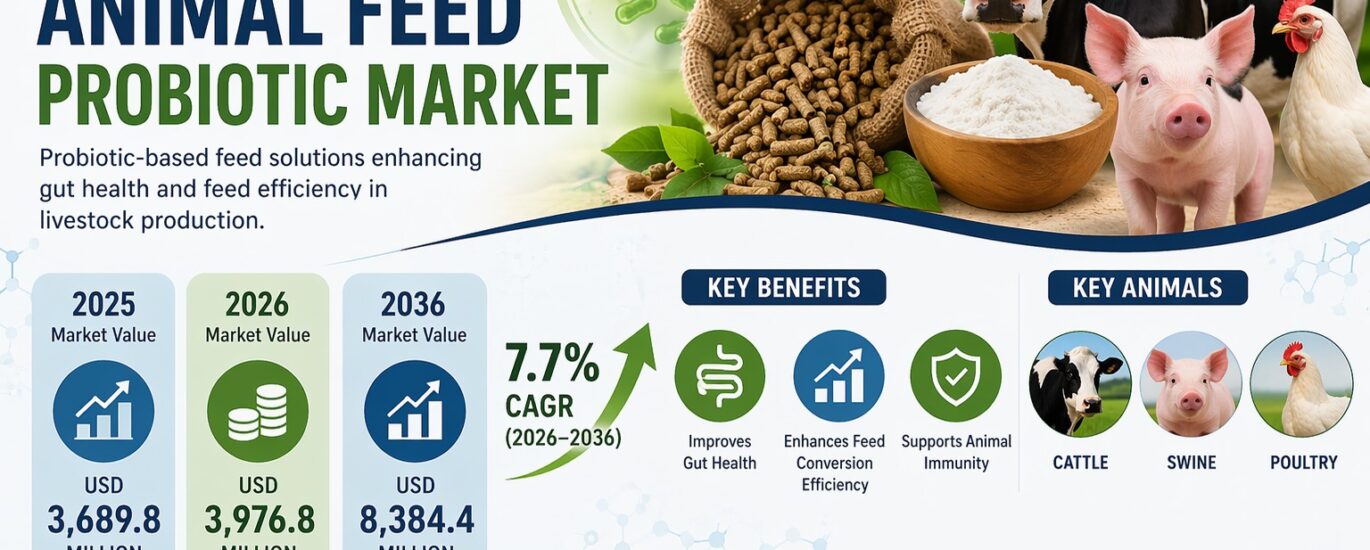
The global animal feed probiotic market is entering a high-growth phase as livestock producers increasingly prioritize gut health, feed efficiency, and antibiotic-free production systems. Valued at USD 3,976.8 million in 2026, the market is projected to reach USD 8,384.4 million by 2036, registering a CAGR of 7.7% during the forecast period.
The shift away from traditional antibiotic growth promoters is fundamentally changing feed formulation strategies worldwide. Commercial poultry, swine, cattle, and aquaculture operators are increasingly adopting probiotic-based feed additives to improve digestion, optimize nutrient absorption, strengthen immunity, and reduce disease risks.
Request For Sample Report | Customize Report | Purchase Full Report: https://www.futuremarketinsights.com/reports/sample/rep-gb-13847
Convenience of Antibiotic-Free Production Becomes a Major Growth Driver
The animal feed probiotic industry is benefiting from a structural transition toward residue-free meat production, stricter food safety regulations, and growing consumer demand for clean-label animal products.
Key growth drivers include:
- Rising pressure to reduce antibiotic usage across livestock production systems
- Growing focus on feed conversion efficiency amid volatile grain prices
- Expansion of intensive commercial livestock and poultry farming
- Increasing demand for residue-free meat, dairy, and aquaculture products
- Higher investment in microbial biotechnology and strain engineering
Supply Chain Transformation Creates New Market Opportunities
The value chain for animal feed probiotics is becoming more sophisticated as microbial strain suppliers, fermentation specialists, feed formulators, and commercial integrators work together to deliver strain-specific solutions.
Upstream suppliers include microbial strain developers, industrial fermentation companies, encapsulation technology providers, and ingredient manufacturers. Midstream participants include feed additive formulators and premix manufacturers who incorporate probiotic cultures into livestock feed blends. Downstream demand comes from poultry integrators, cattle ranchers, swine producers, aquaculture farms, and companion animal feed manufacturers.
Profitability improves significantly at the formulation and validation stage, where suppliers can differentiate based on strain survivability, thermal stability, and measurable improvements in feed conversion ratios.
Several major producers are also pursuing backward integration by building in-house fermentation facilities and microbial research labs to secure supply, protect margins, and accelerate innovation.
Key Segments Continue to Shape Industry Demand
The bacteria segment is expected to dominate the market with a 75.3% share in 2026. Spore-forming bacterial strains such as Bacillus are increasingly preferred because they can survive harsh pelleting temperatures and remain viable throughout the feed production cycle.
Livestock applications are projected to account for 57.3% of the market in 2026, driven by large-scale poultry and swine operations where even marginal improvements in feed conversion ratios can significantly impact profitability.
Pricing Trends Reflect Technology and Strain Performance Premiums
Pricing in the animal feed probiotic market is increasingly influenced by strain stability, encapsulation quality, microbial concentration, and species-specific efficacy.
Standard dry probiotic blends continue to compete on price in mass-market livestock feed applications. However, premium products with advanced encapsulation, post-pellet compatibility, and documented pathogen exclusion performance command significantly higher margins.
Regional Markets Reveal Diverging Growth Trajectories
Brazil is projected to remain one of the fastest-growing markets with an 8.1% CAGR through 2036. The country’s export-driven poultry and beef sectors are increasingly adopting probiotics to comply with residue-free meat requirements in international markets.
Japan is forecast to grow at 7.6%, supported by precision livestock farming and demand for highly specialized microbial formulations.
India is expected to register a CAGR of 5.9% as commercial feed mills increasingly rely on probiotics to improve digestibility and offset fluctuations in grain quality.
Competitive Landscape: Innovation, Validation, and Scale Determine Leadership
Competition in the animal feed probiotic market is increasingly centered on strain performance, thermal stability, scientific validation, and the ability to deliver measurable productivity gains.
Major players include: Alltech, IFF, Novonesis, Evonik Industries AG, and Novus International, Inc.
Industry leaders are investing in:
- Species-specific probiotic blends for poultry, swine, cattle, and aquaculture
- Encapsulation technologies that improve heat resistance during feed processing
- Post-pellet liquid application systems for precise microbial delivery
- Real-time microbial viability testing and diagnostic tools
- Strategic partnerships with livestock integrators and feed mills
Analyst Outlook: Precision Microbiome Management Will Define the Future
The animal feed probiotic market is evolving from a simple antibiotic alternative into a sophisticated microbiome management industry. Future growth will be driven by precision microbial formulations, strain-specific efficacy data, and improved compatibility with automated feed manufacturing systems.
Opportunities are expected to emerge in:
- Multi-strain synbiotic formulations
- Species-specific microbiome mapping
- Advanced encapsulation and thermo-tolerant coatings
- Rapid microbial diagnostics and on-site viability testing
- Sustainable livestock production systems with lower antibiotic dependency
About FMI
Future Market Insights (FMI) is a globally recognized market intelligence provider delivering actionable insights across food and beverage, agriculture, chemicals, healthcare, and industrial sectors.
Contact Us
Future Market Insights Inc.
Christiana Corporate, 200 Continental Drive,
Suite 401, Newark, Delaware – 19713, USA
T: +1-347-918-3531
For Sales Enquiries: sales@futuremarketinsights.com