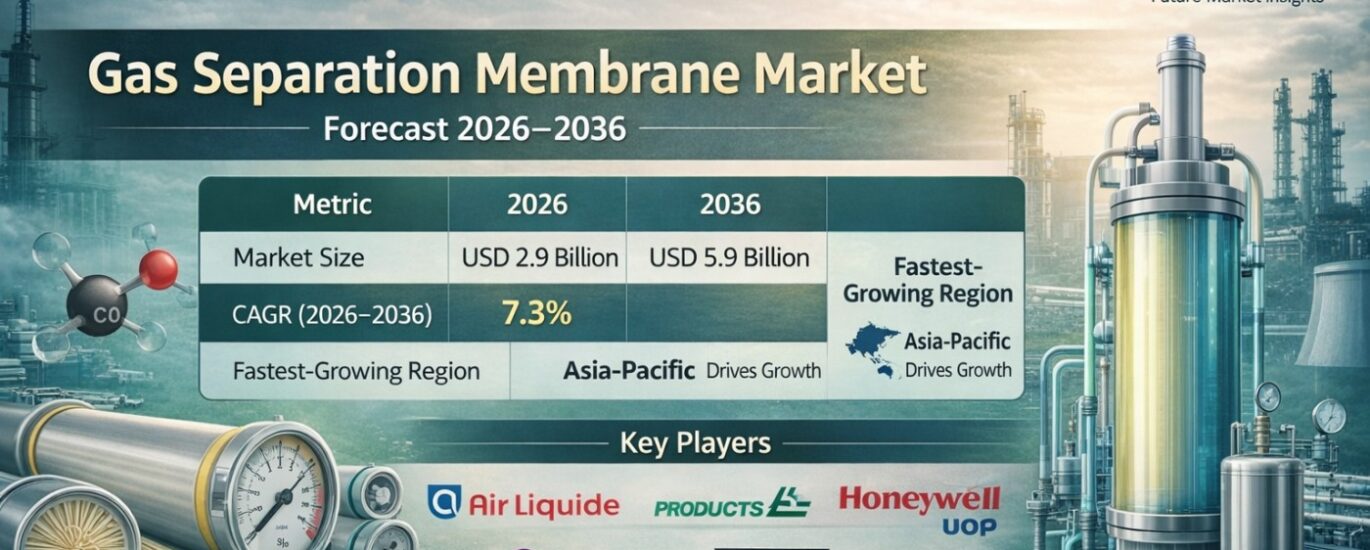
The global gas separation membrane market is valued at USD 2.9 billion in 2026 and is projected to reach USD 5.9 billion by 2036, expanding at a CAGR of 7.3%. The market is gaining momentum as industries adopt energy-efficient and cost-effective solutions for gas purification and separation. Compared to traditional methods, membrane systems offer compact design, continuous operation, and lower energy consumption, making them suitable for modern industrial processes.
Demand growth is supported by increasing use in hydrogen recovery, nitrogen generation, oxygen enrichment, and carbon dioxide separation. Refineries, petrochemical plants, and natural gas processing facilities are integrating membrane systems to improve efficiency, meet purity requirements, and reduce operational complexity.
Key Market Drivers
Growth is driven by the rising hydrogen economy, accelerating demand for purification systems, along with expansion in natural gas processing and LNG infrastructure. Industries are focusing on operational efficiency and cost optimization, while stringent environmental regulations are supporting carbon capture adoption. At the same time, growth in biogas upgrading and renewable gas applications is creating new opportunities for membrane deployment.
Request For Sample Report | Customize Report |purchase Full Report – https://www.futuremarketinsights.com/reports/sample/rep-gb-5513
Market Segmentation Analysis
The market is structured across material type, construction format, and application scope. Polymeric membranes dominate with around 60% share due to cost efficiency and versatility. Within this category, polyimide leads with approximately 36% share for its thermal and chemical stability, followed by polysulfone at about 22%, valued for mechanical strength and affordability. Inorganic and metallic membranes continue to serve high-performance niche applications.
By construction type, hollow fiber membranes lead with approximately 60.2% share, supported by high packing density and scalability for large-volume gas processing. Spiral wound systems account for around 26.4% of demand, offering advantages in pressure handling and maintenance, while plate and frame designs contribute about 13.4%, mainly used in flexible or pilot-scale operations.
Industrial Demand and Application Trends
Gas separation membranes are widely adopted across industries such as chemicals, pharmaceuticals, food processing, and energy. Their integration into core processes helps stabilize gas quality, reduce dependence on energy-intensive technologies, and simplify operations.
Key application trends include hydrogen recovery from refinery off-gases to improve resource utilization, natural gas treatment for carbon dioxide removal and dehydration, and biogas upgrading for biomethane production. Adoption is also increasing in decentralized and modular gas processing systems, supporting flexible deployment across industrial sites.
Supply Chain Analysis (Who Supplies Whom)
The industry operates through a multi-stage value chain where raw material suppliers provide polymer resins and specialty chemicals to membrane manufacturers, who develop modules such as hollow fiber and spiral wound systems. These are integrated into complete gas separation units by EPC contractors and system integrators.
Pricing Trends
Pricing varies depending on material, system complexity, and operating conditions. Polymeric membranes remain the most cost-competitive option, supporting broad adoption, while advanced inorganic and metallic membranes command premium pricing due to higher performance. Although initial investment is relatively high, long-term efficiency gains justify adoption. Increasing competition and manufacturing scale are gradually reducing system costs.
Regional Analysis
Regional demand reflects industrial growth and regulatory frameworks. North America remains a key market driven by refining, shale gas processing, and hydrogen initiatives. Asia Pacific is the fastest-growing region due to rapid industrial expansion in China and India. Europe maintains stable demand supported by environmental regulations and renewable gas adoption, while Latin America and the Middle East are witnessing growth linked to natural gas processing and industrial diversification.
Country-Level Outlook (2026–2036)
China leads with a CAGR of 8.2% driven by decarbonization and hydrogen demand, followed by India at 7.8% supported by green hydrogen and biogas initiatives. The United States grows at 7.5% due to emissions compliance and shale gas processing, while Saudi Arabia and Brazil benefit from industrial diversification and bioenergy expansion. Germany remains stable with 6.5% growth, supported by strong regulatory and engineering frameworks.
Competitive Landscape
The market is moderately consolidated, with key players including Air Products and Chemicals Inc., Air Liquide Advanced Separations LLC, Honeywell International (UOP Separex), Membrane Technology and Research Inc., UBE Industries Ltd., Evonik Industries AG, Parker Hannifin Corporation, Fujifilm Manufacturing Europe B.V., DIC Corporation, and Schlumberger Ltd.
Competition is increasingly focused on polymer innovation, modular system development, expansion into hydrogen and renewable gas applications, and strengthening long-term service capabilities.
Market Trends
The market is shifting toward low-energy and sustainable separation technologies, along with rising adoption of modular and decentralized systems. Growth in renewable gas and hydrogen applications continues to expand use cases, while improvements in membrane durability and selectivity are enhancing long-term performance.
Challenges and Risks
The industry faces challenges including membrane fouling, performance degradation, high upfront investment, sensitivity to contaminants, and operational limits under extreme conditions. Regulatory compliance and certification requirements can also delay deployment.
Future Outlook
The gas separation membrane market is expected to grow steadily through 2036, supported by industrial decarbonization, expansion of hydrogen infrastructure, and rising demand for efficient gas processing technologies. Advancements in materials and system design will further improve performance and cost efficiency, reinforcing the role of membrane technology in next-generation industrial systems.
About Future Market Insights (FMI)
Future Market Insights, Inc. (ESOMAR certified, recipient of the Stevie Award, and a member of the Greater New York Chamber of Commerce) offers profound insights into the driving factors that are boosting demand in the market. FMI stands as the leading global provider of market intelligence, advisory services, consulting, and events for the Packaging, Food and Beverage, Consumer Technology, Healthcare, Industrial, and Chemicals markets. With a vast team of over 400 analysts worldwide, FMI provides global, regional, and local expertise on diverse domains and industry trends across more than 110 countries.
Contact Us:
Future Market Insights Inc.
Christiana Corporate, 200 Continental Drive,
Suite 401, Newark, Delaware – 19713, USA
T: +1-347-918-3531
For Sales Enquiries: sales@futuremarketinsights.com
Website: https://www.futuremarketinsights.com
LinkedIn| Twitter| Blogs | YouTube