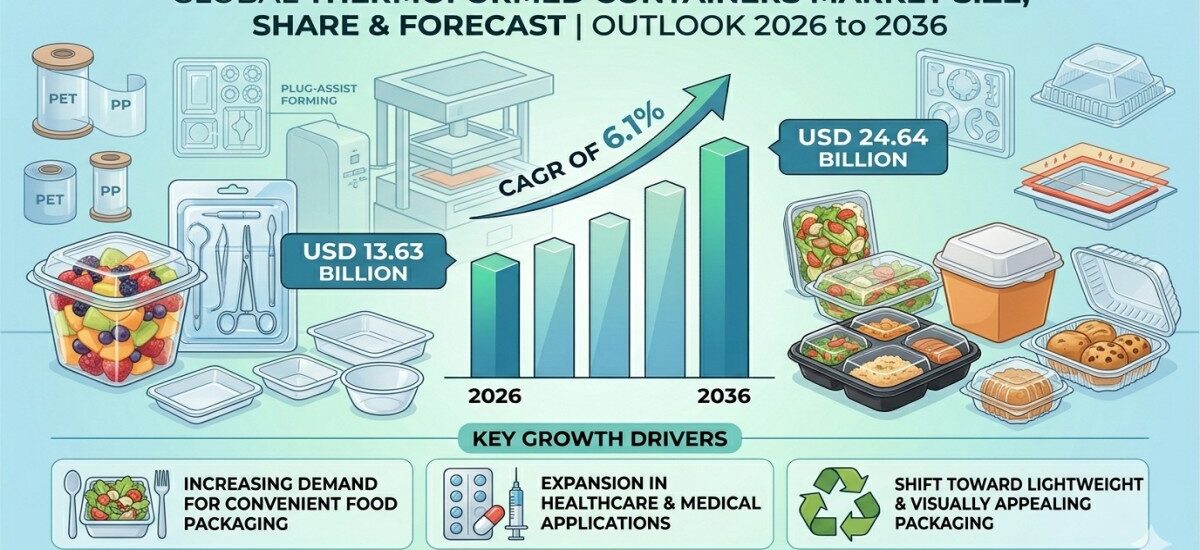
The global thermoformed containers market is poised for steady expansion as demand for efficient, lightweight, and visually appealing packaging continues to rise across food, healthcare, and consumer goods sectors. The market is valued at USD 13.63 billion in 2026 and is projected to reach USD 24.64 billion by 2036, growing at a CAGR of 6.1% over the forecast period.
This growth is largely driven by evolving consumer lifestyles that prioritize convenience, hygiene, and ready-to-consume products. Thermoformed containers offer a compelling combination of clarity, durability, portion control, and stackability, making them ideal for modern retail shelves and fast-paced foodservice operations. The expansion of takeaway culture, online food delivery, and organized retail infrastructure continues to strengthen long-term demand.
Discover Growth Opportunities in the Market – Get Your Sample Report Now
https://www.futuremarketinsights.com/reports/sample/rep-gb-8606
Key Demand Drivers and Regulatory Dynamics
Expansion of Foodservice and Retail Channels
The rapid growth of quick-service restaurants, cloud kitchens, and supermarket chains is significantly increasing the consumption of thermoformed containers. These formats are essential for handling high volumes while maintaining speed and efficiency.
Rising Demand for Convenience Packaging
Urban consumers increasingly prefer packaging that is lightweight, easy to handle, and suitable for on-the-go consumption. Thermoformed containers support portion control and improve product presentation, which enhances retail appeal.
Food Safety and Hygiene Compliance
Strict food safety regulations are encouraging the adoption of packaging that ensures contamination prevention, secure sealing, and temperature retention. Thermoformed containers meet these requirements effectively, making them a trusted solution across food and healthcare sectors.
Sustainability Pressures
Environmental concerns and regulatory scrutiny around plastic usage are influencing material choices. Manufacturers are investing in recyclable polymers, lightweight designs, and circular packaging solutions to align with sustainability goals.
Product, Material, and Technology Innovations
Material Leadership and Performance
Polystyrene continues to dominate the market, accounting for approximately 46% of demand in 2026 due to its cost efficiency, insulation properties, and ease of processing. Polypropylene is gaining traction for its heat resistance and microwave compatibility, while PET is preferred for its clarity and recyclability.
Advancements in Thermoforming Technology
Manufacturers are adopting thin-wall thermoforming techniques that reduce material usage without compromising structural integrity. Enhanced barrier properties are improving moisture and oxygen resistance, extending product shelf life.
Design and Functional Improvements
Ongoing innovations focus on improving stackability, sealing strength, and durability during transportation. Anti-fog features and high-clarity designs are also enhancing shelf visibility, particularly in fresh food and retail applications.
Leading Applications and Market Share
Food packaging remains the dominant application, accounting for approximately 51% of total demand in 2026. Thermoformed containers are widely used for ready meals, fresh produce, bakery items, and dairy products due to their ability to preserve freshness and ensure efficient handling.
Pharmaceutical packaging represents a stable and growing segment, driven by demand for blister packs, trays, and sterile enclosures that meet strict regulatory standards. Consumer goods and electronics packaging also contribute significantly, utilizing thermoformed formats for protection, organization, and retail display.
Industrial applications, while smaller in share, continue to grow steadily as manufacturers seek durable and cost-effective packaging for components and logistics operations.
Regional Insights and Country-Level Growth
Asia Pacific is the fastest-growing region, supported by rapid urbanization, expanding foodservice networks, and increasing consumption of packaged foods. China leads with a CAGR of 7.2%, driven by large-scale food delivery ecosystems and retail modernization. India follows closely with a CAGR of 6.9%, fueled by the growth of quick-service restaurants and changing consumer eating habits.
North America remains a mature yet innovation-driven market, growing at around 6.3% CAGR. Demand is supported by premium packaging requirements and widespread adoption across foodservice and retail sectors.
Europe shows steady growth at approximately 5.7% CAGR, with strong emphasis on sustainability and regulatory compliance. Countries such as Germany and Japan maintain stable demand, focusing on high-quality, precision-engineered packaging solutions with advanced functional features.
Competitive Landscape and Key Players
The thermoformed containers market is highly competitive, with leading global players and regional manufacturers competing on innovation, scale, and supply chain efficiency.
Key companies include Pactiv LLC, Dart Container Corporation, Amcor plc, Berry Global Inc., Anchor Packaging LLC, Genpak LLC, Sonoco Products Company, D&W Fine Pack LLC, Placon Corporation, and Huhtamaki Group.
These companies differentiate themselves through investments in sustainable materials, advanced manufacturing technologies, and customized packaging solutions tailored to specific end-use industries. Strong distribution networks and long-term partnerships with foodservice and retail clients further strengthen their market position.
Analyst Perspective: Operational Efficiency and Strategic Value
Thermoformed containers provide significant operational advantages due to their compatibility with automated filling and sealing systems. Their lightweight structure reduces transportation costs, while their stackable design optimizes storage efficiency.
From a strategic perspective, these containers enable businesses to enhance product presentation, improve handling efficiency, and meet evolving food safety standards. Their versatility across multiple industries further reinforces their long-term value as a reliable packaging solution.
Future Outlook and Emerging Trends
The future of the thermoformed containers market will be shaped by sustainability, innovation, and evolving consumption patterns. Manufacturers are expected to accelerate the development of recyclable, mono-material, and bio-based packaging solutions.
Advancements in smart packaging features, such as anti-fog coatings and temperature-resistant designs, will continue to improve product performance. The growth of food delivery platforms and ready-to-eat meal consumption will further drive demand for packaging that can withstand transportation and handling challenges.
Automation in manufacturing processes will also play a key role, enabling higher production efficiency and reduced material waste.
Key Market Insights
The thermoformed containers market is valued at USD 13.63 billion in 2026 and is projected to reach USD 24.64 billion by 2036, reflecting a CAGR of 6.1%. Polystyrene remains the leading material with approximately 46% market share, while food packaging dominates applications with around 51% share. Asia Pacific leads growth, with China and India emerging as key high-growth markets.
Why FMI: https://www.futuremarketinsights.com/why-fmi
About Future Market Insights (FMI)
Future Market Insights, Inc. (FMI) is an ESOMAR-certified, ISO 9001:2015 market research and consulting organization, trusted by Fortune 500 clients and global enterprises. With operations in the U.S., UK, India, and Dubai, FMI provides data-backed insights and strategic intelligence across 30+ industries and 1200 markets worldwide.
Contact Us:
Future Market Insights Inc., Christiana Corporate, 200 Continental Drive, Suite 401, Newark, Delaware – 19713, USA
T: +1-347-918-3531
For Sales Enquiries: sales@futuremarketinsights.com
Website: https://www.futuremarketinsights.com
LinkedIn| Twitter| Blogs | YouTube