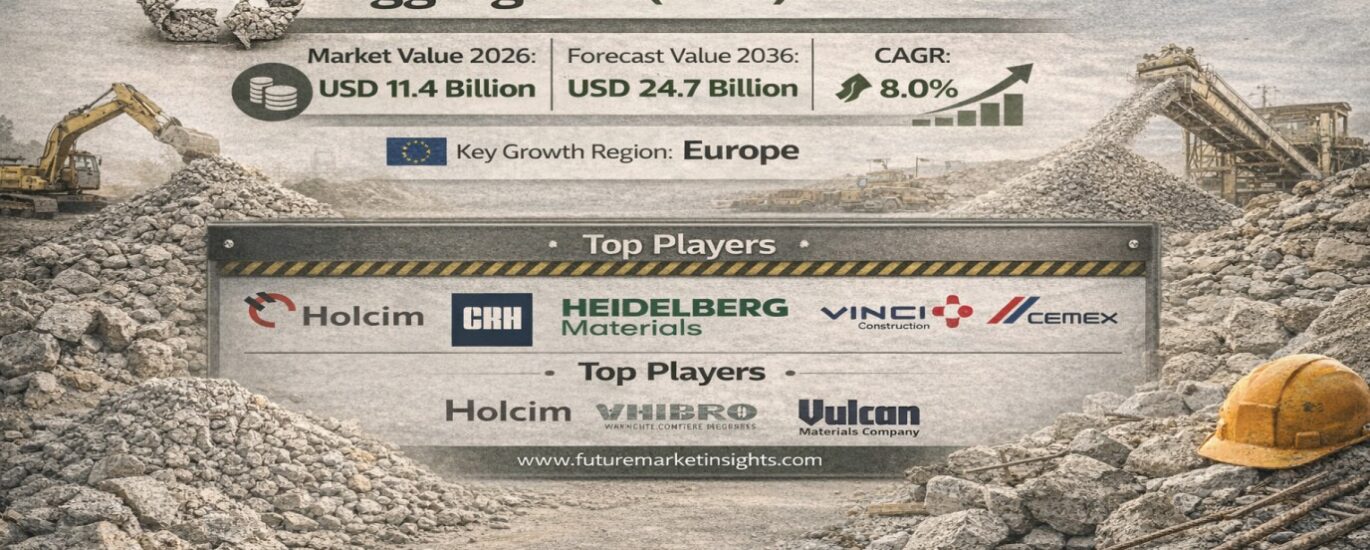
The recycled concrete aggregates (RCA) market is projected to grow from USD 11.4 billion in 2026 to USD 24.7 billion by 2036, reflecting a steady CAGR of 8.0%. This growth trajectory indicates a structural transformation in the construction sector, driven by sustainability mandates rather than short-term demand cycles.
Increasing restrictions on landfill disposal of construction and demolition waste are accelerating adoption of recycled aggregates. Developers are being compelled to integrate recycled materials into projects, shortening procurement cycles and reshaping sourcing strategies.
Corporate sustainability commitments are also playing a major role. Companies are linking environmental performance and circularity targets to financial outcomes, pushing the industry toward long-term adoption of recycled construction materials.
Market Summary
The recycled concrete aggregates market consists of processed materials derived from construction and demolition waste, including crushed concrete, recycled asphalt, and mixed demolition aggregates. These materials are widely used in infrastructure development, particularly in road construction, structural applications, and public works projects.
The market specifically includes revenues generated from processed aggregates produced through stationary and mobile recycling plants. It excludes activities such as waste collection, landfill operations, and the sale of unprocessed debris.
Request For Sample Report | Customize Report |purchase Full Report – https://www.futuremarketinsights.com/reports/sample/rep-gb-15333
Why Urban Mining Is Replacing Quarrying
Urban mining is emerging as a dominant sourcing strategy due to economic and environmental advantages. As quarry sites become scarce and geographically distant from demand centers, transportation costs for virgin aggregates are rising significantly. In contrast, recycled materials sourced from local demolition sites offer a clear cost and logistics advantage.
Additionally, governments are introducing mandates that require minimum recycled content in public infrastructure projects. This is reinforcing demand while reducing landfill pressure. From a sustainability perspective, recycled aggregates significantly lower the carbon footprint of construction by eliminating extraction and processing emissions associated with virgin materials.
Market Segmentation Outlook
By product type, gravel and crushed stone dominate the market, accounting for approximately 45 percent of total demand. These materials are widely used in road base and sub-base applications where consistency and volume are critical. Their dominance is supported by the large volumes of concrete waste generated from aging infrastructure.
By form, processed aggregates hold the largest share, estimated at around 65 percent. Advanced crushing, screening, and contaminant removal technologies are enabling the production of high-quality materials suitable for structural applications. This shift toward processed aggregates is creating premium product categories within the market.
By application, roads and pavement represent the leading segment, accounting for roughly 38 percent of demand. Government agencies are increasingly revising specifications to allow higher usage of recycled materials, ensuring a stable and long-term demand base.
Technology and Innovation Trends
Technological advancements are significantly improving the quality and value of recycled aggregates. Sensor-based sorting systems and AI-driven robotics are enabling efficient removal of contaminants such as wood, plastic, and glass. This results in high-purity aggregates that can compete directly with virgin materials.
Another key innovation is carbon mineralization, where carbon dioxide is embedded into recycled concrete. This process not only enhances material properties but also transforms recycled aggregates into carbon-negative construction inputs. Such innovations are expected to create new premium segments and accelerate adoption among environmentally conscious developers.
Regional Outlook
The market shows strong growth across Europe, driven by regulatory frameworks and infrastructure investments. Poland is emerging as a leading growth market due to rapid infrastructure modernization and strict compliance with European waste directives. The Netherlands is leveraging its advanced circular economy model and limited landfill capacity to maximize recycling efficiency.
Spain is benefiting from large volumes of construction waste and increasing integration of recycled materials into public procurement systems. The United Kingdom has a mature recycling ecosystem supported by fiscal measures such as the aggregates levy, which makes recycled materials more competitive than virgin stone. France is experiencing steady growth due to stringent environmental regulations aimed at reducing construction-related emissions.
Competitive Landscape
The competitive environment is dominated by vertically integrated companies that control both material supply and logistics networks. These players are acquiring recycling facilities and investing in advanced processing technologies to secure feedstock and improve margins.
Large companies are offering closed-loop solutions, managing demolition waste, processing materials, and supplying recycled aggregates within a single value chain. This integrated approach strengthens their competitive advantage.
At the same time, emerging players are focusing on innovation, particularly in carbon reduction technologies and mobile recycling solutions. These companies are targeting niche segments and forming partnerships with construction firms to deliver on-site recycling capabilities.
Key Players
The recycled concrete aggregates market includes major global players such as Heidelberg Materials, Holcim, CRH, CEMEX, Tarmac, and Vinci Construction. Other important participants include Vulcan Materials Company, Martin Marietta, Dura Vermeer, Neustark, Materrup, Recycleye, Everox, Porr, and PreZero.
Market Outlook
The recycled concrete aggregates market is set for sustained long-term growth, driven by infrastructure expansion, environmental regulations, and the global shift toward circular construction practices. As technology continues to improve material quality and regulatory frameworks strengthen, recycled aggregates will increasingly become a mainstream alternative to virgin materials, reshaping the future of the construction industry.
About Future Market Insights (FMI)
Future Market Insights, Inc. (ESOMAR certified, recipient of the Stevie Award, and a member of the Greater New York Chamber of Commerce) offers profound insights into the driving factors that are boosting demand in the market. FMI stands as the leading global provider of market intelligence, advisory services, consulting, and events for the Packaging, Food and Beverage, Consumer Technology, Healthcare, Industrial, and Chemicals markets. With a vast team of over 400 analysts worldwide, FMI provides global, regional, and local expertise on diverse domains and industry trends across more than 110 countries.
Contact Us:
Future Market Insights Inc.
Christiana Corporate, 200 Continental Drive,
Suite 401, Newark, Delaware – 19713, USA
T: +1-347-918-3531
For Sales Enquiries: sales@futuremarketinsights.com
Website: https://www.futuremarketinsights.com
LinkedIn| Twitter| Blogs | YouTube