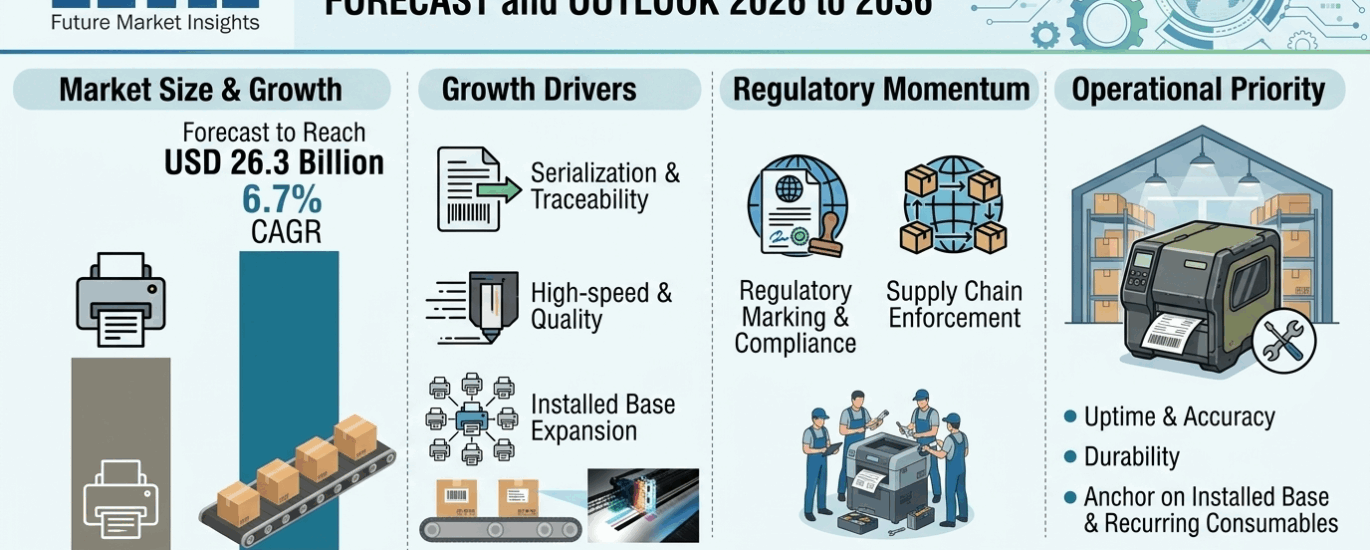
The global industrial printer market is entering a sustained growth trajectory, driven by rising demand for high-speed, high-quality printing solutions across manufacturing, packaging, and logistics operations. Valued at USD 13.7 billion in 2026, the market is projected to reach USD 26.3 billion by 2036, representing a CAGR of 6.7% over the forecast period. Growth is underpinned by operational dependence on serialization, regulatory marking, and traceability enforcement across manufacturing supply chains. Manufacturers prioritize uptime, accuracy, and durability over discretionary capital upgrades, anchoring demand to installed base expansion and recurring consumable usage rather than episodic equipment replacement.
Industrial printers are increasingly critical in sectors such as automotive, electronics, pharmaceuticals, and consumer goods, where operational continuity, code permanence, and regulatory compliance are mandatory. Investments focus on integrating printers into automated production lines, supporting variable data printing, and meeting traceability mandates while maintaining cost-effective ownership over the lifecycle.
Discover Growth Opportunities – Get Your Sample Report Now
https://www.futuremarketinsights.com/reports/sample/rep-gb-18290
Regulatory Compliance and Production Automation Drive Adoption
Manufacturers are adopting industrial printing platforms not only to maintain continuous production but also to ensure regulatory compliance, traceability, and brand integrity.
Key demand drivers include:
- Integration with automated production lines and Enterprise Resource Planning (ERP) systems
- High-speed, high-precision coding for packaging, labeling, and component marking
- Compliance with serialization, anti-counterfeiting, and batch identification standards
- Growth in contract manufacturing, logistics, and custom product lines requiring frequent changeovers
Technology Innovation Enhancing Industrial Printing
Industrial printing systems are evolving to meet diverse production needs:
- Inkjet Printing: Non-contact, high-speed, flexible printing across multiple substrates, capturing 46% of market share.
- Laser Printing: Durable, heat-resistant marking suitable for metals, plastics, and electronics.
- Thermal Transfer Printing: Reliable labeling for compliance and logistics applications.
- Dot Matrix Printing & Others: Specialized use in legacy or niche industrial workflows.
Advancements in print resolution, ink chemistry, and connectivity enable seamless integration with automated production lines, reducing downtime and improving throughput consistency.
Leading Applications: Packaging and Labeling Dominate
- Packaging & Labeling (52.0% market share): High-volume printing for traceability, compliance, and branding.
- Automotive Parts Marking: Ensures durability and legibility for regulatory and safety purposes.
- Textile, Electronics & Pharmaceutical Coding: Supports variable data printing and short-run customization.
Industrial printers are increasingly adopted where operational throughput, compliance, and repeatability are critical.
Regional Insights: China, India, USA Lead Expansion
Asia-Pacific emerges as the fastest-growing region, with China and India leading adoption due to high-volume manufacturing, regulatory enforcement, and expanding automated production lines.
- China – CAGR 8.1%: Large-scale electronics, consumer goods, and packaging production; high automation penetration; anti-counterfeiting and traceability enforcement.
- India – CAGR 7.9%: Formalization of manufacturing, expansion of pharmaceutical and packaged food production, and logistics labeling growth.
- USA – CAGR 7.4%: Compliance-driven adoption, high automation intensity, and replacement of aging equipment.
- Germany – CAGR 6.6%: Precision manufacturing focus, Industry 4.0 integration, and controlled replacement cycles.
- Japan – CAGR 6.2%: Incremental modernization, precision electronics manufacturing, and disciplined capital investment.
Competitive Landscape: Innovation, Service, and Scale Define Leaders
The industrial printer market is moderately consolidated, with leading vendors emphasizing performance, integration flexibility, and service networks.
Key players include:
- HP Inc. – Industrial inkjet presses and large-format systems
- Epson (Seiko Epson) – High-speed label and inkjet printing platforms
- Canon – Large format, commercial, and specialty industrial printers
- Brother International – Durable marking systems and industrial label printers
- Xerox – Digital presses and automated workflow solutions
Vendors differentiate through uptime reliability, compatibility with variable data printing, digital integration, and lifecycle support.
Analyst Perspective: Operational Efficiency to Strategic Advantage
Industrial printers are no longer just support equipment they are integral to production efficiency, traceability, and compliance. “Manufacturers are leveraging industrial printers to maintain continuous operations while integrating printing data with ERP and MES systems,” notes a senior market analyst. “Investment in flexible, high-speed printing systems delivers measurable gains across packaging, electronics, and automotive manufacturing.”
Future Outlook: Connectivity, Automation, and High-Precision Printing
Emerging trends include:
- Smart, network-connected industrial printers with real-time monitoring
- Enhanced ink chemistries for durability, precision, and substrate compatibility
- Integration with automated identification systems for traceability and serialization
- Expansion in electronics, pharmaceutical, and automotive sectors for variable data and customized marking
Despite cost sensitivity and environmental constraints, ongoing R&D and automation adoption will continue to drive industrial printer uptake globally.
Key Market Stats
- Market Value (2026): USD 13.7 Billion
- Forecast Value (2036): USD 26.3 Billion
- CAGR (2026–2036): 6.7%
- Leading Technology: Inkjet Printing – 46% market share
- Leading Application: Packaging & Labeling – 52% market share
- Fastest-Growing Regions: China, India, USA
- Top Players: HP Inc., Epson, Canon, Brother International, Xerox
Why FMI:
https://www.futuremarketinsights.com/why-fmi
About Future Market Insights (FMI)
Future Market Insights, Inc. (FMI) is an ESOMAR-certified, ISO 9001:2015 market research and consulting organization, trusted by Fortune 500 clients and global enterprises. With operations in the U.S., UK, India, and Dubai, FMI provides data-backed insights and strategic intelligence across 30+ industries and 1,200 markets worldwide.
Contact Us:
Future Market Insights Inc.
Christiana Corporate, 200 Continental Drive, Suite 401, Newark, Delaware – 19713, USA
T: +1-347-918-3531
For Sales Enquiries: sales@futuremarketinsights.com
Website: https://www.futuremarketinsights.com
LinkedIn| Twitter| Blogs | YouTube