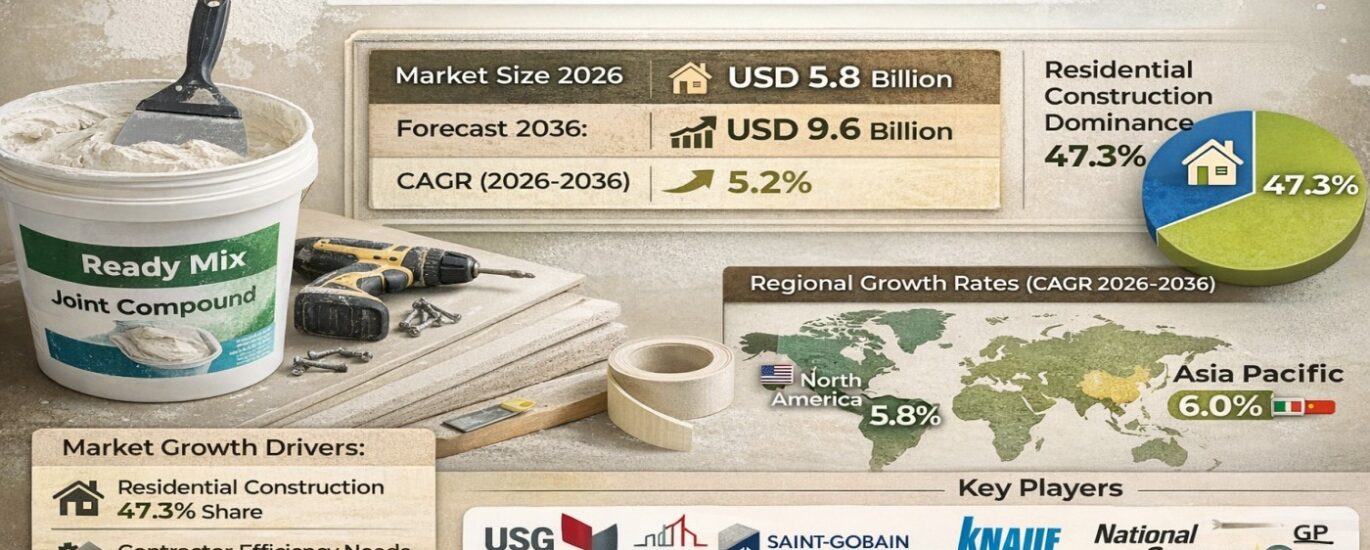
The global joint compound market is poised for steady growth, projected to rise from approximately USD 5.8 billion in 2026 to nearly USD 9.6 billion by 2036, reflecting a robust CAGR of 5.2% over the forecast period. Joint compounds—commonly known as drywall mud—are essential for achieving smooth, paint-ready walls and ceilings, making them a cornerstone of modern interior construction and renovation.
Market Growth Drivers:
The market’s growth is closely tied to residential construction, commercial fit-outs, and widespread remodeling activity. Key drivers include:
- Residential Construction Dominance: Housing interiors account for 47.3% of total demand, fueled by new home builds, apartment complexes, and renovation projects.
- Contractor Efficiency Needs: Ready-mix and lightweight compounds reduce labor, accelerate project timelines, and improve worksite ergonomics.
- DIY and Home Improvement Trends: Homeowners increasingly favor easy-to-apply, low dust, and fast-drying formulations.
Request For Sample Report | Customize Report |purchase Full Report – https://www.futuremarketinsights.com/reports/sample/rep-gb-2442
Emerging Trends:
Industry trends are reshaping how joint compounds are manufactured and used:
- Ready-Mix Leadership: Pre-blended compounds now account for 68.5% of demand, offering consistent texture and uniform drying times.
- Specialty Formulations: Low dust, mold-resistant, and quick-set options are gaining adoption in commercial and institutional projects with strict health and safety regulations.
- Digital and E-Commerce Access: Online ordering platforms, though currently 6% of the market, are improving material availability for both contractors and homeowners.
Regional Insights:
Market expansion varies across geographies:
- North America & Europe: Mature markets maintain steady demand driven by remodeling, renovations, and high-quality finishing standards.
- Asia Pacific: Fast-growing urbanization and large-scale housing programs drive rapid adoption, particularly in India (CAGR 6.3%) and China (CAGR 5.5%).
- Turkey & Middle East: Reconstruction and urban development projects boost compound usage in earthquake-affected and expanding regions.
Competitive Landscape:
The global joint compound sector is highly competitive, with performance and reliability valued over price. Leading companies include:
USG Corporation, Saint-Gobain CertainTeed, Knauf Gips KG, National Gypsum ProForm, Georgia Pacific, Etex Group Siniat, PABCO Building Products, CSR Limited Gyprock, Yoshino Gypsum, Gypsemna
Key competitive factors include:
- Advanced formulation technologies for faster drying and cleaner sanding
- Strong distribution networks via professional, contractor, and retail channels
- Targeted product segmentation catering to taping, filling, and finishing requirements
Analyst Insights / Strategic Outlook:
Industry analysts note that contractors and professionals increasingly prioritize compounds that combine reliability, ergonomics, and performance. Ready-mix and lightweight products are particularly well-positioned to capture market share due to the efficiency gains they offer. Moreover, rising housing starts, urban redevelopment programs, and commercial fit-outs provide sustained opportunities for compound manufacturers.
Experts predict that companies balancing innovation, quality, and distribution will maintain competitive advantage. The convergence of construction technology, digital ordering, and eco-conscious formulations (low VOC, low dust) is expected to further influence buying patterns.
Future Opportunities:
The joint compound market is entering a decade of steady, resilient growth. Rising renovation activity, urban residential expansion, and specialized commercial projects are driving consistent demand. Manufacturers innovating in ready-mix, lightweight, and performance-enhancing formulations are likely to capitalize on efficiency trends, shaping the next phase of the global market. For investors and industry decision-makers, the sector represents a reliable intersection of steady volume growth, technological evolution, and market diversification.
About Future Market Insights (FMI)
Future Market Insights, Inc. (ESOMAR certified, recipient of the Stevie Award, and a member of the Greater New York Chamber of Commerce) offers profound insights into the driving factors that are boosting demand in the market. FMI stands as the leading global provider of market intelligence, advisory services, consulting, and events for the Packaging, Food and Beverage, Consumer Technology, Healthcare, Industrial, and Chemicals markets. With a vast team of over 400 analysts worldwide, FMI provides global, regional, and local expertise on diverse domains and industry trends across more than 110 countries.
Contact Us:
Future Market Insights Inc.
Christiana Corporate, 200 Continental Drive,
Suite 401, Newark, Delaware – 19713, USA
T: +1-347-918-3531
For Sales Enquiries: sales@futuremarketinsights.com
Website: https://www.futuremarketinsights.com
LinkedIn| Twitter| Blogs | YouTube