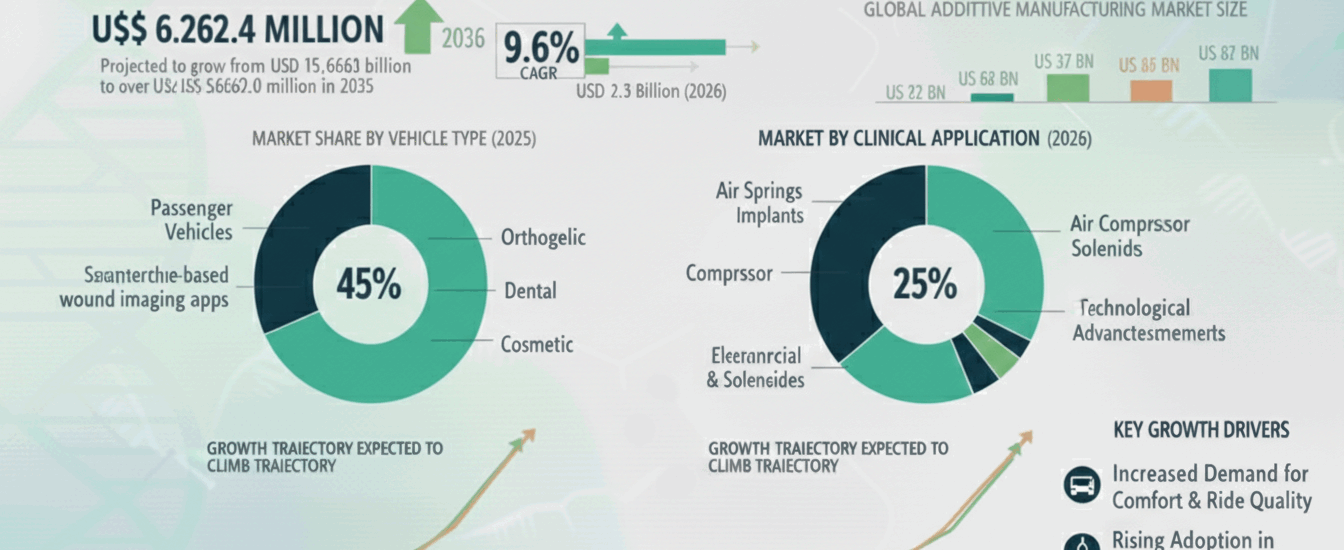
The global automotive and commercial vehicle technology landscape is entering a new phase of comfort-led engineering and performance optimization. According to the latest strategic outlook by Future Market Insights (FMI), the global Air Suspension Systems Market—valued at USD 6,262.4 million in 2025—is projected to surpass USD 15,662.0 million by 2035, expanding at a robust CAGR of 9.6% during the forecast period.
The report highlights a fundamental structural shift in vehicle design priorities: air suspension is no longer considered a luxury-only feature. Instead, it is increasingly being treated as a core performance and safety system across luxury vehicles, electric vehicles (EVs), and heavy commercial platforms. Automakers and fleet operators are prioritizing ride quality, load leveling, and long-term vehicle durability—positioning air suspension as a mission-critical vehicle subsystem rather than an optional upgrade.
As vehicle platforms become heavier, more electrified, and more software-controlled, suspension technologies are being re-engineered to support stability, efficiency, and adaptive ride control across varied operating environments.
The Rise of Comfort-Driven and Load-Adaptive Vehicle Engineering
A key driver of market expansion is the growing global emphasis on ride comfort, vehicle stability, and adaptive load management. Air suspension systems use air-filled bags instead of traditional metal springs, enabling vehicles to automatically adjust ride height and stiffness based on load conditions and road surfaces.
This adaptive capability is proving increasingly valuable across luxury passenger vehicles, long-haul trucks, buses, and specialty commercial fleets. Manufacturers are leveraging air suspension to improve passenger comfort, reduce vibration, and optimize vehicle aerodynamics for better fuel efficiency and energy management.
“Air suspension is becoming a strategic design element rather than a premium add-on,” notes a senior market analyst. “As vehicles become heavier due to batteries and advanced electronics, adaptive suspension systems are essential to maintaining ride quality, safety, and handling consistency. This is especially true for electric and autonomous vehicle platforms.”
This transition is creating long-term platform-level adoption, where once a vehicle architecture is validated with air suspension, manufacturers are unlikely to revert to traditional systems—creating strong supplier stickiness and long replacement cycles.
Segment Insights: Heavy Trucks Lead Adoption
Heavy Trucks (49.8% Share): Heavy trucks dominate the air suspension systems market due to their critical need for load balancing, stability, and reduced component wear. Air suspension improves axle load distribution and reduces stress on tires and chassis components, lowering maintenance costs and extending vehicle life.
As global freight volumes continue to rise, long-haul transportation fleets are increasingly standardizing air suspension systems to enhance cargo protection, driver comfort, and operational efficiency.
OEM Sales Channel (65.8% Share): OEM-installed air suspension systems remain the dominant sales channel. Automakers prefer OEM integration as it allows for precise system tuning, safety validation, and seamless integration with vehicle electronics. OEM systems are now standard in many luxury vehicles, heavy trucks, and buses.
The growing production of premium vehicles and electric platforms is further strengthening OEM demand, making air suspension a default factory-installed feature rather than an aftermarket upgrade.
Electric and Autonomous Vehicles Accelerate Demand
Air suspension systems are gaining strong momentum in electric and autonomous vehicles. EVs typically carry heavier battery packs, which can negatively impact ride quality and handling when using traditional suspension systems. Air suspension helps counterbalance this weight, maintaining a smooth and level ride.
Additionally, air suspension allows for variable ride height adjustments, improving aerodynamics at highway speeds and enhancing ground clearance when needed. These features directly contribute to improved energy efficiency and extended driving range—critical performance metrics for electric vehicles.
In autonomous vehicles, air suspension also plays a key role in maintaining sensor stability. Smooth ride conditions improve the performance of cameras, LiDAR, and radar systems, supporting safer and more reliable autonomous operation.
Regional Performance: USA and Europe Anchor Market Value
While growth is global, several regions are emerging as strategic value anchors:
United States (9.1% CAGR): The U.S. is projected to dominate market share, with valuation expected to exceed USD 4,756.2 million by 2035. Strong commercial vehicle production, infrastructure investment, and construction sector growth are driving demand for heavy-duty air suspension systems.
United Kingdom (8.8% CAGR): The UK market is being driven by high consumer spending on luxury vehicles and the growing penetration of electric vehicles. The strong presence of premium OEMs such as Jaguar Land Rover, Rolls-Royce, and Aston Martin is supporting widespread adoption.
Germany (8.1% CAGR): Germany remains a global technology hub for air suspension systems, supported by major suppliers and luxury vehicle manufacturers such as Mercedes-Benz, BMW, and Audi. The country’s leadership in both luxury and commercial vehicle production continues to fuel demand.
Navigating Restraints: Cost and Traditional Suspension Competition
Despite strong growth, traditional suspension systems such as coil and leaf springs remain strong competitors, particularly in lower-cost and mass-market vehicles. These systems are less expensive to manufacture and simpler to maintain, making them attractive for budget-conscious vehicle segments.
However, as vehicle buyers increasingly prioritize comfort, safety, and adaptive performance, the value proposition of air suspension is strengthening. Over time, continued cost optimization and increased production scale are expected to narrow the cost gap between air and traditional suspension technologies.
Subscribe for Year-Round Insights → Stay ahead with quarterly and annual data updates: https://www.futuremarketinsights.com/reports/brochure/rep-gb-2857
Request for Sample Report | Customize Report |purchase Full Report –https://www.futuremarketinsights.com/reports/sample/rep-gb-2857
Competitive Landscape: Scale, Technology, and Platform Integration
The market is led by large Tier 1 suppliers with global manufacturing capabilities and deep OEM relationships. Key players such as Continental AG, ThyssenKrupp AG, WABCO, Hendrickson USA, ZF Friedrichshafen AG, and Hitachi Automotive, Ltd. are positioning themselves as full-system solution providers.
These companies are investing heavily in electronic control integration, predictive maintenance technologies, and lightweight system designs to support next-generation vehicle platforms. Strategic acquisitions and partnerships are also strengthening competitive positioning and accelerating innovation cycles.
Recent industry developments, including Arnott Inc.’s acquisition of AccuAir Control Systems and new product launches by Air Lift Company, reflect increasing consolidation and technology-driven competition within the sector.
Strategic Outlook Through 2035
The path to USD 15.66 billion will be shaped by electrification, autonomous driving, premium vehicle growth, and commercial fleet modernization. As vehicle platforms evolve, air suspension systems are expected to become a standard architecture component rather than a niche feature.
Manufacturers that can deliver scalable, electronically integrated, and cost-optimized air suspension solutions will be best positioned to capture long-term growth opportunities across passenger and commercial vehicle segments.
Explore More Related Studies Published by FMI Research:
Battery Powered Surgical Drill Market-https://www.futuremarketinsights.com/reports/battery-powered-surgical-drill-market
Cytotoxic Chemotherapy Market-https://www.futuremarketinsights.com/reports/cytotoxic-chemotherapy-market
Targeted Oncology Biologics Market-https://www.futuremarketinsights.com/reports/targeted-oncology-biologics-market
Chaperone-based Therapeutics Market-https://www.futuremarketinsights.com/reports/chaperone-based-therapeutics-market
Substrate Reduction Therapies Market-https://www.futuremarketinsights.com/reports/substrate-reduction-therapies-market
About Future Market Insights (FMI)
Future Market Insights, Inc. (FMI) is an ESOMAR-certified, ISO 9001:2015 market research and consulting organization, trusted by Fortune 500 clients and global enterprises. With operations in the U.S., UK, India, and Dubai, FMI provides data-backed insights and strategic intelligence across 30+ industries and 1200 markets worldwide.
Why FMI: Decisions that Change Outcomes- https://www.futuremarketinsights.com/why-fmi
Contact Us:
Future Market Insights Inc.
Christiana Corporate, 200 Continental Drive,
Suite 401, Newark, Delaware – 19713, USA
T: +1-347-918-3531
Website: https://www.futuremarketinsights.com
LinkedIn| Twitter| Blogs | YouTube
Have a specific Requirements and Need Assistant on Report Pricing or Limited Budget please contact us – sales@futuremarketinsights.com