The global two-wheeler battery manufacturing industry is no longer just a supporting act in the electric mobility revolution—it’s one of the main drivers shaping how fast, affordable, and scalable clean transportation can become. From electric scooters zipping through Asian megacities to conventional motorcycles still dominating rural markets, batteries sit at the heart of two-wheeler mobility worldwide.
Today, a mix of established giants and ambitious new manufacturers are racing to expand capacity, localize supply chains, and develop next-generation battery technologies. Understanding where manufacturing is concentrated—and why—offers valuable insight for businesses looking to scale, investors seeking growth markets, and policymakers planning long-term electrification strategies.
Why Two-Wheeler Battery Manufacturing Matters Globally
Two-wheelers represent the fastest-growing segment of battery-powered transportation, especially in Asia, where scooters and motorcycles are the backbone of daily mobility. Electric two-wheelers rely heavily on lithium-ion battery packs, while millions of internal combustion engine vehicles still depend on VRLA and lead-acid batteries every year.
Where these batteries are made directly affects cost, supply security, technology innovation, and market access. Countries that control battery manufacturing gain strategic advantages—lower vehicle prices, resilient supply chains, and influence over future technology standards. As emissions regulations tighten globally, battery manufacturing has become a critical lever in the clean energy transition.
Why Is Manufacturing Concentrated in Just a Few Countries?
Two-wheeler battery manufacturing is geographically concentrated due to several reinforcing factors. Access to processed critical minerals like lithium, nickel, cobalt, and lead plays a role, but processing capacity and technical expertise matter even more. Cell manufacturing requires massive capital investment, specialized know-how, and deep supplier ecosystems—barriers that naturally favor early movers.
Large domestic two-wheeler markets create scale economies, while policy incentives, localization mandates, and trade agreements further shape where factories are built. Skilled labor, battery management systems, thermal solutions, and electronics clusters also create strong agglomeration effects. Together, these forces have propelled five countries—China, India, Japan, Vietnam, and Indonesia—to the forefront.
China: The Undisputed Manufacturing Powerhouse
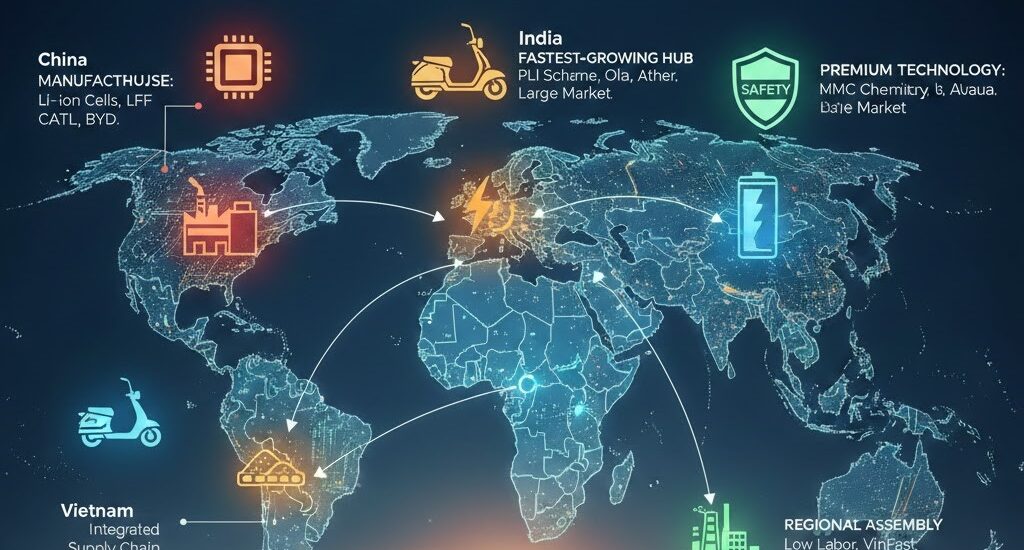
- China dominates global two-wheeler battery manufacturing, controlling 70–80% of global lithium-ion cell capacity. Industry leaders such as CATL, BYD, EVE Energy, and Lishen benefit from deeply integrated ecosystems spanning cathodes, electrolytes, separators, and pack assembly.
- China’s strength in lithium iron phosphate (LFP) chemistry makes it especially competitive for two-wheelers, where safety, durability, and cost matter more than ultra-high energy density. Beyond lithium-ion, China remains a major exporter of lead-acid batteries to Asia, Africa, and Latin America.
- Massive domestic demand—over 30 million electric two-wheelers annually—ensures scale advantages that new entrants struggle to match. While geopolitical tensions are pushing diversification, China’s cost leadership and vertical integration keep it firmly in the lead.
India: The Fastest-Growing Battery Manufacturing Hub
India is emerging as the fastest-growing two-wheeler battery hub, driven by explosive electric scooter adoption and strong government support. The Production-Linked Incentive (PLI) scheme for Advanced Chemistry Cells aims to build large-scale domestic cell manufacturing, while companies like Ola Electric, Ather Energy, TVS, and Bajaj rapidly expand battery pack assembly.
India also remains the world’s largest two-wheeler market, selling over 15 million conventional units annually, sustaining strong lead-acid battery demand. Low labor costs and protective import duties further boost localization. However, reliance on imported lithium-ion cells remains a key challenge—one that new investments and technology partnerships aim to solve.
Japan: Premium Technology and Safety Leadership
Japan occupies a premium niche in two-wheeler battery manufacturing. Companies like Panasonic and GS Yuasa lead in advanced NMC chemistry, safety standards, and high-performance applications. Japanese batteries are known for reliability, energy density, and rigorous quality control.
High production costs limit Japan’s competitiveness in mass markets, but its role as a technology innovator and IP leader remains vital. Increasingly, Japanese firms expand globally through licensing and joint ventures rather than domestic scale-up.
Vietnam and Indonesia: The Rising Contenders
Vietnam has positioned itself as a regional battery assembly hub, leveraging low labor costs, strong electronics manufacturing, and favorable trade agreements. VinFast and contract manufacturers assemble battery packs for ASEAN markets, though cell production remains imported.
Indonesia, meanwhile, is betting big on its dominant nickel resources. Government policies restricting raw nickel exports are designed to force downstream battery manufacturing. While lithium-ion capacity is still developing, Indonesia’s long-term potential lies in building integrated supply chains from mining to cells.
Comparing the Top Five Battery Manufacturing Nations
China leads through unmatched scale and vertical integration. India is rising fastest on demand and policy momentum. Japan dominates premium technology segments. Vietnam excels in regional assembly and exports, while Indonesia offers resource-backed future potential. The key dividing line remains cell manufacturing capability, where China and Japan lead and others rapidly catch up.
The Road Ahead for Manufacturers and Innovators
For both established players and new entrants, two-wheeler battery manufacturing presents enormous opportunities—from localized pack assembly to next-generation cell technologies. Companies that align cost competitiveness with innovation and policy support will define the future of electric mobility.
Access the Full Article –- https://www.futuremarketinsights.com/articles/which-countries-lead-global-two-wheeler-battery-production-in-capacity-cost-structure-and-strategic-advantage