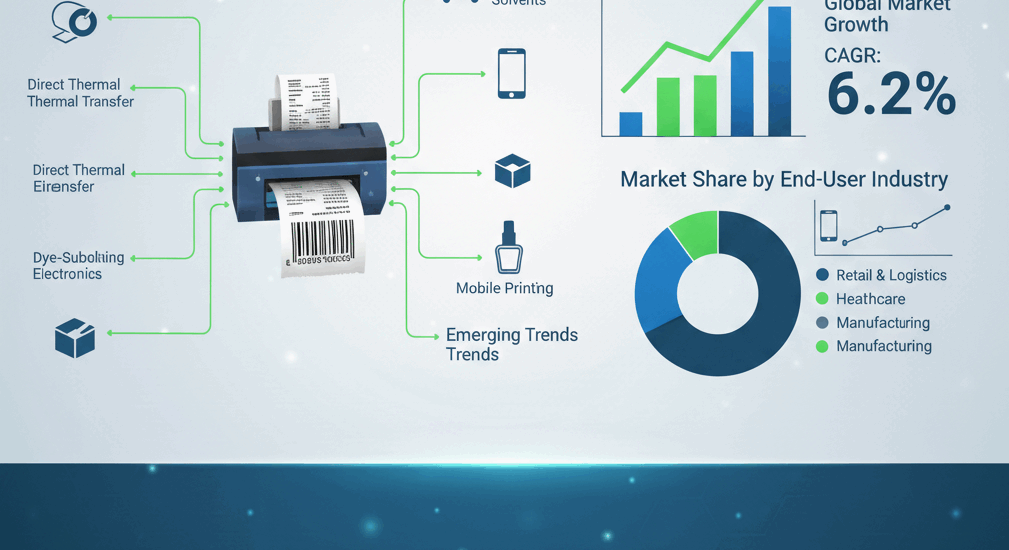
The global Thermal Printing Market is entering a phase of steady, high-volume expansion. Valued at approximately USD 47.8 billion in 2026, the sector is projected to grow to over USD 81.7 billion by 2033, reflecting a CAGR of 5.9%. This growth is underpinned by the “razor and blade” economic model, where low-margin hardware deployments are sustained by high-margin, recurring consumables revenue.
Technology Pricing & Cost Structures
The market is bifurcated by two primary technologies, each with a distinct pricing architecture driven by mechanical complexity and durability.
| Feature | Direct Thermal (DT) | Thermal Transfer (TT) |
| Hardware Pricing | Lower (Simple design, fewer moving parts) | Higher (20–40% premium for ribbon mechanisms) |
| Consumables Cost | Moderate (Only chemically treated paper) | High (Requires both media and ribbons) |
| Printhead Life | 25–50 km (Abrasive contact with treated paper) | 100+ km (Ribbon acts as a buffer/lubricant) |
| Primary Use Case | Receipts, shipping labels (Short-term) | Industrial tracking, outdoor use (Durable) |
The Razor and Blade Strategy
Vendors often subsidize thermal transfer hardware pricing to secure long-term contracts for ribbons and synthetic media. For an industrial user, consumables typically represent 60–80% of the five-year Total Cost of Ownership (TCO).
Exhaustive Market Report: A Complete Study
https://www.futuremarketinsights.com/reports/thermal-printing-market
Supply Chain & Pricing Bottlenecks (2026)
In 2026, hardware price stability is closely tied to two critical “choke points” in the manufacturing ecosystem:
- Printhead Concentration
Manufacturing of high-precision thermal printheads remains concentrated in a few specialized Asian facilities. This oligopoly grants suppliers significant pricing power. High-resolution requirements (e.g., 600 DPI for pharmaceutical micro-labeling) can triple the component cost compared to standard 203 DPI units.
- Semiconductor Volatility
Modern thermal printers are no longer simple mechanical devices; they are IoT-enabled assets. In 2026, rising demand for AI-capable logic chips in other sectors (automotive and data centers) continues to put pressure on the availability of microcontrollers and motor drivers. Manufacturers are forced into “design refreshes” to adapt to available chipsets, passing these non-recurring engineering (NRE) costs onto the end user.
Segment & Regional Demand Dynamics
Logistics and E-commerce: The Scale Engine
The rapid expansion of global e-commerce has turned shipping labels into a commodity of scale. Logistics providers leverage massive volume commitments to negotiate 15–30% discounts on list prices. By 2026, “Jaldi Commerce” (ultra-fast delivery) in emerging markets like India is further accelerating label consumption rates.
Healthcare: The Premium Pocket
Unlike retail, healthcare applications—such as patient wristbands and specimen tracking—demand high-durability and chemical-resistant thermal transfer solutions. This segment is less price-sensitive, prioritizing traceability and regulatory compliance over upfront hardware costs.
Regional Growth Leaders (2026-2036)
- China: Remains the manufacturing hub, benefiting from localized component clusters and domestic scale.
- India: Projected 8.12% CAGR through 2034, driven by government digitization and retail transformation.
- Europe: Facing higher price realization due to rising energy costs and “steel safeguards” impacting the frames and chassis of industrial units.
Key Trends to Watch
- Sustainability Shift: Increased demand for linerless labels and phenol-free thermal paper is driving a premium tier in the consumables market.
- Mobile & IoT Integration: Field service and warehouse “mobile-first” deployments are shifting the market toward compact, battery-operated units with higher wireless connectivity costs.
- Printhead “Health” Monitoring: Predictive maintenance software is now being bundled with hardware to extend printhead life and reduce the TCO for high-volume users.
Why Choose FMI: Empowering Decisions that Drive Real-World Outcomes: https://www.futuremarketinsights.com/why-fmi
About Future Market Insights (FMI)
Future Market Insights, Inc. (FMI) is an ESOMAR-certified, ISO 9001:2015 market research and consulting organization, trusted by Fortune 500 clients and global enterprises. With operations in the U.S., UK, India, and Dubai, FMI provides data-backed insights and strategic intelligence across 30+ industries and 1200 markets worldwide.