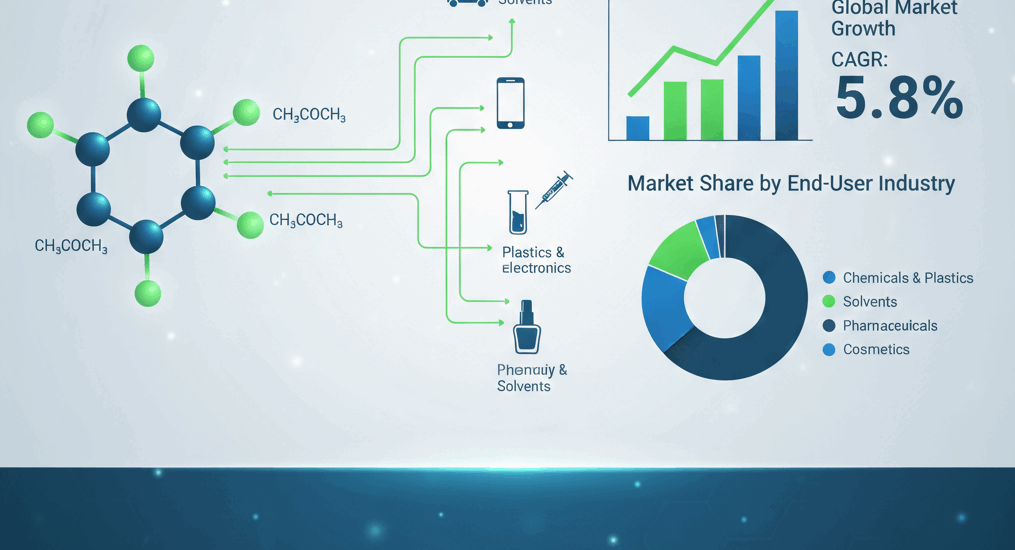
The global Acetone market in 2026 is fundamentally defined by its rigid structural tie to phenol production. As a co-product of the cumene process, which accounts for approximately 95% of global output, acetone supply is biologically linked to the phenol cycle rather than its own demand fundamentals. Valued at roughly USD 7.71 billion in 2026, the market is projected to reach over USD 12.4 billion by 2035, growing at a CAGR of approximately 6.13%.
The “Stoichiometric Trap”: Acetone’s Structural Link to Phenol
Acetone production is governed by a fixed chemical ratio: for every 1 tonne of phenol produced via the cumene process, roughly 0.6 tonnes of acetone are generated automatically. This creates several market-defining constraints:
- Inelastic Supply: Producers cannot increase acetone output to meet rising solvent demand without also increasing phenol production.
- Secondary Status: Investment decisions are almost exclusively driven by phenol margins and downstream derivatives like polycarbonate and epoxy resins.
- The “Flooding” Effect: When phenol demand is high (e.g., during a boom in the electronics or automotive sectors), acetone is “forced” into the market, often leading to oversupply and price depression regardless of solvent demand.
Standalone Production Constraints
Dedicated acetone production routes, such as the isopropanol (IPA) dehydrogenation or direct propylene oxidation, remain niche. In 2026, these account for less than 5% of global capacity. The primary barrier is economic: cumene-process acetone benefits from “revenue sharing” with phenol, making standalone plants—which must recover all costs from acetone alone—structurally uncompetitive.
Exhaustive Market Report: A Complete Study
https://www.futuremarketinsights.com/reports/acetone-market
Regional Capacity and Market Shifts (2026)
The global landscape is witnessing a significant divergence between the high-growth East and the rationalizing West.
| Region | Capacity/Market Share | 2026 Status & Outlook |
| Asia-Pacific | 55% – 60% | The global engine. China alone holds 3.6M+ metric tons of capacity. Growth is fueled by EV light-weighting and electronics. |
| North America | 15% – 20% | Mature and stable. Benefits from shale gas feedstock advantages but faces limited volume expansion. |
| Europe | Contraction | Facing structural “capacity rationalization.” High energy costs and CO2 taxes led to major closures (e.g., INEOS Gladbeck in 2025). |
Key 2026 Regional Events:
- Europe: The insolvency of DOMO Chemicals’ German subsidiaries in early 2026 has tightened regional supply, impacting integrated phenol, acetone, and caprolactam chains.
- India: Deepak Nitrite is a rising power, approving projects to add 185 KTA of acetone capacity, aiming for deeper integration with polycarbonate resins.
Market Drivers and Growth Segments
Despite supply-side constraints, demand for acetone is diversifying beyond traditional solvents:
- EV Light-weighting: Surging demand for Methyl Methacrylate (MMA)-based acrylic sheets for electric vehicles is a primary growth driver.
- BPA & Polycarbonates: Bisphenol-A (BPA) synthesis remains the largest consumer of acetone, tied to the global demand for electronics and construction materials.
- Pharmaceutical APIs: The pharmaceutical grade of acetone is rising at a 7.45% CAGR as high-purity requirements for drug formulations increase post-2024.
- Cosmetics: A notable shift in Southeast Asia is the expansion of personal-care solvent demand, particularly in Thailand and Vietnam.
Supply Stabilization Mechanisms
When phenol and acetone cycles diverge, the industry relies on three primary balancing tools:
- Inventory Build-up: Producers use storage as a buffer. However, this is limited by physical tank capacity, which typically only holds a few weeks of production.
- Global Export Flows: Surplus regions (like China or the US Gulf Coast) “dump” excess acetone into deficit regions (Europe or Southeast Asia), creating volatile but essential trade corridors.
- Solvent Substitution: While limited, some industrial users can switch between acetone and alternative solvents based on price, though this “demand elasticity” is often insufficient to offset major phenol-driven supply swings.
Competitive Landscape
The market remains moderately concentrated, with the top 5 players holding nearly 60% of the share.
- Key Players: INEOS Phenol, Mitsui Chemicals, Shell, Formosa Chemicals & Fibre Corp, and Sinopec.
- Innovation Trend: Leaders are pivoting toward sustainability. For example, Taiwan Mitsui Chemicals introduced biomass-based acetone in late 2024, and pilot plants in Europe are exploring lignin-derived phenol and CO2-to-acetone carbon capture technologies to decouple from traditional cumene feedstocks.
Why Choose FMI: Empowering Decisions that Drive Real-World Outcomes: https://www.futuremarketinsights.com/why-fmi
About Future Market Insights (FMI)
Future Market Insights, Inc. (FMI) is an ESOMAR-certified, ISO 9001:2015 market research and consulting organization, trusted by Fortune 500 clients and global enterprises. With operations in the U.S., UK, India, and Dubai, FMI provides data-backed insights and strategic intelligence across 30+ industries and 1200 markets worldwide.