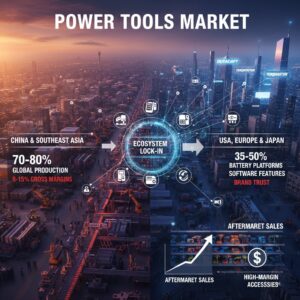
The global power tool industry is a fascinating mix of cutting-edge technology, labor economics, and strategic brand control. If you’re an established manufacturer looking to expand or a newcomer exploring this space, understanding the manufacturing landscape and value chain dynamics is crucial. Surprisingly, 70 to 80 percent of worldwide power tool production happens in China and Southeast Asia. But why? And how do global brands retain their pricing power despite this concentration
Manufacturing Powerhouses: China and Southeast Asia Lead the Way
The lion’s share of power tool production is concentrated in China and Southeast Asia due to fundamental cost advantages. The manufacturing of cordless drills, impact drivers, circular saws, and grinders is labor-intensive, involving manual assembly, wiring, inspection, and packaging. Here, factory labor costs range from $3 to $5 per hour — a fraction of the $25 to $40 hourly wages typical in the U.S. and Western Europe. This massive labor cost differential translates into 40 to 60 percent lower production costs even after considering logistics.
But it’s not just about cheap labor. Manufacturing clusters in regions like China’s Pearl River Delta, the Yangtze River Delta, and emerging hubs in Vietnam and Thailand create powerful supply chain ecosystems. Hundreds of specialized suppliers for motors, batteries, electronic components, and plastic housings are located within a tight radius. This proximity enables rapid design iteration, just-in-time delivery, and aggressive cost optimization — benefits that isolated factories elsewhere cannot match easily.
Moreover, China and parts of Southeast Asia dominate the production of critical components like lithium-ion battery cells and brushless motor controllers. This concentration naturally pulls power tool assembly to regions closest to these inputs, reducing complexity and logistics expenses.
Why Contract Manufacturers Don’t Own Pricing Power
Despite producing the majority of power tools, contract manufacturers (CMs) and original design manufacturers (ODMs) capture relatively slim margins — typically 8 to 15 percent. In contrast, brand owners earn gross margins between 35 and 50 percent. Why the disparity?
CMs operate in a highly competitive environment. Many factories with similar technical skills compete for contracts, driving down prices. Meanwhile, brand owners retain full control over design, intellectual property, and customer relationships, effectively owning the product’s value beyond assembly. This includes control over patents, software, and customer data.
This structural setup means CMs can only profit through operational efficiency. They don’t own the product’s brand equity or proprietary technology, limiting their ability to charge premium prices or build independent brands.
How Leading Brands Maintain Pricing Power
Global leaders like Milwaukee, DeWalt, Makita, and Bosch succeed by controlling the entire ecosystem around their tools — from batteries and software to distribution channels and aftermarket sales.
Battery Ecosystems Lock Customers In
One of the most powerful strategies is the development of proprietary battery platforms. Brands create entire tool families powered by a single battery type. For example, Milwaukee’s M18 system offers over 200 compatible tools. A contractor investing in these batteries faces significant switching costs, as batteries, chargers, and related accessories are not interchangeable across brands. This “ecosystem lock-in” drives recurring revenue for brands far beyond initial tool sales.
Software and Connectivity Differentiation
In the digital age, software features are becoming essential. Milwaukee ONE-KEY, DeWalt Tool Connect, and Bosch Toolbox offer Bluetooth connectivity, inventory management, theft prevention, and data analytics. These capabilities justify price premiums of 15 to 25 percent and require continuous investment — another moat manufacturing contractors can’t easily cross.
Control Over Distribution Channels
Brand owners tightly control pricing through exclusive relationships with major retailers (like Home Depot and Lowe’s), professional distributors, and rental companies. These partnerships limit discounting, protect pricing tiers, and ensure shelf space for premium brands. Even e-commerce channels follow minimum advertised pricing policies enforced by brands.
Aftermarket Sales and Fleet Programs
Batteries, chargers, drill bits, saw blades, and other consumables generate gross margins of 50 to 70 percent, dwarfing initial tool sales profits. Additionally, fleet programs at institutional customers lock in long-term contracts with standardized battery platforms, making switching prohibitively expensive.
Opportunities for Established and New Manufacturers
If you’re a manufacturer looking to expand or innovate, understanding these market dynamics is your starting point. Here’s how you can capitalize:
- Leverage Technology to Differentiate: Invest in software integration, battery innovation, and proprietary features that create brand value beyond manufacturing. Consider partnerships to develop ecosystems rather than standalone products.
- Focus on Supply Chain Clustering: Build or join clusters of suppliers near critical component hubs. This improves cost competitiveness and enables rapid product iteration.
- Pursue Dual Sourcing and Nearshoring Strategically: While Asian hubs dominate, exploring nearshoring can mitigate supply chain risks without sacrificing cost advantages—if done without compromising brand ecosystem control.
- Build Brand Equity and Distribution Relationships: Manufacturing alone won’t unlock premium margins. Invest in marketing, certification, and establishing trusted relationships with professional buyers and retailers.
- Explore Aftermarket and Accessory Innovation: Design tools that perform best with proprietary consumables, creating recurring revenue streams.
Can Emerging Players Break Through
Chinese manufacturers like Positec (owner of Worx) and Chervon have made inroads in DIY markets but struggle to command professional pricing due to brand loyalty and ecosystem lock-in. Breaking into premium segments requires sustained investment in marketing, warranty services, and platform breadth — a long-term commitment many are just beginning.
Conclusion
Power tool manufacturing’s concentration in China and Southeast Asia is driven by labor economics and supplier ecosystems, but brand owners control the real profit pools through proprietary technology, software, battery platforms, and channel management. For manufacturers aiming to expand or innovate, success requires more than production excellence — it demands strategic investment in technology, brand development, and ecosystem creation.
By understanding these forces and adapting your approach, you can find your place in this competitive yet dynamic global market.
Access the Full Article – https://www.futuremarketinsights.com/articles/why-does-manufacturing-dominance-in-china-not-translate-into-pricing-power-in-power-tools