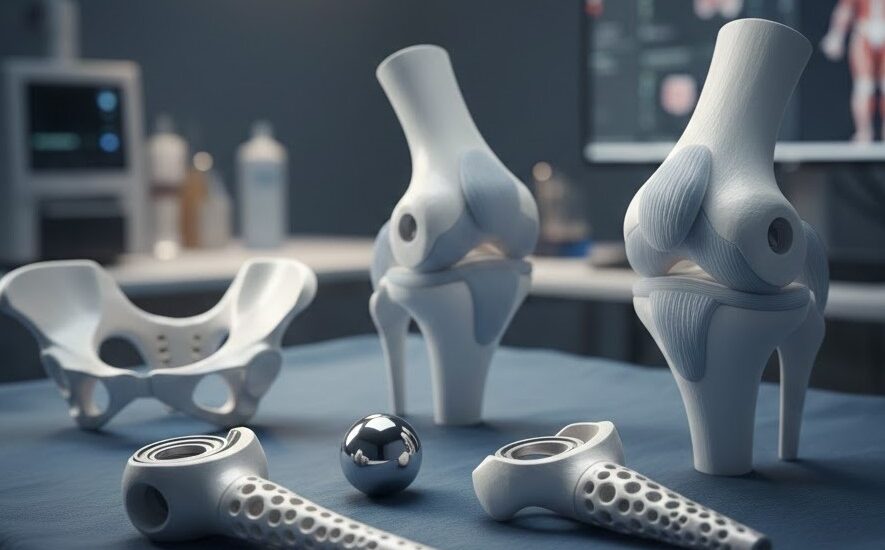
Additive manufacturing has moved from buzzword to backbone in modern orthopedics. Over the past decade, 3D printed hip and knee implants—especially those using porous titanium structures—have gone from niche innovations to mainstream options in joint replacement. For both established orthopedic giants and new manufacturers looking to scale, the key question is no longer “Does 3D printing work?” but “Where does it truly add value, and how durable is that value in real patients?”
What “Success” Really Means in Joint Implants
In orthopedics, success is not a vibe—it’s an endpoint. The cleanest and most trusted definition is revision-free survivorship, meaning the implant stays in place without requiring another surgery over a defined follow-up period. Many studies also track survivorship for specific failure modes like aseptic loosening, which matters deeply for 3D printed porous designs because their core promise is better bone ingrowth and long-term fixation.
Other outcomes—pain relief, function scores, radiographic stability, and migration measured by radiostereometric analysis—are important, but revision remains the hardest and most comparable endpoint across systems. This matters for manufacturers because 3D printing is a manufacturing method, not a clinical indication. A porous cup used in a straightforward primary hip replacement is a very different stress test than one used to rebuild massive bone loss in a revision case. Mixing those populations and asking for one “success ratio” can mislead both engineers and investors.
What the Registry Data Really Says About 3D Printed Hips
The most powerful reality check comes from national joint registries. They capture outcomes across thousands of patients, surgeons, and hospitals—showing what happens at scale in the real world, not just in ideal trial settings.
For primary total hip arthroplasty, large registry data from New Zealand compared 3D printed uncemented acetabular cups with established uncemented designs. The headline result: no statistically significant difference in all-cause revision rates. In other words, 3D printed cups performed on par with conventional cups in everyday clinical use.
Clinical series add more texture. One well-cited study reported slightly higher seven-year survivorship for off-the-shelf 3D printed titanium cups compared with a traditional comparator. That’s a small absolute difference, but it’s directionally reassuring. It suggests there’s no survivorship penalty for adopting printed porous architectures—and potentially a modest upside.
That said, not every story is clean. Some highly porous titanium cup designs have shown early loosening or concerning radiographic patterns. This doesn’t indict additive manufacturing itself. Instead, it highlights that fixation mechanics, surface architecture, shell stiffness, liner locking design, and surgical technique can dominate outcomes—even when the porous surface looks perfect on paper.
The Knee Story: Where 3D Printing Looks Especially Strong
If hips are about parity and reassurance, knees are where the 3D printed story becomes unusually concrete.
Multiple cohorts now report excellent mid- and long-term survivorship for cementless total knee arthroplasty systems using 3D printed porous tibial components. Ten-year data from one system shows overall survivorship around 96–97%, with aseptic loosening survivorship above 98% and tibial component survivorship around 99%.
A critical pattern keeps appearing:
Most revisions happen early. Once early fixation is achieved, late aseptic loosening becomes rare.
That’s exactly what engineers want to see. In fact, radiostereometric analysis trials show that cementless 3D printed tibial components stabilize over time and behave similarly to cemented components in long-term migration patterns. Early migration that doesn’t settle is a known warning sign for future loosening, so this stabilization signal is a big win.
Failures that do occur are usually about alignment, fixation mechanics, infection, or rare structural fatigue—not about the concept of additive manufacturing itself.
What This Means for Established and New Manufacturers
For established orthopedic companies, the evidence base is now deep enough to justify continued investment in additive manufacturing platforms. The data shows clinical non-inferiority at minimum, and in some use cases, potential advantages in fixation durability.
For new manufacturers and technology-driven entrants, this is where opportunity meets discipline:
- The science works—but only if the engineering is ruthless. Porous architecture, load transfer, and worst-case alignment scenarios matter more than marketing narratives.
- Regulatory scrutiny on additive manufacturing process validation is rising. Quality control, powder consistency, post-processing, and inspection workflows are now strategic differentiators.
- Adoption is being pulled by younger patients, higher-BMI cohorts, and surgeons seeking biologic fixation. That’s where future demand curves are steepest.
Just as important, the competitive field isn’t empty. 3D printed implants compete with porous tantalum, advanced porous coatings, improved cementing techniques, and hybrid fixation approaches. The winners won’t be those who simply print more parts—but those who link clinical evidence, manufacturability, regulatory compliance, and supply-chain reliability into one coherent strategy.
The Bottom Line
The real-world data now says something very clear:
3D printed hip and knee implants are not experimental anymore. They perform at least as well as established designs in primary hips and show especially strong durability signals in cementless knees.
For manufacturers—both established leaders and ambitious new entrants—the next phase isn’t about proving that additive manufacturing works. It’s about proving that your design, your process controls, and your fixation mechanics work better, longer, and more reliably at scale.
In orthopedics, success isn’t hype. It’s survivorship. And for 3D printed implants, that survivorship story is finally becoming one the market can trust.
Read the Full Article : https://www.futuremarketinsights.com/articles/what-is-the-success-ratio-of-3d-printed-hip-and-knee-implants