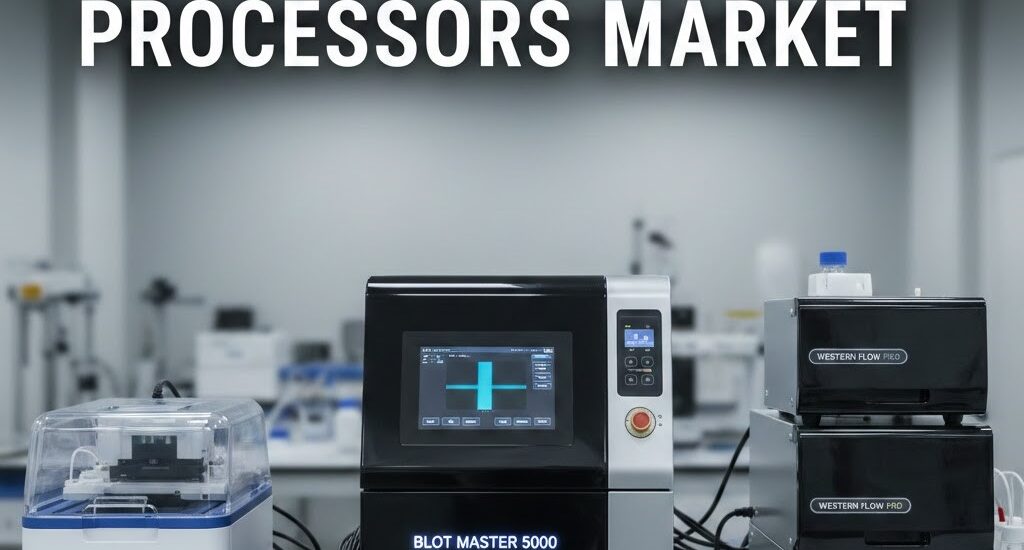
Western blotting remains one of the most trusted techniques for protein detection and validation across academic research, biopharmaceutical development, and clinical laboratories. Even as alternative platforms like mass spectrometry, capillary electrophoresis, and high-throughput immunoassays gain popularity, Western blotting continues to play a critical confirmatory role because of its specificity and ability to visually verify protein size and expression.
Yet the technique has long struggled with one major drawback: reproducibility. Manual Western blotting is highly operator dependent, time-intensive, and vulnerable to inconsistency. This is exactly where automated Western blotting processors are changing the landscape — and where both established manufacturers and innovative new entrants are finding major opportunities to expand their businesses and develop next-generation technologies.
Why Manual Western Blotting Still Creates Problems
Despite decades of use, manual Western blotting remains surprisingly fragile as a workflow. Small inconsistencies in membrane blocking, antibody incubation, washing steps, and reagent preparation can dramatically affect signal intensity and background noise. Even experienced scientists struggle to reproduce identical conditions across different runs, operators, or laboratories.
Timing differences alone can cause blots to be under- or over-developed, making quantitative comparisons unreliable. Add in temperature fluctuations, uneven agitation, or slight dilution errors, and variability becomes unavoidable. In regulated environments — where Western blots may support regulatory submissions, biologics batch release, or manufacturing validation — this variability becomes more than a technical nuisance. It becomes a business risk.
This challenge is exactly what automation was designed to solve.
Throughput Gains Are Now a Strategic Priority
Throughput is no longer just a convenience; it’s a competitive advantage. In biopharmaceutical development, Western blotting is routinely used to confirm protein expression, assess post-translational modifications, and validate product consistency across manufacturing runs. Manual processing quickly becomes a bottleneck when dozens or hundreds of samples must be analyzed under tight timelines.
Automated processors enable parallel processing of multiple blots under identical conditions, dramatically increasing laboratory capacity without adding staff. This is particularly important in core facilities that serve multiple research groups and must meet unpredictable demand with consistent turnaround times.
Beyond speed, automation also reduces hands-on labor. Scientists spend less time repeating manual steps and more time on experimental design, data interpretation, and method development. That shift in labor allocation directly improves productivity and supports more sophisticated research programs.
Compliance and Data Integrity Are Driving Adoption
- One of the strongest drivers of automation is regulatory pressure. Laboratories operating under Good Laboratory Practice (GLP) or Good Manufacturing Practice (GMP) guidelines must document every critical process parameter. Manual Western blotting makes this extremely difficult to do consistently.
- Automated Western blotting processors generate comprehensive electronic records for every run. These include timestamps, temperature logs, reagent tracking, and full protocol histories. Digital documentation eliminates transcription errors, improves audit readiness, and supports data integrity requirements mandated by regulators.
- Many modern systems integrate directly with laboratory information management systems (LIMS), enabling centralized record keeping and secure data storage. Reagent traceability — including antibody lot numbers, expiration dates, and usage history — further strengthens compliance and quality assurance.
In regulated biopharma environments, avoiding inspection findings or regulatory delays is often reason enough to justify investment in automation.
Why Automation Coexists With Alternative Protein Methods
Even as mass spectrometry and capillary-based systems advance, Western blotting continues to hold a unique place. Mass spectrometry offers sensitivity and multiplexing but lacks the intuitive visual confirmation of protein size. ELISAs provide throughput but cannot resolve isoforms or confirm antibody specificity in the same way.
Capillary-based automated Western systems are gaining adoption, but most laboratories use them alongside traditional blotting processors rather than replacing them entirely. Capillary systems are ideal for high-throughput screening and quantitation, while traditional blots remain essential for confirmatory work, large-format gels, and specialized membranes or detection chemistries.
Regulatory agencies also continue to expect Western blotting data as confirmatory evidence. This expectation ensures that investment in Western blotting processors remains not just relevant, but strategically important.
Opportunities for Established and Emerging Manufacturers
- For established life science companies, Western blotting processors represent a natural extension of existing antibody, reagent, and imaging portfolios. These companies are investing in smarter automation, better software integration, and modular platforms that can evolve with changing laboratory needs.
- At the same time, new manufacturers are entering the space with fresh ideas: compact processors for small labs, cloud-connected systems for remote monitoring, AI-driven protocol optimization, and flexible platforms designed for emerging detection chemistries. These innovations are lowering barriers to adoption and expanding the addressable market beyond large biopharma into academic labs and regional research centers.
- The most successful players — both old and new — are those focusing on operational risk control rather than assay novelty. Laboratories aren’t adopting processors because Western blotting is new. They’re adopting them because automation reduces errors, protects data integrity, improves throughput, and strengthens regulatory compliance.
Looking Ahead: A Market Built on Reliability, Not Hype
The future of Western blotting isn’t about replacing the technique. It’s about making it more reliable, auditable, and scalable. Automated processors are becoming foundational tools in modern protein analysis workflows, not optional upgrades.
For manufacturers, this creates long-term growth opportunities centered on reproducibility, compliance, and digital integration. For laboratories, it means fewer failed experiments, stronger regulatory confidence, and more time spent on science instead of manual repetition.
In a world where data integrity and operational efficiency matter more than ever, automated Western blotting processors are quietly becoming one of the most practical and impactful upgrades a laboratory can make.
Get the Full Article – https://www.futuremarketinsights.com/articles/why-are-western-blotting-processors-adopted-to-control-variability-and-compliance-risk-rather-than-replace-the-assay-itself