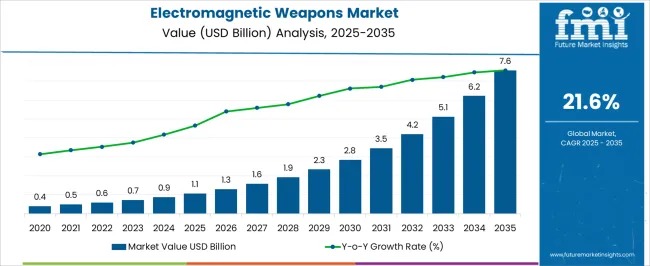
The global electromagnetic weapons market is poised for exceptional growth as defense forces worldwide accelerate the adoption of advanced directed-energy and non-kinetic weapon systems. Valued at USD 1.1 billion in 2025, the market is projected to expand to USD 7.6 billion by 2035, registering a strong compound annual growth rate (CAGR) of 21.6% during the forecast period.
This rapid expansion highlights the shift of electromagnetic weapons from experimental defense technologies to operationally deployable systems, increasingly integrated into modern military strategies across land, airborne, and naval platforms.
Market Evolution Reflects Transition from Testing to Large-Scale Deployment
During the early adoption phase (2020–2024), the electromagnetic weapons market experienced measured growth, rising from USD 0.4 billion to USD 1.1 billion. This phase was characterized by extensive prototype testing, system validation, and feasibility assessments, as defense agencies explored tactical applications and compatibility with existing defense infrastructure.
By 2025, the market reaches a pivotal inflection point, marking the transition toward broader adoption. From 2025 to 2030, the market is expected to exceed USD 2.3 billion, driven by increasing deployments across naval vessels, aerial defense platforms, and ground-based systems, alongside expanding production capabilities.
Between 2030 and 2035, the market enters a consolidation phase, during which leading defense contractors strengthen their market presence, technological standards mature, and electromagnetic weapons become an established component of next-generation defense architectures.
Get access to comprehensive data tables and detailed market insights — request your sample report today!
Defense Modernization and Precision Warfare Driving Market Growth
The growth of the electromagnetic weapons market is being driven by the global emphasis on defense modernization, electronic warfare capabilities, and precision engagement systems. Electromagnetic weapons offer significant operational advantages, including rapid response, scalable power output, reduced collateral damage, and enhanced targeting accuracy, aligning well with evolving military doctrines.
Technological advancements in energy storage, pulse power generation, real-time sensors, and adaptive targeting algorithms have further accelerated deployment readiness. In parallel, rising investments in research and development and government-backed defense programs are supporting long-term market expansion.
Lethal Weapons and Particle Beam Technologies Lead Adoption
By product type, lethal electromagnetic weapons dominate the market, accounting for 57.6% of revenue share in 2025. This leadership is driven by the demand for systems capable of neutralizing high-value targets with speed and precision in complex combat environments.
From a technology perspective, particle beam weapons emerge as the leading segment, holding 49.3% market share, supported by advancements in beam control, energy efficiency, and long-range targeting capabilities. These systems are increasingly favored for their compatibility with software-defined and sensor-fused defense platforms.
Military Applications Remain the Primary Growth Engine
The military application segment represents the largest end-use category, contributing 61.2% of total market revenue in 2025. Electromagnetic weapons are gaining traction in military operations due to their effectiveness in electronic warfare, counter-drone systems, missile defense, and precision strike missions.
As armed forces prioritize faster engagement cycles, improved mission success rates, and enhanced battlefield control, electromagnetic weapons are becoming integral to modern defense planning.
Asia-Pacific Emerges as High-Growth Region
Regionally, North America, Asia-Pacific, and Europe are the key growth markets. Asia-Pacific stands out as the fastest-growing region, led by:
- China, growing at a CAGR of 29.2%, supported by large-scale defense investments and advanced R&D programs
- India, expanding at 27.0% CAGR, driven by defense modernization initiatives and increasing domestic manufacturing
In Europe, countries such as Germany, France, and the United Kingdom continue to invest in electromagnetic and electronic warfare technologies, while the United States remains a mature yet innovation-driven market with sustained defense spending.
Competitive Landscape Strengthens Around Major Defense Contractors
The electromagnetic weapons market is increasingly consolidated among major defense contractors, including Lockheed Martin, BAE Systems, Boeing, Raytheon Technologies, Northrop Grumman, Rheinmetall, Thales, Elbit Systems, and Rafael Advanced Defense Systems.
These companies are focusing on high-energy output systems, modular platform integration, improved energy efficiency, and advanced control software, reinforcing their competitive positioning in a rapidly evolving defense environment.
Outlook
With global defense strategies shifting toward non-kinetic, software-driven, and precision-based warfare, the electromagnetic weapons market is set to play a pivotal role in shaping future military capabilities. Continued innovation, expanding deployments, and strong government support are expected to sustain robust growth through 2035 and beyond.
About Future Market Insights (FMI)
Future Market Insights, Inc. (FMI) is an ESOMAR-certified, ISO 9001:2015 market research and consulting organization, trusted by Fortune 500 clients and global enterprises. With operations in the U.S., UK, India, and Dubai, FMI provides data-backed insights and strategic intelligence across 30+ industries and 1200 markets worldwide.