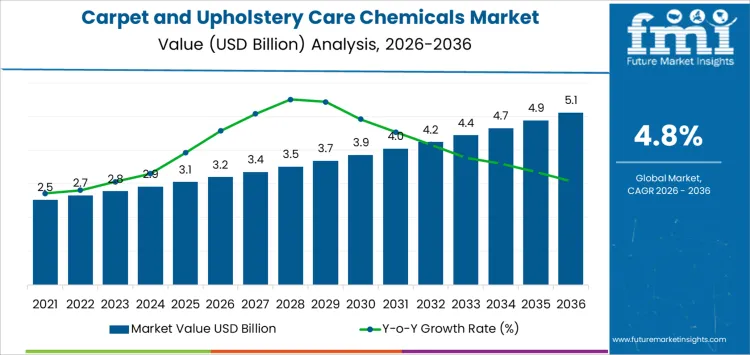
The global Carpet and Upholstery Care Chemicals Market is experiencing a surge in demand as commercial, residential, and hospitality sectors increasingly seek advanced cleaning solutions that provide superior performance, convenience, and sustainability. Valued at approximately USD 3.2 billion in 2025, the market is projected to expand to around USD 5.2 billion by 2035, exhibiting a steady compound annual growth rate (CAGR) of nearly 4.8% over the next decade.
This strong growth underscores the evolving needs of end users, who are embracing not only well-established chemical formulations but also new, next-generation technologies that enhance cleaning efficiency while meeting environmental and safety expectations.
Transformative Growth Across Product Segments and Use Cases
The carpet and upholstery care chemicals landscape is dominated by a diverse range of product categories, among which carpet shampoos and detergents account for the largest share, due largely to their broad applicability and deep cleaning performance. Other significant segments include spot and stain removers, upholstery cleaners, deodorizers, and fabric protectants, each designed to address specific maintenance needs across different surfaces and fibers.
Innovative cleaning methods, such as hot water extraction, remain widely adopted for deep professional cleaning, while encapsulation and dry/low-moisture formulations are gaining ground due to their reduced water usage, faster drying times, ease of use, and suitability for eco-conscious consumers.
Regional Demand Dynamics Boost Market Expansion
Geographically, the Asia-Pacific region, particularly markets such as China and India, is emerging as a key growth engine, driven by rapid urbanization, expanding middle-income populations, rising disposable incomes, and heightened demand for both professional and DIY cleaning products. China’s market is among the fastest-growing globally, reflecting a strong emphasis on cleanliness and interior aesthetics in both residential and commercial environments.
North America remains a mature and robust market, with consistent demand from commercial facilities and residential users alike. Growth in Europe and Latin America is also gaining momentum, helped by increasing interest in sustainable and high-performance care solutions.
To access the complete data tables and in-depth insights, request a sample report here
Leading Players and Technological Advances Shape the Competitive Landscape
The competitive landscape features a blend of well-known multinational manufacturers and emerging challengers innovating to gain market share:
- Diversey continues to expand its portfolio with high-performance formulations tailored for heavy-duty commercial applications, while also embracing environmentally friendly and biodegradable ingredients that appeal to sustainability-minded buyers.
- Ecolab, with its global reach, remains a trusted name in both professional and industrial cleaning sectors, known for reliable products that balance cleaning power with safety.
- 3M has carved out a reputation for innovation, offering advanced stain protection technologies and deep-cleaning solutions that reduce labor time and improve fabric longevity.
- Reckitt and Procter & Gamble bring strong consumer brand recognition to the category, delivering products that appeal to homeowners and professional cleaners seeking both effectiveness and convenience.
- Zep, Spartan Chemical, and Betco are expanding their presence with concentrated offerings designed for institutional and commercial users who demand high-efficiency performance.
In addition, Unilever and Clorox are pushing into greener chemistry and safer formulations, responding to a growing preference for non-toxic, low-VOC cleaning agents that protect both users and the environment.
A Wave of New Entrants and Innovation
Beyond these industry stalwarts, emerging manufacturers and specialty chemical firms are entering the market with cutting-edge technologies that promise differentiated value:
- Startups are developing bio-based cleaning agents and enzyme-enhanced formulas that break down stains more effectively while minimizing ecological impact.
- Several innovators are leveraging smart packaging and dosing systems to reduce waste and simplify application, especially for commercial housekeeping teams.
- Research into low-temperature activation chemistries is enabling cleaners to perform well even in energy-conscious or regulated environments, providing deeper cleaning without excessive heat or water.
These developments are opening new opportunities for both established and emerging companies to capture market share in an increasingly competitive environment.
Meeting Consumer Expectations and Sustainability Goals
Heightened awareness about indoor air quality and hygiene, combined with greater sensitivity to environmental health considerations, is driving demand for solutions that are both highly effective and responsibly formulated. Industry leaders are responding with products that are biodegradable, free from harsh solvents, and aligned with evolving regulatory standards around safety and sustainability.
As carpet and upholstery care chemicals continue to evolve, manufacturers who embrace innovation, invest in R&D, and adapt to changing end-user needs are poised to thrive.