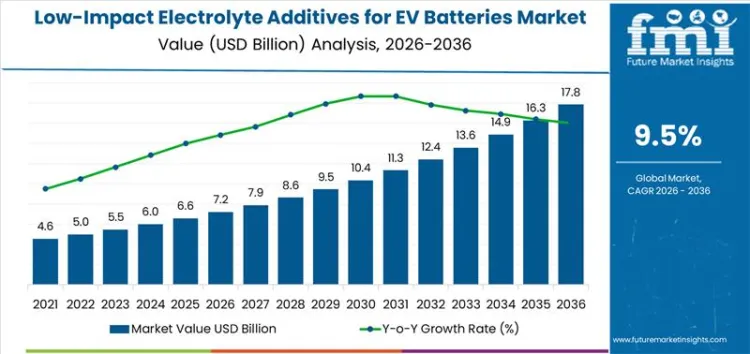
The global market for low-impact electrolyte additives for electric vehicle (EV) batteries is on a strong growth trajectory, with projected revenues reaching USD 7.2 billion by 2026, driven by soaring demand for eco-friendly and high-performance battery solutions across automotive and energy storage sectors. As the EV industry accelerates its shift toward sustainable technologies, manufacturers of battery additives—from long-standing chemical giants to dynamic innovators—are expanding their portfolios with advanced, environmentally safe formulations designed to improve battery efficiency, safety, and lifespan.
Electrolyte additives play a crucial role in enhancing the performance of lithium-ion cells, boosting ionic conductivity, improving thermal stability, and reducing degradation in high-energy density systems. These low-impact additives are increasingly important as automakers and battery producers push for greener materials that align with tightening global environmental standards and sustainability goals.
Market Growth Fueled by Innovation and Sustainable Adoption
With electric vehicle adoption climbing around the world, battery manufacturers are under increasing pressure to deliver longer-lasting and safer cells without compromising environmental stewardship. This has driven both established players and newer companies to innovate rapidly, introducing additive chemistries that not only enhance electrochemical performance but also minimize environmental and toxicological footprints.
The shift toward low-impact solutions is being supported by regulatory environments that favor reduced hazardous materials and encourage recyclable and benign battery chemistry components. These trends are encouraging suppliers and OEMs alike to place greater emphasis on sustainable materials science within the EV ecosystem.
Key Industry Players — Legacy Leaders and Emerging Innovators
Traditional chemical manufacturers like BASF have been at the forefront of developing advanced electrolyte additive portfolios that focus on engineered conductivity and stability improvements while reducing environmental impact. These companies leverage decades of materials science expertise and global distribution networks to serve major battery producers across continents.
Mitsubishi Chemical has likewise expanded its offering with high-quality additives that improve cycle life and safety for a range of EV battery designs. Their solutions are increasingly adopted by manufacturers seeking performance gains in demanding high-energy applications.
Solvay has carved out space with customizable formulations that balance high performance and low ecological footprint, responding to customer demand for bespoke additive packages that can be tailored to specific battery chemistries and applications.
Capchem, known for its materials tailored to high-voltage systems, is gaining recognition for innovations emphasizing safety and long-term stability. Their low-impact additive solutions cater to next-generation battery technologies where both performance and sustainability are priorities.
Alongside these established players, several younger and regionally specialized firms are emerging as notable contributors to the market’s evolution. These companies are introducing cutting-edge additive chemistries designed to address niche performance challenges, such as high temperature tolerance, rapid charge capability, and compatibility with novel battery formats like solid-state or alternative chemistries. Their agility in research and development is helping to accelerate the pace of innovation and diversify the competitive landscape.
To access the complete data tables and in-depth insights, request a sample report here
Regional Dynamics and Opportunities
Asia Pacific continues to be a growth powerhouse, with strong EV manufacturing infrastructures and supportive government initiatives catalyzing demand for advanced electrolyte solutions. North America and Europe are also seeing significant momentum, spurred by investments in EV infrastructure, clean energy policies, and commitments to reduce carbon emissions.
Market expansion is not uniform, however—each region presents unique opportunities and challenges based on local production ecosystems, regulatory frameworks, and technology adoption curves. This diversity is prompting additive suppliers to customize strategies for different regions to optimize market penetration and build long-term partnerships.
Technological Progress Driving Market Differentiation
The evolution of electrolyte additives reflects broader changes in battery technology. As lithium-ion systems continue to dominate the EV space, the demand for additives that can mitigate aging, enhance safety, and support high energy density remains central to R&D efforts. At the same time, exploratory additive technologies that support emerging chemistries such as sodium-ion and early solid-state platforms are gaining interest, positioning the market to adapt to future innovations in battery design.
Advancements in formulation techniques, analytical testing, and materials engineering are accelerating the development of multifunctional additives. These newer technologies aim to deliver combined benefits—improving cycle life, reducing degradation, and enhancing thermal safety—all while keeping ecological impact at the forefront of product design.
Outlook
With projected growth through the mid-2030s, the low-impact electrolyte additives market represents a critical juncture in the transition to sustainable electric mobility. The interplay between legacy chemical experts and new technology innovators is shaping a competitive, dynamic landscape focused on delivering performance gains without compromising environmental priorities. As electric vehicles become mainstream and battery technologies continue to evolve, low-impact electrolyte additives will remain a key enabler of safer, greener, and more efficient energy storage solutions.