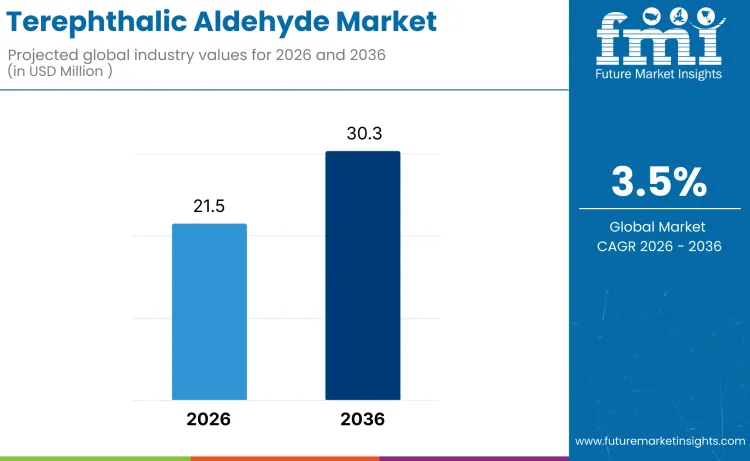
The global terephthalic aldehyde market is on a trajectory of steady growth, with the total market value projected at USD 21.5 million in 2026 and expected to rise significantly over the next decade. This expansion reflects growing demand from pharmaceutical intermediates, advanced materials, and specialty chemical sectors, driving both established players and emerging manufacturers to explore new technologies and broaden their market footprint.
Terephthalic aldehyde — a key organic chemical intermediate — has become increasingly vital across high-precision synthesis applications, particularly within pharmaceutical development and specialty chemical manufacturing. Demand has been bolstered by the need for high-purity intermediates that enable complex molecular synthesis, while technical advancements in production processes are creating fresh opportunities for companies seeking competitive advantage through innovation.
Strong Demand Across Core Applications Fuels Market Momentum
One of the pivotal forces behind this market’s growth is its application in pharmaceutical intermediates, which accounts for a significant share of global consumption. As drug development and molecular research intensify worldwide, the requirement for reliable, high-quality intermediates has surged. Pharmaceutical companies and research institutions are relying more heavily on terephthalic aldehyde due to its performance characteristics that support stringent regulatory standards and precise chemical transformations.
Beyond pharmaceuticals, terephthalic aldehyde is also leveraged in the production of optical brighteners and specialty polymers. Industries such as textiles, coatings, and advanced materials utilize these compounds for enhanced functional properties — including fluorescence, mechanical resilience, and thermal stability — contributing to consistent demand outside core pharmaceutical use cases.
To access the complete data tables and in-depth insights, request a sample report here
Established Leaders and Emerging Manufacturers Expand Competitive Landscape
The competitive landscape of the terephthalic aldehyde market is characterized by specialized chemical manufacturers who emphasize quality, consistency, and compliance. Established players like Haihang Industry Co. Ltd., Wuhai Xinye Chemical Co. Ltd., Tokyo Chemical Industry Co. Ltd., and Sigma-Aldrich Corporation have long been recognized for their robust production capabilities and deep customer relationships. These companies continue to strengthen their market positions by maintaining high standards of purity and delivery reliability that meet critical industrial and research needs.
In recent years, a wave of new manufacturers has entered the scene, aiming to capture niche segments and introduce differentiated technologies. Companies such as Hebei Xingyu Chemical Co. Ltd. and Hunan Astar Bio-chemical Technology Co. Ltd. have expanded production capacity and embraced specialized product portfolios. These emerging participants are targeting technical grade formulations and customized solutions to serve evolving customer requirements — particularly where precise performance or tailored purity profiles are essential.
New market entrants are also investing in cleaner, more sustainable production technologies. This reflects broader industry trends toward environmentally responsible manufacturing, with innovators developing processes that reduce emissions, minimize wastewater, and lower overall environmental impact. These advancements not only help meet regulatory expectations but also attract customers seeking responsible supply chain partners.
Regional Dynamics Highlight Growth Hotspots and Innovation Centers
Globally, demand for terephthalic aldehyde varies across regions, with Asia Pacific, particularly China and India, emerging as significant demand centers due to thriving pharmaceutical manufacturing sectors and expanding specialty chemical capacity. In these dynamic markets, companies are scaling up operations and adopting advanced quality control systems to remain competitive on a global stage.
Meanwhile, the United States and Europe continue to demonstrate steady demand growth fueled by research-driven applications and high-value synthesis requirements. Research institutions in these regions are increasingly leveraging terephthalic aldehyde for cutting-edge work in advanced materials and molecular design, providing fertile ground for suppliers capable of delivering ultra-high purity products. These regions also serve as hubs for technological collaboration, with industry and academia often partnering to push the boundaries of material science and chemical synthesis.
Innovation and Technology Investments Drive Future Opportunities
As manufacturers and market participants look ahead, innovation remains a key differentiator. New technologies that enhance production efficiency, improve product consistency, and reduce environmental footprints are gaining traction. Several companies are developing proprietary methods to improve aldehyde purity, automate analytical testing, and customize intermediates for specialized applications.
These technologies not only address immediate market needs but also position suppliers to capitalize on emerging trends in sectors such as high-performance polymers, advanced coatings, and precision-engineered materials. By integrating research and development with commercial scaling strategies, market players — both established and new — are creating new pathways for growth and unlocking broader applications for terephthalic aldehyde.