

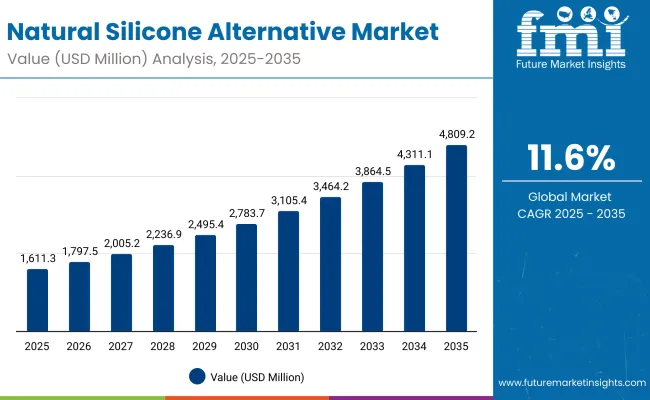
The global Natural Silicone Alternative Market is poised for extraordinary growth over the next decade, projected to soar from a valuation of USD 1,611.3 million in 2025 to nearly USD 4,809.2 million by 2035, representing a staggering 198% increase with a compound annual growth rate (CAGR) of 11.6%. This dynamic expansion underscores a powerful shift in the personal care and cosmetics industry as both established manufacturers and innovative newcomers accelerate development of high-performance, eco-friendly silicone substitutes.
This landmark growth is fueled by rising consumer demand for clean, vegan, palm-free, and COSMOS/ECOCERT-certified formulations, alongside advances in natural ingredient technologies. Industry giants like Croda, Evonik, Seppic, BASF, and Clariant are leveraging their deep expertise to develop sugar-derived alkane emollients and plant-based ester blends that match or exceed traditional silicones in sensory performance—such as slip, spreadability, and shine—while delivering sustainability benefits.
At the same time, a wave of new entrants and specialty ingredient developers are disrupting the market with cutting-edge biopolymer slip agents, AI-powered formulation platforms, and digital compliance tools, creating fresh competitive opportunities and partnerships with indie and masstige beauty brands. This evolving ecosystem is driving broader adoption and greater scale across diverse regions including Asia-Pacific, Europe, and North America.
Gain access to detailed segment-wise analysis and forecast statistics – Request the Sample Report Today
Key Segments of the Natural Silicone Alternative Market Report:
By Chemistry:
- Alkane emollients (sugar-derived) — leading with 40.6% share in 2025
- Ester blends (plant-based)
- Hemisphere/volatile replacements (natural iso-alkanes)
- Biopolymer slip agents
By Application:
- Leave-on skincare — dominating at 47.5% share
- Haircare leave-on
- Color cosmetics
- Suncare
By Sensory Target:
- Slip & spreadability — largest with 52.5% share
- Shine/gloss
- Mattifying/blur
- Long-wear/film-forming
By Compliance Certification:
- Vegan/clean
- Palm-free
- COSMOS/ECOCERT
By Customer Tier:
- Indie & masstige brands — driving rapid reformulation pipelines
- Prestige & luxury brands
- Contract manufacturers (B2B)
By Region:
- North America
- Latin America
- Europe
- East Asia
- South Asia & Pacific
- Middle East & Africa
Market Highlights and Growth Drivers:
- Technological Innovation & Sensory Performance:
Leading ingredient suppliers are pioneering new natural chemistries—especially sugar-derived alkane emollients—that replicate the silky slip and spreadability of silicones without compromising biodegradability or sustainability. This innovation is critical as skincare, haircare, and color cosmetics brands seek to maintain premium sensory experiences while meeting clean beauty standards. - Surging Demand from Indie and Masstige Brands:
Agile indie brands and masstige labels prioritize clean-label ingredients and are rapidly reformulating to incorporate natural silicone alternatives. Their success in capturing consumer interest is prompting prestige and luxury brands to follow, resulting in a broader mainstream shift. - Certification and Regulatory Compliance:
The growing importance of COSMOS, ECOCERT, vegan, and palm-free certifications is reshaping procurement strategies worldwide. Compliance not only builds consumer trust but also facilitates entry into major retail channels. This regulatory pressure ensures consistent market expansion, especially in Europe and Asia-Pacific. - Regional Expansion with Asia-Pacific Leading:
Asia-Pacific is the fastest-growing region, with China and India posting robust CAGRs of 18.0% and 20.2% respectively. Government support for sustainable beauty, growing middle classes, and booming indie brand ecosystems fuel this rapid adoption. Europe, led by Germany and the UK, maintains steady growth with stringent sustainability mandates, while the U.S. market experiences gradual but steady reformulation driven by retailer and regulatory demands. - Emerging Business Models:
Manufacturers are shifting toward hybrid models that combine raw material innovation with digital formulation support and compliance-as-a-service offerings. Cloud-based databases, AR/VR-enabled product testing, and AI formulation tools are providing scalable advantages and enabling faster time-to-market for certified natural silicone products.
Leading Players Shaping the Future:
- Croda: Holding an 8.5% market share in 2025, Croda continues to push the frontier with advanced sugar-derived alkane emollients and strategic partnerships with contract manufacturers globally.
- Evonik and INOLEX: Innovators in biopolymer slip agents, expanding their portfolios to align with rising vegan and palm-free demand.
- BASF and Seppic: Engaged in large-scale collaborations in Asia-Pacific, expanding accessibility of natural silicone alternatives for indie and masstige brands.
- Gattefossé, Ashland, Natura-Tec, Lucas Meyer Cosmetics: Specialists in customized formulations focusing on luxury and niche segments, emphasizing sustainability and sensory excellence.
Market Outlook by Region:
- United States:
Forecasted to grow from USD 304 million in 2025 to nearly USD 1 billion by 2035, driven by clean-label compliance, indie brand disruption, and retailer reformulation mandates. - United Kingdom:
Expected CAGR of 11.7%, supported by COSMOS/ECOCERT certifications and strong consumer demand for vegan, palm-free skincare and cosmetics. - India:
Fastest-growing with CAGR of 20.2%, propelled by rising awareness, government sustainability initiatives, and rapid scaling by contract manufacturers serving indie and masstige brands. - China:
CAGR of 18.0%, with expansive adoption in leave-on skincare and haircare leave-on driven by government policies and local ingredient production improving affordability. - Germany:
Steady growth aligned with stringent EU regulations, premium skincare innovation, and carbon footprint compliance mandates.
Why the Market is Growing:
The natural silicone alternative market is thriving because it perfectly balances consumer demand for clean, sustainable beauty products with formulation performance requirements. Rapid advances in ingredient technology and certification compliance enable brands to confidently transition away from traditional silicones. Meanwhile, a diverse competitive landscape, spanning global giants and nimble startups, fosters continuous innovation and ecosystem collaboration, ensuring the market’s resilience and long-term growth.
Conclusion:
As consumers increasingly prioritize sustainability and ingredient transparency, the natural silicone alternative market is evolving from niche to mainstream. With robust innovation from both established leaders and new entrants, ongoing expansion in high-growth regions, and accelerating adoption across multiple personal care categories, this market offers lucrative opportunities for manufacturers, contract producers, and brands aiming to lead the clean beauty revolution through 2035 and beyond.
Why FMI: https://www.futuremarketinsights.com/why-fmi
About Future Market Insights (FMI)
Future Market Insights, Inc. (FMI) is an ESOMAR-certified, ISO 9001:2015 market research and consulting organization, trusted by Fortune 500 clients and global enterprises. With operations in the U.S., UK, India, and Dubai, FMI provides data-backed insights and strategic intelligence across 30+ industries and 1200 markets worldwide.
Contact Us:
Future Market Insights Inc.
Christiana Corporate, 200 Continental Drive,
Suite 401, Newark, Delaware – 19713, USA
T: +1-347-918-3531
For Sales Enquiries: sales@futuremarketinsights.com
Website: https://www.futuremarketinsights.com
LinkedIn| Twitter| Blogs | YouTube




