

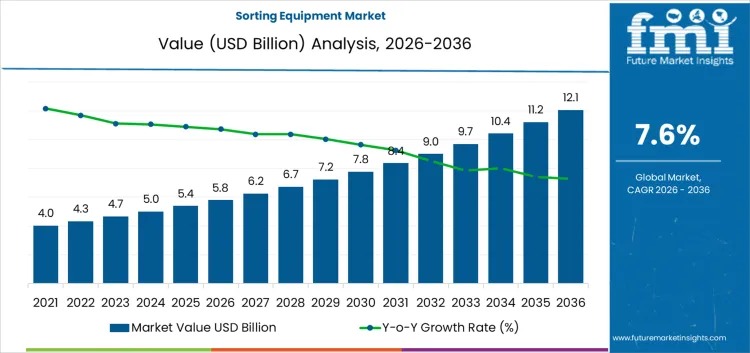
The Sorting Equipment Market is entering a sustained growth phase as industries accelerate automation to meet rising throughput, quality, and compliance demands. Valued at USD 5.8 billion in 2026, the market is forecast to reach USD 12.1 billion by 2036, expanding at a CAGR of 7.6%. Growth reflects structural reliance on automated separation systems rather than discretionary capacity additions, with capital investment focused on yield consistency, contamination control, and uptime reliability across continuous processing environments.
Subscribe for Year-Round Insights → Stay ahead with quarterly and annual data updates
Market Growth Anchored in Efficiency Gains
Sorting equipment demand is closely linked to operational efficiency improvements rather than cyclical industrial expansion. Food processors, recycling operators, and logistics hubs are prioritizing systems that reduce labor dependency while delivering predictable performance under high-volume conditions. Procurement teams increasingly evaluate total lifecycle value, emphasizing detection accuracy, ease of integration with conveyors and control software, and long-term service support. These criteria support steady multi-year upgrade cycles across mature industrial infrastructure.
Key Growth Drivers
- Rising automation across food processing, recycling, and logistics
- Regulatory pressure on food safety and waste recovery
- Need for consistent quality under variable input conditions
- Labor shortages accelerating adoption of automated systems
Technology Trends Shaping Market Demand
Technological advancement continues to redefine sorting performance. Optical sorters account for nearly 37% of global demand, making them the leading product category. These systems utilize cameras, sensors, and machine vision to identify materials by color, size, shape, and composition with high accuracy. Their non-contact operation supports high-speed processing while minimizing product damage, making them suitable across food, recycling, and industrial applications.
While belt, freefall, and lane sorters address specific material flow requirements, market preference increasingly favors sensor-based and AI-assisted systems that adapt to changing product mixes without mechanical changeover.
Technology Highlights
- High-accuracy, sensor-driven material identification
- AI and machine vision improving defect detection
- Reduced mechanical wear through non-contact sorting
- Seamless integration with automated handling lines
End-Use Industries Driving Volume
The food industry represents approximately 34% of total demand, making it the largest end-use segment. Strict safety regulations and brand protection requirements necessitate continuous sorting equipment utilization. High production volumes further justify investment in advanced automated systems.
Recycling and waste management operations form another critical demand base, driven by regulatory mandates to improve recovery rates and reduce contamination. Mining, agriculture, pharmaceuticals, plastics, and chemicals also apply sorting equipment to enhance material quality and processing efficiency.
Major End-Use Sectors
- Food processing and packaged foods
- Recycling and waste management
- Mining and minerals
- Logistics and e-commerce distribution
- Agriculture and industrial manufacturing
Adoption Constraints and Market Challenges
Despite strong fundamentals, scalability is influenced by capital intensity and operational constraints. High upfront system costs can limit adoption among small and mid-sized operators with inconsistent feedstock volumes. Installation often requires production line reconfiguration, increasing downtime exposure and project planning complexity. Skilled technicians are essential for calibration, software optimization, and maintenance, slowing rapid deployment.
Energy consumption, sensor wear, and maintenance frequency also affect lifecycle cost assessments, influencing purchasing decisions in cost-sensitive environments.
Key Challenges
- High initial investment requirements
- Downtime risks during installation
- Skilled labor dependency for system optimization
- Performance sensitivity to input variability
Regional Growth Dynamics
Regional demand aligns with automation penetration, labor cost pressure, and regulatory enforcement intensity. The USA leads with a CAGR of 7.8%, supported by large logistics hubs, e-commerce growth, and recycling compliance requirements. South Korea (7.4%) benefits from precision manufacturing and high automation standards, while Germany (7.3%) sustains demand through quality-driven manufacturing and strict recycling norms.
The UK (7.2%) and Japan (7.1%) show consistent growth driven by infrastructure modernization, food safety compliance, and automation adoption in response to labor constraints. Across regions, demand growth remains upgrade-led rather than greenfield expansion-driven.
Competitive Landscape Overview
The global sorting equipment market is moderately consolidated, with competition centered on detection accuracy, adaptability, and after-sales support. Buyers favor vendors offering modular systems that can be retrofitted into existing facilities. Increasing use of AI-assisted defect detection and real-time analytics is reshaping competitive differentiation.
Leading Companies
- Tomra Systems
- Bühler Group
- Key Technology (Duravant)
- Satake Corporation
- Steinert Global
Outlook and Strategic Implications
Looking ahead, the sorting equipment market is expected to maintain steady momentum through 2036. Growth will remain anchored in replacement and modernization cycles, supported by regulatory pressure, labor availability challenges, and rising expectations for consistent quality outcomes.
Get data that aligns with your strategic priorities — ask for report customization today:
Related Reports
Evaporative Air Cooler Market- https://www.futuremarketinsights.com/reports/evaporative-air-cooler-market
Metal based Safety Gratings Market- https://www.futuremarketinsights.com/reports/metal-based-safety-gratings-market
Tritium Light Source Market- https://www.futuremarketinsights.com/reports/tritium-light-sources-market
Have a specific Requirements and Need Assistant on Report Pricing or Limited Budget please contact us – sales@futuremarketinsights.com
About Future Market Insights (FMI)
Future Market Insights, Inc. (FMI) is an ESOMAR-certified, ISO 9001:2015 market research and consulting organization, trusted by Fortune 500 clients and global enterprises. With operations in the U.S., UK, India, and Dubai, FMI provides data-backed insights and strategic intelligence across 30+ industries and 1200 markets worldwide.
Contact Us:
Future Market Insights Inc.
Christiana Corporate, 200 Continental Drive,
Suite 401, Newark, Delaware – 19713, USA
T: +1-347-918-3531
Why FMI: https://www.futuremarketinsights.com/why-fmi
For Sales Enquiries: sales@futuremarketinsights.com
Website: https://www.futuremarketinsights.com
LinkedIn| Twitter| Blogs | YouTube




