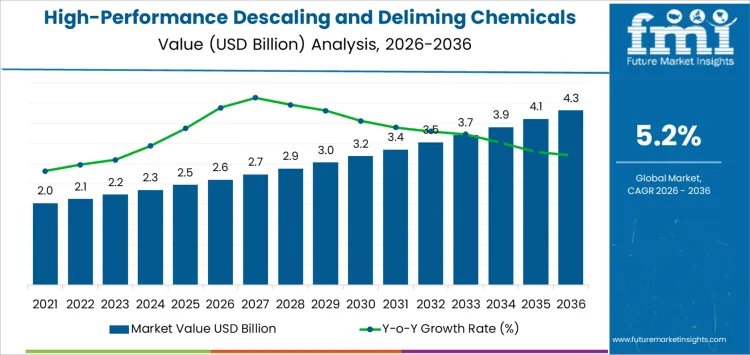
The global High-Performance Descaling and Deliming Chemicals Market is set to expand from an estimated USD 2.6 billion in 2026 to USD 4.3 billion by 2036, reflecting robust growth driven by increasing adoption across industrial, commercial, and institutional applications. This sustained expansion underscores the market’s evolution as established manufacturers scale operations and new entrants bring innovative technologies to meet rising demand for advanced maintenance solutions.
As production facilities, hospitality operations, and large commercial complexes seek cost-efficient ways to protect critical equipment from mineral scale buildup, descaling and deliming chemicals have become essential tools in extending asset longevity and optimizing operational performance.
Industry Leaders Driving Market Maturation
A number of well-known industry leaders continue to anchor the market with extensive product portfolios and global reach. Companies such as Ecolab, Diversey, Zep, Spartan Chemical, and Betco have solidified their roles by delivering a wide range of high-performance acid and specialty formulations for use in food service equipment, boilers, and heat exchangers. Their long-standing relationships with facility operators and service contractors help streamline preventive maintenance programs while reinforcing standards for efficiency and safety.
Multinational corporations like 3M, Clorox, and Reckitt also contribute significantly to market volume with branded solutions that serve both commercial and light industrial segments. These products are often integrated into routine cleaning and scale control efforts where easy-to-use formulations and broad distribution networks make them attractive to facility managers across diverse sectors.
Emerging Players and New Technologies Reshaping the Landscape
In addition to established players, several newer companies and technology innovators are entering the space with differentiated offerings. For instance, specialty chemical vendors focusing on organic acid–based descaling agents and chelation-enhanced formulations are gaining traction where gentler yet effective scale removal is demanded. These alternatives offer compatibility with sensitive materials and align with growing interest in environmentally conscious chemistries.
Startups and regional innovators are also bringing fresh approaches to market. Their emphasis on digital integration, smarter dosing systems, and predictive maintenance solutions is resonating with end users who seek to minimize downtime and reduce total cost of ownership. Digital tools that monitor scale formation in real time or automate chemical dosing based on equipment usage patterns are especially appealing in sectors with stringent uptime requirements.
This influx of innovation is not only broadening the range of available products but also helping smaller manufacturers carve out niche positions by addressing specific customer pain points that traditional products may overlook.
To access the complete data tables and in-depth insights, request a sample report here
Market Drivers: Efficiency, Maintenance, and Operational Continuity
The core driver behind market growth remains the universal challenge of mineral scale buildup in equipment exposed to hard water and high temperatures. Scale formation in boilers, heat exchangers, industrial piping, and food processing systems directly affects heat transfer efficiency, increases energy consumption, and accelerates wear on components.
Across food and beverage processing plants, healthcare facilities, hotel kitchens, and large commercial buildings, facility managers have increasingly adopted structured maintenance programs that feature high-performance descaling and deliming products as standard practice. By incorporating these chemicals into routine service planning, organizations can safeguard operational continuity and reduce emergency repair costs.
In sectors such as pharmaceuticals and utilities, where uninterrupted operations are mission-critical, advanced descaling chemistries are becoming part of long-term equipment lifecycle strategies. These buyers prioritize products that combine strong scale removal profiles with minimized corrosion risk, swift neutralization processes, and straightforward handling protocols.
Regional Growth Trends and Global Outlook
Market expansion is noticeable across key global regions, with Asia Pacific nations like China experiencing particularly strong demand due to rapid industrialization and heavy water-using processes in manufacturing. Brazil’s market is emerging due to hospitality and industrial infrastructure upgrades, while stable growth continues in the United States, Europe, and other developed markets where preventive maintenance and hygiene standards are deeply rooted in operational culture.
As water conditions and equipment intensities vary by region, manufacturers are tailoring product lines and service models to local needs, deploying formulations that address specific mineral profiles and regulatory environments. This localized strategy is helping both global leaders and agile smaller manufacturers deepen market penetration and support customer preferences more effectively.
Outlook: Innovation and Collaboration as Catalysts for Growth
Looking ahead, the High-Performance Descaling and Deliming Chemicals Market is positioned for continued advancement as both established firms and dynamic newcomers invest in research, distribution expansion, and value-added support services. The integration of sustainability-focused chemistries, coupled with intelligent maintenance technologies, offers a compelling pathway for growth while enhancing environmental stewardship and operational efficiency.
Manufacturers keen to expand their business footprints are actively exploring strategic partnerships, enhancing regional production capacities, and prioritizing customer-centric innovations that solve real-world maintenance challenges. As the market matures, collaboration between technology pioneers and traditional chemical producers will likely accelerate adoption and unlock new opportunities across industries where equipment uptime and performance remain essential.