

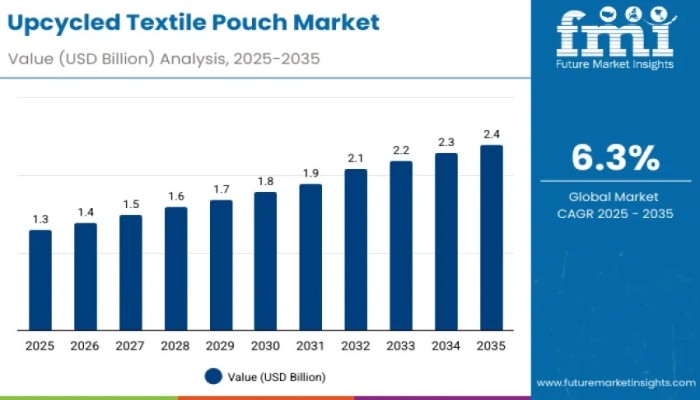
The global upcycled textile pouch market is entering a decisive growth phase, driven by the convergence of sustainability mandates, circular fashion movements, and evolving consumer expectations around ethical packaging. According to the latest market outlook, the industry is projected to expand from USD 1.3 billion in 2025 to USD 2.4 billion by 2035, registering a robust compound annual growth rate (CAGR) of 6.3% over the forecast period.
This growth reflects a fundamental shift in how brands across fashion, beauty, retail, and lifestyle sectors approach packaging. Instead of relying on virgin plastics or single-use materials, companies are increasingly turning to upcycled cotton, denim, canvas, and blended textile waste to create durable, reusable, and visually distinctive pouch formats that align with circular economy goals.
Unlock Growth Potential and Explore Market Opportunities With Our Comprehensive Industry Overview. Request Your Sample Now
Sustainability and Circular Fashion Drive Market Momentum
Between 2020 and 2024, global waste-reduction initiatives and circular fashion campaigns reshaped the pouch and secondary packaging landscape. Apparel brands, eco-luxury labels, and ethical retailers began adopting upcycled textile pouches as a tangible way to reduce landfill waste while reinforcing sustainability narratives. By 2035, consumer preference for eco-certified, traceable, and ethically produced packaging is expected to be a central driver pushing market value beyond USD 2.4 billion.
Asia-Pacific currently dominates production due to its access to large volumes of textile waste and cost-efficient upcycling operations. At the same time, Europe and North America are shaping demand through premium applications, branded sustainability compliance, and artisan craftsmanship, particularly in luxury fashion and gifting segments.
Quick Stats: Upcycled Textile Pouch Market
- Market Value (2025): USD 1.3 billion
- Forecast Value (2035): USD 2.4 billion
- Forecast CAGR (2025–2035): 6.3%
- Leading End-Use Segment (2025): Fashion & Apparel – 43.5%
- Key Growth Region: Asia-Pacific
- Fastest-Growing Country: South Korea – 7.1% CAGR
Cotton Textile Waste Emerges as the Leading Material
Among material types, cotton textile waste is projected to account for 36.5% of the market in 2025, making it the most widely used substrate for upcycled textile pouches. Its softness, biodegradability, and premium feel align strongly with luxury sustainability goals. Cotton waste sourced from post-industrial scraps and post-consumer garments ensures scalable circular production while offering the tactile and aesthetic qualities sought by high-end brands.
As plastic-free packaging becomes a brand differentiator, cotton-based upcycled pouches continue to gain traction as a reusable alternative that enhances brand perception and environmental responsibility.
Stand-Up Pouches Lead by Design and Functionality
By pouch type, stand-up pouches are expected to command 39.7% of the market in 2025. Their upright structure improves retail visibility, storage efficiency, and usability, making them ideal for apparel, accessories, and cosmetics packaging. Lightweight construction, reusability, and compatibility with custom printing and closures have made stand-up textile pouches a preferred choice for fashion-forward brands.
As retailers focus on packaging that delivers both functionality and storytelling, stand-up pouches remain the dominant format in the upcycled textile segment.
Fashion and Apparel Remain the Core Growth Engine
The fashion and apparel industry is forecast to retain its leadership position, accounting for 43.5% of total market demand in 2025. Designers and apparel brands are increasingly replacing plastic garment covers with reusable cloth bags and cotton pouches that support long-term brand exposure and repeated consumer use.
In parallel, apparel and accessories packaging leads application demand with a 35.9% share, reflecting the industry’s shift toward breathable, reusable, and aesthetically refined packaging solutions. Enhanced unboxing experiences, combined with natural dyes and biodegradable coatings, are strengthening adoption across both luxury and boutique segments.
Drivers, Challenges, and Emerging Opportunities
Market growth is being fueled by sustainability commitments from fashion, beauty, and lifestyle brands seeking to reduce carbon footprints and landfill waste. Upcycled textile packaging aligns closely with circular economy principles while offering storytelling value that resonates with conscious consumers.
However, challenges remain. Variability in textile quality, high manual labor requirements, and inconsistencies in color and fabric sourcing can limit scalability for large-volume orders. These factors currently restrict mass-market adoption, particularly for brands requiring strict uniformity.
Despite these constraints, new opportunities are emerging across corporate gifting, event packaging, hospitality, and B2B collaborations. Designers and manufacturers are exploring hybrid production models that integrate automation with artisanal craftsmanship, enabling scale without sacrificing authenticity. Traceable supply chains, digital tagging, eco-certified printing, and low-impact dyeing are also gaining momentum, enhancing transparency and consumer trust.
Regional and Country-Level Outlook
- United States: Growing at 6.4% CAGR, driven by eco-conscious retailers and D2C brands collaborating with local upcyclers.
- Germany: Expanding at 6.2% CAGR, supported by circular packaging mandates and innovation in blended textile pouches.
- United Kingdom: Forecast to grow at 6.3% CAGR, fueled by fashion collaborations and luxury gifting applications.
- China: Growing at 6.3% CAGR, backed by large-scale textile recovery programs and export-driven pouch production.
- India: Advancing at 6.2% CAGR, supported by small and mid-scale textile upcycling enterprises and apparel exporter partnerships.
- Japan: Recording 7.0% CAGR, focusing on premium-grade, precision-made upcycled pouches.
- South Korea: Leading global growth at 7.1% CAGR, driven by tech-enabled design, cosmetics demand, and export-ready solutions.
Competitive Landscape
The upcycled textile pouch market is moderately fragmented, with companies such as Logo Pouch, Alchemy Goods, Looptworks, Suay Sew Shop, Bagworld India, Lucid Upcycled Private Limited, Jaggery, ReCharkhaEcoSocial, Earth Care Bags, and Mdecopack Private Limited shaping the competitive environment. Players are investing in eco-certified collections, community-based upcycling models, and enhanced durability to meet rising global demand.
As sustainability evolves from a compliance requirement to a brand identity pillar, upcycled textile pouches are poised to become a defining symbol of ethical luxury, circular innovation, and responsible retail packaging through 2035.
Why FMI: https://www.futuremarketinsights.com/why-fmi
About Future Market Insights (FMI)
Future Market Insights, Inc. (FMI) is an ESOMAR-certified, ISO 9001:2015 market research and consulting organization, trusted by Fortune 500 clients and global enterprises. With operations in the U.S., UK, India, and Dubai, FMI provides data-backed insights and strategic intelligence across 30+ industries and 1200 markets worldwide.
Contact Us:
Future Market Insights Inc.
Christiana Corporate, 200 Continental Drive,
Suite 401, Newark, Delaware – 19713, USA
T: +1-347-918-3531
For Sales Enquiries: sales@futuremarketinsights.com
Website: https://www.futuremarketinsights.com
LinkedIn| Twitter| Blogs | YouTube




