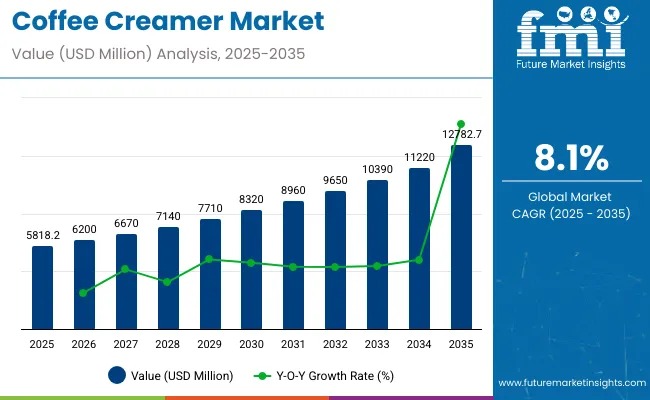
The global coffee creamer market is undergoing a significant transformation as evolving dietary habits, lifestyle shifts, and premium coffee culture reshape consumer expectations. Valued at USD 5,818.2 million in 2025, the market is projected to reach USD 12,782.7 million by 2035, expanding at a robust 8.1% CAGR over the forecast period. This growth reflects a broader shift in how consumers personalize and enhance their coffee experiences at home, at work, and on the move.
Demand is being redefined by the rapid adoption of plant-based, lactose-free, and functional creamers, alongside sustained interest in indulgent flavors and café-style experiences. Almond, oat, soy, and coconut-based creamers are moving from niche to mainstream as consumers seek alternatives aligned with vegan lifestyles, lactose intolerance, and perceived health benefits. At the same time, flavored and seasonal offerings are driving emotional engagement and repeat purchases.
Explore trends before investing – request a sample report today!
Major brands such as Nestlé (Coffee-Mate), Danone (International Delight), Califia Farms, and Nutpods are capitalizing on this shift with inventive portfolios that balance indulgence and functionality. From creamers fortified with MCT oils, proteins, collagen, and adaptogens to limited-edition flavors like peppermint mocha and brown sugar cinnamon, innovation is accelerating across price points and formats.
Convenience is another decisive growth lever. The rise of single-serve packaging and ready-to-drink (RTD) coffee beverages has expanded consumption occasions beyond the kitchen. Health-focused buyers are also influencing formulation strategies, pushing brands toward low-sugar, clean-label, and naturally sourced ingredients, while sustainability commitments are becoming central to brand positioning.
Regional Spending and Trade Dynamics
Per capita spending on coffee creamers varies widely by geography. North America, led by the United States, records the highest spend due to frequent coffee consumption and strong demand for flavored and specialty creamers. Europe follows, supported by traditional coffee rituals and a growing preference for plant-based options. Meanwhile, Asia-Pacific and the Middle East are emerging as high-growth regions as urbanization, rising incomes, and Western coffee habits fuel adoption.
Global trade flows reflect this imbalance. The United States, Germany, and the Netherlands serve as major exporters, leveraging advanced food processing capabilities and strong brand equity. Import demand is strongest in Asia-Pacific, Latin America, and the Middle East, where domestic production remains limited but coffee culture is expanding rapidly.
Market Momentum and Competitive Structure
Semi-annual analysis indicates a steady acceleration in growth. CAGR increased from 7.6% in H1 2024–2034 to 8.1% in H2 2025–2035, highlighting sustained demand and improving revenue realization across channels.
The competitive landscape is moderately concentrated:
- Tier 1 players such as Nestlé, Danone, Unilever, and Royal FrieslandCampina dominate through global distribution, extensive R&D, and diversified portfolios across dairy and non-dairy creamers.
- Tier 2 brands, including Califia Farms and Nutpods, compete through clean labels, premium plant-based positioning, and direct-to-consumer strategies.
- Tier 3 entrants, like Laird Superfood, are scaling rapidly with functional, wellness-oriented creamers supported by digital marketing and influencer engagement.
Shifting Demand Trends and Brand Responses
Health-driven reformulation is at the forefront. Sugar-free, keto-friendly, and vegan creamers are gaining traction across the U.S., Canada, and Europe. Nestlé’s Natural Bliss plant-based line boosted North American plant-based sales by 9%, while Califia Farms’ zero-sugar launches captured double-digit growth among health-focused consumers.
RTD formats are also surging. Café-style lattes and cold brews with integrated creamers recorded strong uptake in the U.S., UK, and Japan. Nestlé’s Starbucks RTD innovations delivered a 6.5% sales lift, while Danone’s International Delight Iced Coffee posted 8% year-on-year growth.
Younger consumers are shaping brand storytelling. Limited-edition collaborations, bold packaging, and digital-first campaigns are resonating with Gen Z and millennials, driving higher engagement and social-commerce conversions.
Country-Wise Growth Outlook
Among major markets, India stands out with an 8.9% CAGR through 2035, supported by rapid café expansion, growing preference for non-dairy creamers, and strong online retail penetration. China (7.4%) and Japan (6.6%) are benefiting from premium RTD demand and lactose-free formulations, while the USA (6.2%) and Germany (5.8%) continue to lead innovation in clean-label and organic creamers.
Segment Insights and Outlook
Dairy-based creamers still account for 57% of market value in 2025, driven by familiarity and texture preferences, though lactose-free variants are gaining ground. Organic creamers dominate by nature, holding 68% share, as consumers increasingly prioritize transparency, sustainability, and ingredient purity.
Looking ahead, the coffee creamer market will be shaped by flavor diversity, functional benefits, sustainability commitments, and omnichannel availability. Brands that successfully balance affordability with innovation and regional customization are best positioned to capture long-term growth in this rapidly evolving global category.