

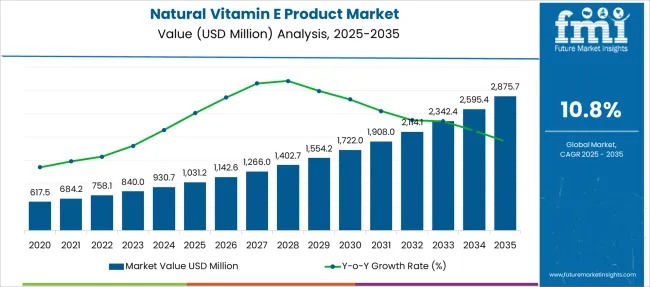
The global Natural Vitamin E Product Market is entering a high-growth phase as consumers, manufacturers, and regulators increasingly prioritize naturally sourced antioxidants over synthetic alternatives. The market is estimated to be valued at USD 1,031.2 million in 2025 and is projected to reach USD 2,875.7 million by 2035, expanding at a strong CAGR of 10.8% during the forecast period. This growth reflects structural shifts across food, nutraceutical, pharmaceutical, and personal care industries toward cleaner, traceable, and sustainably produced ingredients.
Natural vitamin E, primarily derived from plant-based oils, has gained wide acceptance due to its scientifically supported role in immune defense, cardiovascular protection, skin health, and oxidative stress management. Rising awareness of preventive healthcare, coupled with regulatory encouragement for natural formulations, continues to elevate demand across both developed and emerging economies.
Explore trends before investing – request a sample report today!
Market Snapshot Highlights
- Market size (2025): USD 1,031.2 million
- Forecast value (2035): USD 2,875.7 million
- Forecast CAGR (2025–2035): 10.8%
- Leading product segment (2025): Tocopherols (68.2% share)
- High-growth regions: North America, Asia-Pacific, Europe
Growth Drivers Anchored in Health, Regulation, and Technology
The steady expansion of the natural vitamin E product market is being driven by a combination of health-centric consumer behavior and favorable regulatory frameworks. Natural vitamin E is increasingly preferred in food fortification, dietary supplements, infant nutrition, and dermatological products due to its GRAS status, non-GMO compatibility, and alignment with clean-label claims.
Technological advancements have played a pivotal role. Innovations in molecular distillation, solvent-free extraction, and purification technologies have improved yield efficiency, stability, and bioavailability of naturally derived vitamin E. These advancements allow manufacturers to deliver high-purity tocopherols and tocotrienols at commercial scale without compromising sustainability goals.
In parallel, companies are strengthening vertical integration and traceable sourcing strategies to meet global sustainability mandates. Partnerships between agri-processors, food-tech firms, and cosmeceutical innovators are shaping a more resilient and transparent supply chain.
Tocopherols Dominate Product Landscape
By product type, tocopherols are expected to account for 68.2% of total market revenue in 2025, making them the most dominant segment. Their leadership is supported by extensive use as natural antioxidants and preservatives in food, supplements, and cosmetics.
Tocopherols are widely recognized for their efficacy in neutralizing free radicals and supporting cellular health. Continuous improvements in extraction from natural oils have enabled the production of high-stability, high-potency tocopherols, reinforcing their preference over synthetic vitamin E across regions.
Functional Foods and Beverages Drive Application Demand
In terms of application, functional food and beverages are projected to capture 31.7% of market revenue in 2025. Natural vitamin E is increasingly incorporated into fortified dairy, cereals, juices, and plant-based beverages to enhance nutritional value and oxidative stability.
This trend is closely linked to global preventive healthcare adoption, where consumers actively seek ingredients associated with heart health, immunity, and anti-aging benefits. Advances in food processing that preserve heat-sensitive nutrients have further supported vitamin E inclusion in ready-to-eat and minimally processed foods.
Soybean Oil Emerges as Key Source
By source, soybean oil is anticipated to hold 47.5% of the total revenue share in 2025, positioning it as the leading raw material for natural vitamin E extraction. Its dominance stems from a high concentration of mixed tocopherols, cost-efficient scalability, and consistent global availability.
Ongoing progress in enzymatic and non-solvent extraction methods has enhanced purity levels while supporting non-GMO and allergen-free labeling—critical factors for food and nutraceutical manufacturers targeting eco-conscious consumers.
Health Trends and Demographics Strengthen Demand
Rising prevalence of age-related conditions, including myopia, cardiovascular disorders, and metabolic diseases, is reinforcing long-term demand. According to the International Myopia Institute, nearly 30% of the global population is currently myopic, with projections indicating 50% by 2050. Such trends are increasing consumption of antioxidant-rich functional foods and supplements.
At the same time, growth in cosmeceuticals and organic personal care products is accelerating vitamin E adoption, particularly in formulations positioned as natural alternatives to chemical-based solutions.
Regional Momentum Across North America and Asia-Pacific
North America continues to benefit from strong demand for organic and vegan cosmetics, supported by expanding e-commerce channels and retail innovation. Product launches infused with natural vitamin E are reinforcing regional market share.
Asia-Pacific is emerging as a high-growth region, driven by rising awareness of vitamin E deficiency, expanding pharmaceutical manufacturing, and increasing prevalence of chronic diseases in India and China. The region’s rapidly evolving healthcare and nutraceutical sectors are expected to significantly contribute to global market expansion.
Competitive Landscape
The global natural vitamin E product market remains moderately consolidated, with key players including BASF SE, Koninklijke DSM N.V., Archer Daniels Midland Company, Merck KGaA, Prinova Group LLC, and others. Leading companies are investing heavily in R&D, capacity expansion, and new product development to strengthen global footprints and address unmet demand.
As sustainability, clean-label compliance, and functional health continue to converge, the natural vitamin E product market is well-positioned for sustained, data-backed growth through 2035.




