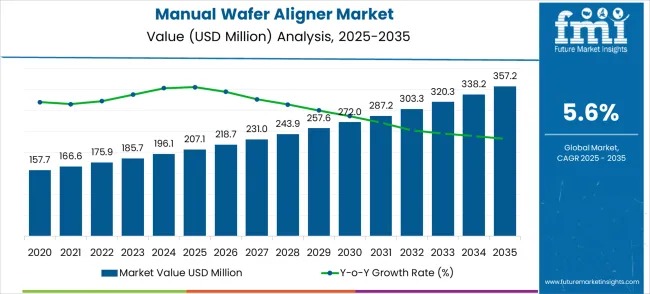
The global Manual Wafer Aligner Market is witnessing steady, value-focused growth as semiconductor manufacturing expands beyond fully automated, high-volume fabs. The market is projected to increase from USD 207.1 million in 2025 to USD 357.2 million by 2035, registering a 5.6% CAGR. This growth is underpinned by rising demand for cost-effective, high-precision wafer positioning solutions across semiconductor fabs, university laboratories, pilot production lines, and specialty electronics manufacturing environments.
Manual wafer aligners remain essential where flexibility, repeatable accuracy, and lower capital investment are prioritized. As chip production diversifies into power electronics, MEMS, sensors, and analog devices, manual alignment tools continue to provide reliable support for low- to mid-volume manufacturing and research-driven fabrication.
Subscribe for Year-Round Insights → Stay ahead with quarterly and annual data updates
In a semiconductor landscape shaped by rapid innovation cycles and shifting supply chains, ongoing access to updated equipment and technology data is increasingly critical for informed strategic planning.
Key Growth Drivers Strengthening Market Momentum
Multiple structural trends are supporting the expansion of the manual wafer aligner market:
- Growing emphasis on manufacturing cost optimization in small and mid-scale fabs
- Rising research and development activity across universities and innovation centers
- Increasing demand for specialty and legacy semiconductors
- Expansion of 200mm wafer production lines for power devices and sensors
Together, these factors reinforce the role of manual wafer aligners as practical, precision-driven solutions in environments where automation is not economically justified.
Wafer Notch Aligners Lead Alignment Technology Adoption
By alignment type, wafer notch aligners command 58.3% market share in 2025, making them the dominant technology category. Their leadership is driven by:
- Superior wafer orientation accuracy
- Seamless integration with standard photolithography workflows
- High repeatability with simplified operator control
Manufacturers continue to invest in improved notch detection and positioning mechanisms, ensuring wafer notch aligners remain the preferred choice for precision manual alignment across semiconductor and research applications.
200mm Wafer Applications Anchor Demand Growth
The 200mm wafer segment accounts for 42.1% of total market demand, reflecting its importance in legacy and specialty semiconductor production. Manual wafer aligners are widely adopted in 200mm processing environments supporting:
- Power semiconductors and automotive electronics
- Industrial and medical sensors
- MEMS-based components
- Analog and mixed-signal devices
These environments value manual aligners for their balance of precision, flexibility, and reduced ownership costs, especially in multi-product and small-batch manufacturing scenarios.
Advanced Materials Research Expands Addressable Market
The growing focus on advanced semiconductor materials such as silicon carbide (SiC), gallium nitride (GaN), and ultra-thin substrates is further driving adoption. These materials are essential for next-generation applications including electric vehicles, renewable energy systems, 5G infrastructure, and aerospace electronics.
Manual wafer aligners are extensively used in early-stage material development and prototyping, where delicate substrates require controlled handling and precise alignment that high-speed automated tools may not yet support.
Technology Advancements Enhance Manual Aligner Capabilities
Modern manual wafer aligners have evolved significantly, incorporating advanced features that improve accuracy and usability:
- Optical alignment systems with digital imaging
- Enhanced vacuum chuck designs for wafer stability
- Multi-axis alignment controls for fine positioning
- Ergonomic system layouts that reduce operator fatigue
These innovations are expanding the applicability of manual wafer aligners into advanced microelectronics, MEMS, and photonics research, making them increasingly competitive with semi-automated alternatives.
Regional Outlook: Asia Pacific Drives Growth Momentum
Asia Pacific leads global market growth, supported by strong semiconductor manufacturing investments and expanding electronics production.
- China records the fastest growth at 7.6% CAGR, driven by expanding fab infrastructure and government-backed semiconductor initiatives
- India follows with 7.0% CAGR, supported by rising electronics manufacturing and semiconductor assembly activity
- Germany (6.4%), United States (5.3%), United Kingdom (4.8%), and Japan (4.2%) show steady adoption linked to R&D strength and specialty manufacturing
In mature markets, manual wafer aligners remain essential for pilot lines, research institutions, and niche production environments.
Competitive Landscape Emphasizes Precision and Reliability
The manual wafer aligner market includes 10–14 specialized manufacturers, with the top five players accounting for 55–60% of global revenue. Competition is centered on:
- Alignment accuracy and mechanical stability
- Compatibility with multiple wafer sizes
- Cleanroom compliance and reliability
- Strong technical support and after-sales service
Leading companies include GL Automation, H-Square, G2 Automated Technologies, Emu Technologies, and SPS-International, while regional Asian manufacturers are gaining traction through cost-effective and customizable offerings.
Strategic Outlook: Flexibility Supports Long-Term Relevance
As semiconductor manufacturing prioritizes flexibility, innovation, and cost control, manual wafer aligners are expected to remain vital across R&D, specialty production, and medium-scale fabs. Their ability to deliver precision without high capital expenditure ensures sustained relevance through 2035.
Get data that aligns with your strategic priorities — ask for report customization today:
Related Reports
Power Generator for Military Market- https://www.futuremarketinsights.com/reports/power-generator-for-military-market
Aerospace Valves Market- https://www.futuremarketinsights.com/reports/aerospace-valves-market
Power System Simulator Market- https://www.futuremarketinsights.com/reports/power-system-simulator-market
Have a specific Requirements and Need Assistant on Report Pricing or Limited Budget please contact us – sales@futuremarketinsights.com
About Future Market Insights (FMI)
Future Market Insights, Inc. (FMI) is an ESOMAR-certified, ISO 9001:2015 market research and consulting organization, trusted by Fortune 500 clients and global enterprises. With operations in the U.S., UK, India, and Dubai, FMI provides data-backed insights and strategic intelligence across 30+ industries and 1200 markets worldwide.
Contact Us:
Future Market Insights Inc.
Christiana Corporate, 200 Continental Drive,
Suite 401, Newark, Delaware – 19713, USA
T: +1-347-918-3531
Why FMI: https://www.futuremarketinsights.com/why-fmi
Website: https://www.futuremarketinsights.com
LinkedIn| Twitter| Blogs | YouTube