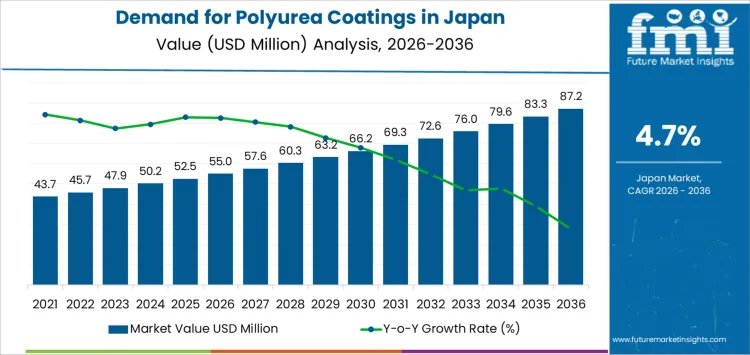
The Japan polyurea coatings market is on a strong growth trajectory, with demand expected to rise from an estimated USD 57.0 million in 2026 to approximately USD 87.2 million by 2036, reflecting robust adoption trends and expanding industrial applications. This growth reflects an increasing embrace of high-performance protective coatings across infrastructure, industrial operations, transportation, and building construction sectors, as established manufacturers and innovative newcomers alike leverage advanced material technologies to serve a broader set of application needs.
Polyurea coatings are rapidly gaining ground in Japan due to their exceptional performance characteristics. Fast curing times, superior chemical and abrasion resistance, and excellent adhesion on concrete and metal surfaces make these coatings ideal solutions for waterproofing, structural protection, and industrial maintenance. Building and construction applications alone account for half of all polyurea usage in the market, with contractors and facility managers favoring seamless systems that minimize downtime and maximize surface longevity.
A diversified landscape of market players is fueling this growth. Established global brands such as ArmorThane, Rhino Linings, SPI (Specialty Products Inc.), Teknos Group, and Nukote International maintain a strong presence in Japan, providing proven coating systems and supply networks that support major civil, industrial, and commercial projects. These companies continue to refine product portfolios to meet exacting Japanese engineering specifications and environmental standards, while building deeper partnerships with local applicators and infrastructure operators.
At the same time, new entrants and technology innovators are reshaping the competitive environment. Emerging manufacturers focusing on next-generation formulations—including solvent-free, high-solids polyurea, bio-based hybrid blends, and nanotechnology-enhanced coatings—are attracting attention for their sustainability and performance improvements. These advanced products not only bolster protective lifespans but also support greener construction practices with lower volatile organic compound (VOC) emissions and enhanced environmental compliance.
Technological innovation has become a key differentiator. Manufacturers are increasingly integrating robotic application systems, precision spray equipment, and smart surface monitoring capabilities that improve consistency, reduce labor intensity, and support real-time quality assurance on large infrastructure projects. Such technologies are particularly valuable in urban redevelopment and heavy industrial environments where project timelines and durability requirements are stringent.
To access the complete data tables and in-depth insights, request a sample report here
Public infrastructure renewal and industrial refurbishment initiatives across regions such as Kyushu, Kanto, and Kansai are driving steady demand for polyurea coatings. In Kyushu and Okinawa, for instance, coastal exposure and maritime structures fuel demand for moisture-resistant coatings, while in urban centers like Kanto, high traffic volumes and complex construction landscapes enhance the need for fast-return to service solutions. Across these diverse geographies, polyurea coatings are increasingly specified for bridges, wastewater treatment plants, warehouse floors, and transport facilities where durability directly impacts public safety and operational continuity.
In Japan’s advanced manufacturing segments, industrial plants and storage facilities are adopting polyurea systems for heavy-duty floor protection and chemical containment. Electronics, pharmaceutical, and food processing facilities particularly value the hygienic, monolithic surface qualities that polyurea coatings provide, supporting rigorous clean-in-place and sanitation protocols. Logistics and cold-storage operators likewise appreciate the coatings’ resilience to temperature cycling and moisture ingress.
The automotive and transportation sectors also present notable expansion opportunities. As Japan’s mobility market evolves with lightweight materials and electric vehicle components, polyurea coatings are increasingly specified for abrasion-resistant under-body protection and structural safeguarding. This broadens the market beyond traditional infrastructure uses and underscores the material’s versatility across multiple industries.
Looking forward, industry consensus suggests that the combination of infrastructure modernization, environmental performance demand, and continuous product innovation will sustain the polyurea coatings market’s upward path. Established companies with deep technical experience are investing in localized training programs and partnerships to expand their footprint, while newer technology-driven firms are challenging traditional formulations and application methodologies with high-performance alternatives.
Moreover, shifting procurement priorities toward lifecycle cost management and rapid turnaround applications are advancing polyurea solutions over conventional coatings in both new construction and refurbishment projects. This dynamic environment encourages collaboration between material innovators, application specialists, and end users to co-develop solutions that meet Japan’s unique blend of seismic, climatic, and industrial performance requirements.