

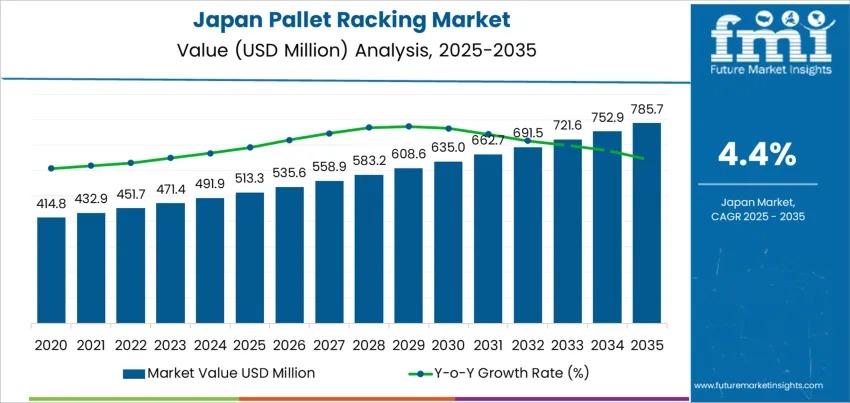
Japan’s pallet racking market is entering a decade of steady, structurally driven growth as logistics operators rethink how to store, move, and access inventory in one of the world’s most space-constrained economies. Valued at USD 513.3 million in 2025, demand for pallet racking in Japan is projected to reach USD 785.7 million by 2035, expanding at a compound annual growth rate (CAGR) of 4.4%. This growth reflects the central role pallet racking now plays in warehouse productivity, urban logistics density, and automation-ready infrastructure rather than simple storage expansion.
Market at a Glance: Key Demand Indicators
- Market Value (2025): USD 513.3 million
- Forecast Value (2035): USD 785.7 million
- CAGR (2025–2035): 4.4%
- Leading System Type: Conventional pallet racking (35% share)
- Dominant Load Capacity: Up to 5 tons (40% of installations)
- High-Growth Regions: Kyushu & Okinawa, Kanto, Kansai, Chubu
- Key Market Players: Gonvarri Material Handling, Hannibal Industries, Mecalux, Daifuku Co. Ltd., Unarco Material Handling
Unlock Growth Potential – Request Your Sample Now and Explore Market Opportunities!
Early Growth Driven by Distribution Expansion and Vertical Storage
Between 2025 and 2030, pallet racking demand in Japan is anchored in the continued expansion of distribution centers serving retail chains, third-party logistics (3PL) providers, and cold storage operators. Urban land scarcity, especially in the Kanto and Kansai regions, is forcing warehouse developers to maximize vertical storage density rather than expand footprints. As a result, selective pallet racking and drive-in systems remain the preferred solutions for balancing access speed and space efficiency.
During this phase, demand rises steadily from USD 513.3 million in 2025 to USD 608.6 million by 2030, adding over USD 95 million in new market value. Food, beverage, and consumer goods dominate new installations due to high inventory turnover and frequent restocking cycles. Automotive parts logistics and electronics distribution also contribute stable demand, supported by standardized pallet loads and predictable throughput.
Post-2030 Shift Toward Automation-Compatible Systems
After 2030, growth accelerates as Japan’s logistics sector pivots from footprint expansion to system upgrades and automation compatibility. By 2035, demand reaches USD 785.7 million, with the market adding USD 177.1 million in the second half of the decade alone.
Warehouses increasingly invest in:
- High-bay racking and narrow-aisle systems
- Shuttle racking integrated with automated guided vehicles (AGVs)
- Layouts optimized for robotic picking and automated storage and retrieval systems (AS/RS)
Labor shortages across Japan’s logistics sector make automation-ready racking a strategic necessity. As SKU diversity increases and same-day delivery expectations rise, pallet racking evolves from static steel infrastructure into a core structural layer of automated logistics ecosystems.
What Is Driving Demand for Pallet Racking in Japan?
The demand for pallet racking in Japan is driven by structural shifts rather than discretionary spending:
- Urban land constraints push warehouses to extract maximum cubic value from limited space.
- E-commerce fulfillment growth increases the need for selective access and frequent reconfiguration.
- Cold chain expansion for food, seafood, and pharmaceuticals demands corrosion-resistant, temperature-stable racking.
- Import-heavy supply chains concentrate inventory in centralized distribution hubs, raising throughput pressure.
Pallet racking systems improve storage density, standardize material handling, and reduce manual labor—critical advantages in a high-cost, labor-constrained market.
System Type and Load Capacity Shape Market Structure
Conventional pallet racking leads the market with a 35% share, valued for its simplicity, low installation cost, and direct pallet access. These systems are widely used in small to mid-sized warehouses where flexibility and quick order fulfillment are essential.
By load capacity, up to 5-ton systems account for 40% of total demand, aligning with standard palletized goods across retail, food, pharmaceuticals, and consumer electronics. This segment allows warehouses to increase vertical storage without requiring reinforced floors or heavy-duty lifting equipment, supporting energy-efficient and narrow-aisle operations.
Regional Growth Outlook Highlights
- Kyushu & Okinawa (5.4% CAGR): Port-led logistics growth, cold storage expansion, and food distribution drive demand.
- Kanto (5.0% CAGR): Dense urban distribution, e-commerce fulfillment, and vertical warehouse design sustain high installation rates.
- Kansai (4.4% CAGR): Balanced growth supported by retrofit projects and steady wholesale logistics.
- Chubu (3.9% CAGR): Automotive and manufacturing supply chains shape incremental, production-aligned demand.
- Tohoku & Rest of Japan (3.2–3.4% CAGR): Agriculture, frozen food, and municipal warehousing support stable, necessity-driven demand.
Constraints: Seismic Standards and Retrofit Challenges
Japan’s strict seismic regulations significantly influence pallet racking design and cost. Systems must meet rigorous anchoring, bracing, and load-distribution standards, increasing material and installation expenses. Retrofitting older warehouses remains capital-intensive, and limited skilled installation labor can slow project timelines. These factors temper rapid replacement cycles despite growing automation needs.
Competitive Landscape: Suppliers Shaping the Market
Leading suppliers such as Gonvarri Material Handling, Mecalux, Daifuku Co. Ltd., Hannibal Industries, and Unarco Material Handling are shaping Japan’s pallet racking market through modular designs, automation integration, and certified seismic-resistant systems.
Daifuku’s strength in automation integration positions it strongly in smart warehouse projects, while global players like Mecalux and Gonvarri focus on scalable, high-capacity solutions adapted to Japan’s spatial and regulatory environment.
Why FMI: https://www.futuremarketinsights.com/why-fmi
About Future Market Insights (FMI)
Future Market Insights, Inc. (FMI) is an ESOMAR-certified, ISO 9001:2015 market research and consulting organization, trusted by Fortune 500 clients and global enterprises. With operations in the U.S., UK, India, and Dubai, FMI provides data-backed insights and strategic intelligence across 30+ industries and 1200 markets worldwide.
Contact Us:
Future Market Insights Inc.
Christiana Corporate, 200 Continental Drive,
Suite 401, Newark, Delaware – 19713, USA
T: +1-347-918-3531
For Sales Enquiries: sales@futuremarketinsights.com
Website: https://www.futuremarketinsights.com
LinkedIn| Twitter| Blogs | YouTube




