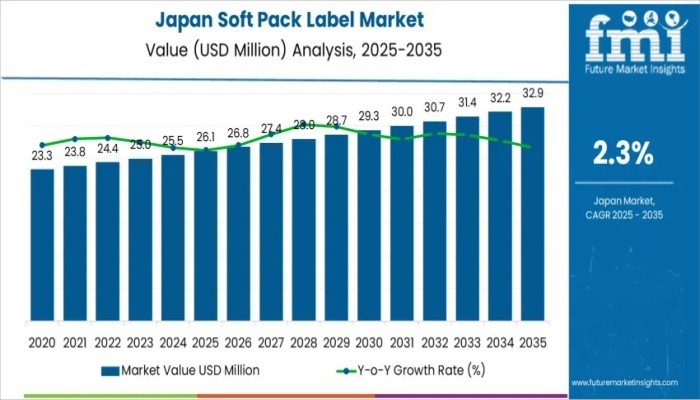
The demand for soft pack labels in Japan is set to experience steady and resilient growth over the next decade, supported by the country’s expanding flexible packaging sector, sustainability-driven innovation, and evolving consumer lifestyles. According to the latest market outlook, Japan’s soft pack label demand is projected to rise from USD 26.1 million in 2025 to USD 32.9 million by 2035, registering a compound annual growth rate (CAGR) of 2.3% during the forecast period.
Soft pack labels widely used on flexible packaging formats such as pouches, sachets, and lightweight bags—play a critical role in brand identification, regulatory compliance, and consumer communication. They are essential across industries including food & beverages, pharmaceuticals, personal care, and household products, where flexibility, durability, and visual appeal are non-negotiable.
Discover Growth Opportunities in the Market – Get Your Sample Report Now
Quick Stats: Demand for Soft Pack Label in Japan
- Market Value (2025): USD 26.1 million
- Forecast Value (2035): USD 32.9 million
- CAGR (2025–2035): 2.3%
- Key Materials: Paper, Film, Foil
- Leading End-Use Sector: Food & Beverage
- High-Growth Regions: Kyushu & Okinawa, Kanto, Kansai
- Top Companies: Avery Dennison, CCL Industries, UPM Raflatac, Henkel, Toppan Printing
Market Outlook: Flexible Packaging at the Core of Growth
Japan’s soft pack label industry is closely tied to the rapid adoption of flexible packaging solutions. Consumers increasingly prefer lightweight, portable, and resealable packs that fit busy urban lifestyles and smaller household sizes. Ready-to-eat meals, snacks, instant foods, and single-serve personal care products are driving the need for reliable labeling solutions that adhere seamlessly to flexible substrates.
From 2025 to 2030, the market is expected to grow from USD 26.1 million to USD 30.7 million, adding USD 4.6 million in value. This phase will be fueled by expanding demand for convenience foods, customization in packaging design, and increasing use of flexible packs in e-commerce and retail.
Between 2030 and 2035, demand will continue to rise to USD 32.9 million, contributing an additional USD 2.2 million. While growth may moderate as the market matures, the essential role of soft pack labels in flexible packaging will ensure sustained demand, particularly for high-quality and eco-friendly label solutions.
Sustainability and Innovation Shaping Industry Direction
Japan’s strong focus on environmental responsibility is reshaping packaging strategies. Soft pack labels are increasingly designed using recyclable, biodegradable, and low-impact materials, aligning with national sustainability goals and consumer expectations.
Key technological advancements supporting market growth include:
- Improved pressure-sensitive adhesives for low-surface-energy films
- Enhanced print quality for vibrant branding and detailed information
- Smart labeling features such as QR codes and traceability
- Resealable and tamper-evident label designs
These innovations are making soft pack labels more functional, durable, and environmentally aligned, further accelerating adoption across industries.
Segment-Wise Insights: Paper and Food & Beverage Dominate
By Material Type
- Paper labels account for 62% of total demand, favored for their cost-effectiveness, printability, and eco-friendly appeal.
- Film and foil labels follow, serving applications requiring higher moisture resistance or premium finishes.
By End Use
- The food and beverage sector leads with 44% share, driven by labeling needs for ingredients, nutrition, expiration dates, and branding.
- Personal care, pharmaceuticals, and household products also contribute steadily, supported by demand for lightweight and attractive packaging.
Regional Demand Outlook: Growth Across Japan
- Kyushu & Okinawa (CAGR 2.9%) lead growth, supported by tourism, hospitality, and rising demand for convenient packaged goods.
- Kanto (2.7%), driven by Tokyo’s urban population, manufacturing base, and strong e-commerce activity.
- Kansai (2.3%) benefits from food processing, personal care production, and hospitality demand.
- Chubu (2.1%), supported by SMEs and eco-conscious manufacturing.
- Tohoku (1.8%) and Rest of Japan (1.7%) show steady growth as modern packaging solutions gradually expand into regional markets.
Competitive Landscape: Focus on Performance and Sustainability
Japan’s soft pack label market is moderately consolidated, with global and domestic players competing on innovation, adhesion performance, and sustainability.
Leading Companies Include:
- Avery Dennison (approx. 35% market share)
- CCL Industries
- UPM Raflatac
- Henkel
- Toppan Printing
Competition is intensifying around eco-friendly materials, advanced adhesive technologies, and customization capabilities, as brands seek differentiation in crowded retail environments.
Why FMI: https://www.futuremarketinsights.com/why-fmi
About Future Market Insights (FMI)
Future Market Insights, Inc. (FMI) is an ESOMAR-certified, ISO 9001:2015 market research and consulting organization, trusted by Fortune 500 clients and global enterprises. With operations in the U.S., UK, India, and Dubai, FMI provides data-backed insights and strategic intelligence across 30+ industries and 1200 markets worldwide.
Contact Us:
Future Market Insights Inc.
Christiana Corporate, 200 Continental Drive,
Suite 401, Newark, Delaware – 19713, USA
T: +1-347-918-3531
For Sales Enquiries: sales@futuremarketinsights.com
Website: https://www.futuremarketinsights.com
LinkedIn| Twitter| Blogs | YouTube