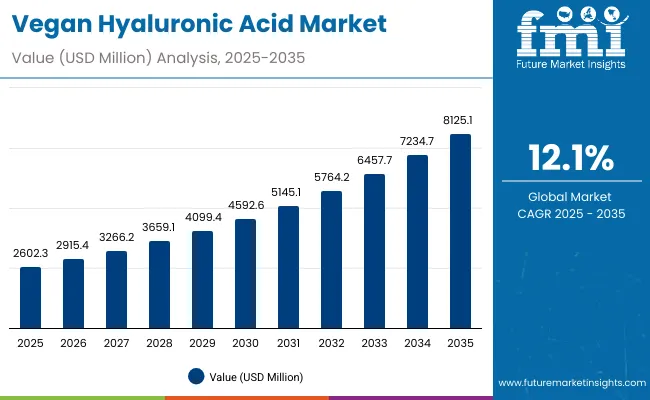
The global Vegan Hyaluronic Acid Market is entering a transformative growth phase, driven by clean-label demand, rapid biotechnological innovation, and the strategic expansion of both established leaders and emerging manufacturers. Valued at USD 2,602.3 million in 2025, the market is projected to reach USD 8,125.1 million by 2035, registering a strong CAGR of 12.1% over the forecast period. This represents an absolute opportunity of USD 5,522.8 million, underlining the category’s evolution from a niche alternative to a mainstream ingredient across nutraceuticals, cosmeceuticals, and functional wellness solutions.
To access the complete data tables and in-depth insights — Request Your Sample Report Now
Market Momentum Backed by Technology and Consumer Trust
During the early forecast phase (2025–2030), the market is expected to add nearly USD 1.99 billion, fueled by rising adoption of vegan-certified, antioxidant-rich formulations in skincare, nutrition, and preventive healthcare. Momentum is forecast to accelerate further between 2030 and 2035, contributing over 64% of total decade growth, as extraction efficiency, fermentation scalability, and bioavailability technologies mature.
Asia-Pacific, Europe, and North America continue to emerge as key growth regions, supported by expanding e-commerce penetration, regulatory clarity, and widespread consumer acceptance of plant-based and cruelty-free ingredients.
Established Leaders and New Manufacturers Driving Competitive Evolution
The competitive landscape reflects a healthy balance between global leaders and agile innovators. Companies such as Bloomage Biotech, DSM-Firmenich, Evonik, Contipro, and Kewpie are strengthening leadership through advanced fermentation platforms, clinical validation, and global distribution networks. Bloomage Biotech alone accounts for 8.7% of global value share in 2025, reinforcing its role as a technology benchmark in vegan hyaluronic acid.
At the same time, new and mid-sized manufacturers are actively expanding capacity, forming strategic partnerships, and investing in next-generation fermentation, encapsulation, and traceability systems. Players including Givaudan, Croda, Roquette, Ashland, and Lubrizol are integrating vegan hyaluronic acid into broader active-ingredient ecosystems, creating opportunities for differentiated formulations and faster market entry.
Why the Vegan Hyaluronic Acid Market Is Growing
Growth is being propelled by multiple reinforcing factors:
- Rising consumer preference for natural, vegan-certified, and clean-label products
- Strong clinical evidence supporting hydration, anti-aging, barrier repair, and preventive wellness benefits
- Convergence of nutraceuticals and cosmeceuticals, enabling “beauty-from-within” positioning
- Expansion of D2C and e-commerce models, improving access and education
- Technological advances ensuring higher purity, scalability, and sustainability
Together, these trends are positioning vegan hyaluronic acid as a core functional ingredient rather than a substitute.
Key Segments of the Vegan Hyaluronic Acid Market
By Source:
- Fermentation-derived (bacterial, yeast, fungal) – Leading with 64.6% share in 2025
- Plant-based engineered polysaccharides
- Synthetic biopolymers
- Algae-derived substitutes
By Function:
- Hydration & moisture-binding (dominant at 51.5% share)
- Plumping & volume restoration
- Wound healing & repair
- Anti-aging & wrinkle reduction
- Barrier strengthening
- Post-procedure soothing
By Product Type:
- Serums & ampoules
- Creams & lotions
- Masks & patches
- Capsules / nutricosmetics
- Sprays & mists
- Injectables
By Channel:
- E-commerce marketplaces
- D2C brand websites
- Pharmacies & drugstores
- Specialty beauty retailers
- Dermatology clinics
- Mass retail
By Claim:
- Vegan-certified
- Organic-certified
- Clean-label
- Fragrance-free / hypoallergenic
- Eco-friendly packaging
By Region:
- North America
- Europe
- Asia-Pacific
- Latin America
- Middle East & Africa
Regional Outlook Highlights
- India (CAGR 23.1%) and China (19.5%) are emerging as high-growth engines, supported by expanding preventive nutrition, domestic biotech investment, and strong cosmeceutical innovation.
- Japan (16.6%) continues to benefit from premium skincare and anti-aging demand.
- UK (13.3%) and Germany (9.9%) emphasize evidence-based formulations, vegan certification, and pharmacy-led adoption.
- The United States, valued at USD 551.25 million in 2025, remains a mature but steadily expanding market driven by hydration-focused skincare and functional wellness products.
Outlook Toward 2035
Looking ahead, competitive differentiation is expected to shift from raw ingredient supply toward integrated, ecosystem-based offerings. Manufacturers that combine sustainability, clinical substantiation, transparent sourcing, and formulation support are likely to capture long-term brand loyalty. As both established players and new entrants continue to expand capacity and introduce new technologies, the vegan hyaluronic acid market is poised to become a cornerstone of global clean-label innovation through 2035.
Why FMI: https://www.futuremarketinsights.com/why-fmi
About Future Market Insights (FMI)
Future Market Insights, Inc. (FMI) is an ESOMAR-certified, ISO 9001:2015 market research and consulting organization, trusted by Fortune 500 clients and global enterprises. With operations in the U.S., UK, India, and Dubai, FMI provides data-backed insights and strategic intelligence across 30+ industries and 1200 markets worldwide.
Contact Us:
Future Market Insights Inc.
Christiana Corporate, 200 Continental Drive,
Suite 401, Newark, Delaware – 19713, USA
T: +1-347-918-3531
For Sales Enquiries: sales@futuremarketinsights.com
Website: https://www.futuremarketinsights.com
LinkedIn| Twitter| Blogs | YouTube