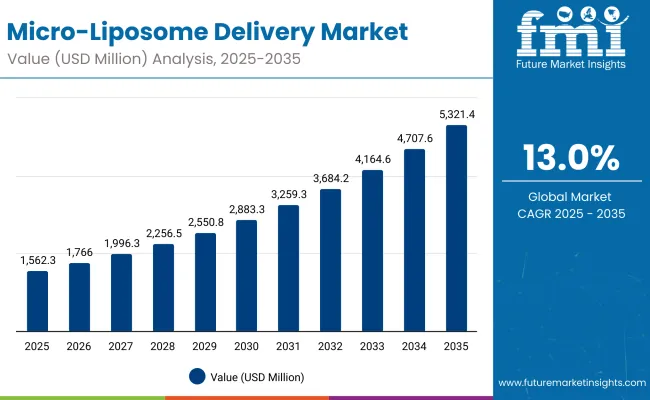
The Micro-Liposome Delivery Market is entering a decisive growth phase, driven by rapid innovation in skincare science and rising consumer demand for high-efficacy formulations. Valued at USD 1,562.3 million in 2025, the market is forecast to reach USD 5,321.4 million by 2035, expanding at a robust CAGR of 13.0%. This nearly 2X growth over the decade highlights the increasing importance of advanced delivery systems that enhance absorption, stability, and performance of active ingredients.
As skincare consumers globally shift toward science-backed, results-oriented products, micro-liposome technology is emerging as a cornerstone for both established global brands and new-age manufacturers looking to expand their portfolios and enter premium segments.
To access the complete data tables and in-depth insights — Request Your Sample Report Now
Why the Micro-Liposome Delivery Market Is Growing
Micro-liposomes encapsulate active ingredients at a microscopic level, enabling deeper skin penetration, controlled release, and improved bioavailability. This technological edge is transforming how anti-aging, brightening, and skin repair products perform. Consumers now expect visible, faster, and clinically proven results, pushing brands to adopt micro-liposome systems as a competitive differentiator.
The surge in clinical-grade and dermatologist-tested skincare further accelerates adoption. Products leveraging micro-liposome delivery align seamlessly with regulatory expectations and professional endorsements, elevating trust and driving mainstream acceptance beyond niche applications.
Market Growth Trajectory: A Decade of Acceleration
- 2025–2030: Market value rises from USD 1,562.3 million to USD 2,883.3 million, contributing 35% of total decade growth.
- 2030–2035: Growth accelerates sharply, adding USD 2,438.1 million, accounting for 65% of total expansion, fueled by Asia-Pacific demand, premiumization, and e-commerce scalability.
This shift reflects how advanced delivery technologies are becoming standard across premium skincare lines.
Key Segments of the Micro-Liposome Delivery Market
By Function
- Enhanced absorption
- Anti-aging
- Brightening
- Skin repair
By Product Type
- Serums
- Creams/Lotions
- Ampoules
- Gels
By Distribution Channel
- Pharmacies
- E-commerce
- Specialty beauty stores
- Mass retail
By Claim
- Clinical-grade
- Dermatologist-tested
- Vegan
- Clean-label
By Region
- North America
- Europe
- East Asia
- South Asia & Pacific
- Latin America
- Middle East & Africa
Serums Lead Product Innovation
Serums dominate the market with a 53.5% share in 2025, emerging as the preferred format for micro-liposome integration. Their lightweight texture and compatibility with concentrated actives make them ideal for delivering anti-aging and brightening benefits. Premiumization trends further strengthen serum demand, positioning them as high-value, clinically validated skincare essentials.
Clinical-Grade Claims Drive Trust
Clinical-grade products account for 51.5% of market revenues, reflecting consumer preference for dermatologist-endorsed efficacy. This segment benefits from growing collaborations between skincare brands and medical professionals, blurring the line between cosmetic and dermatological solutions.
Regional Growth Highlights
- Asia-Pacific leads global growth, with China (23.3% CAGR) and India (22.1% CAGR) emerging as high-potential markets driven by e-commerce, affordable innovation, and rising middle-class consumption.
- Europe, led by Germany and the UK, benefits from clean-label preferences and aging demographics.
- North America, particularly the USA, shows steady expansion with strong pharmacy and dermatology-clinic distribution networks.
Opportunities for Established and Emerging Manufacturers
The market presents strong opportunities for new manufacturers aiming to scale through cost-effective serums and digital-first strategies, particularly in Asia-Pacific. At the same time, established players are leveraging R&D strength to form new micro-liposome technologies, personalized skincare solutions, and sustainable formulations.
Brands that combine science-backed innovation, transparent claims, and e-commerce reach are best positioned to capture long-term value.
Competitive Landscape: Innovation at the Core
The Micro-Liposome Delivery Market is moderately fragmented. Industry leaders such as Estée Lauder, Shiseido, Lancôme, Clarins, and Clinique continue to dominate through premium serums and advanced formulations. Mid-sized and niche brands including Dr. Dennis Gross Skincare, Obagi, Murad, Biotherm, and Elizabeth Arden are gaining traction by blending clinical efficacy with clean-label and sustainability-linked positioning.
Future Outlook
Looking ahead to 2035, micro-liposome delivery is set to redefine premium skincare standards. With rising personalization, AI-driven skin diagnostics, and expanding global e-commerce, the market will increasingly reward manufacturers that innovate beyond traditional formulations and invest in next-generation delivery technologies.
Why FMI: https://www.futuremarketinsights.com/why-fmi
About Future Market Insights (FMI)
Future Market Insights, Inc. (FMI) is an ESOMAR-certified, ISO 9001:2015 market research and consulting organization, trusted by Fortune 500 clients and global enterprises. With operations in the U.S., UK, India, and Dubai, FMI provides data-backed insights and strategic intelligence across 30+ industries and 1200 markets worldwide.
Contact Us:
Future Market Insights Inc.
Christiana Corporate, 200 Continental Drive,
Suite 401, Newark, Delaware – 19713, USA
T: +1-347-918-3531
For Sales Enquiries: sales@futuremarketinsights.com
Website: https://www.futuremarketinsights.com
LinkedIn| Twitter| Blogs | YouTube