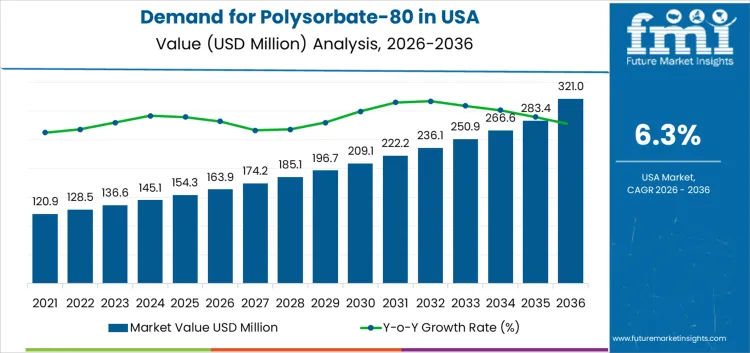
The United States Polysorbate-80 market is projected to be worth USD 163.9 million in 2026, reflecting strong demand growth driven by expanding applications in food & beverage, pharmaceuticals, cosmetics, and emerging green formulations. As companies innovate and broaden their production capabilities, both long-standing and new manufacturers are positioning themselves to capitalize on the rising need for high-performance emulsifiers, stabilizers, and solubilizers across major industrial sectors.
Polysorbate-80 — a versatile non-ionic surfactant widely used to blend oil and water phases in formulations — has become a linchpin ingredient for manufacturers focused on product texture, stability, and performance. With steady market expansion anticipated through the next decade, the ecosystem around Polysorbate-80 is being reshaped by strategic investments, technological developments, and an evolving competitive landscape.
Market Drivers and Strategic Opportunities
The broader adoption of Polysorbate-80 stems from its indispensable role in multiple sectors. In the food and beverage industry, its emulsification properties enhance product uniformity in applications like salad dressings, sauces, and frozen desserts, meeting consumer demands for quality and consistency. Simultaneously, the pharmaceutical sector continues to integrate Polysorbate-80 into injectable formulations, biologics, and vaccine stabilizers, driven by heightened focus on therapeutic delivery systems.
Cosmetics and personal care manufacturers are also increasing their reliance on Polysorbate-80 to improve texture and solubility in lotions, creams, and hair care products. As sustainability and clean-label preferences grow among consumers, there is a discernible shift toward plant-based derivatives, encouraging producers to innovate with greener raw materials.
Innovation and Technology Trends
Across the market landscape, ongoing technological advancements are reshaping production processes and product offerings. Established chemical manufacturers are investing in enhanced extraction techniques, bio-based sourcing, and refined processing capabilities to improve product purity and performance. These technological enhancements are critical in supporting high-value applications like pharmaceutical excipients and advanced skincare formulations.
Emerging firms are also pushing the innovation envelope. Start-ups focusing on eco-efficient production have entered the market with novel technologies aimed at reducing carbon footprint and raw material waste. These new entrants are forming strategic partnerships with ingredient formulators and research institutions to accelerate commercialization of sustainable Polysorbate-80 variants, expanding business models beyond traditional petrochemical-based processes.
To access the complete data tables and in-depth insights, request a sample report here
Established Players Expanding Competitive Footprints
Several legacy chemical and specialty ingredient companies continue to lead the U.S. market, leveraging global scale and R&D expertise. These firms have long histories in surfactant and emulsifier technologies, and their ongoing investments in production capacity and application support serve as a foundation for future growth.
Notably, these established market leaders are not resting on their historical success. They are increasing capital expenditures aimed at facility expansions and next-generation process upgrades. By enhancing production efficiency and broadening applications for specialty grades of Polysorbate-80, these companies are strengthening their foothold in high-growth arenas such as biologics, nutritional supplements, and premium personal care.
In addition to organic growth, these incumbent players are pursuing strategic acquisitions and alliances to extend their product portfolios. Such moves allow them to offer comprehensive solutions that meet evolving customer needs while accessing new market segments and geographic channels.
Emerging Manufacturers Driving Innovation and Market Diversity
Alongside global giants, emerging manufacturers and regional specialty producers are enhancing competitive dynamics. These agile organizations are often quicker to adopt cutting-edge technologies, focusing on sustainability, customization, and niche markets. For example, several newer producers are scaling up plant-based polysorbate solutions that cater to the clean-label trend, appealing to both formulators and eco-conscious consumers.
By emphasizing tailored solutions and rapid customer responsiveness, these emerging companies contribute to diversified offerings in the U.S. Polysorbate-80 market. Their presence stimulates competitive pricing, encourages continuous improvement, and attracts new industry participants.
Outlook and Future Growth
The U.S. market for Polysorbate-80 is expected to maintain a steady trajectory of growth as demand expands across core and adjacently emerging application areas. With consumer preferences shifting toward high-quality, sustainable products, manufacturers are incorporating innovative approaches to deliver both performance and environmental responsibility.
The combined momentum of established leaders and dynamic new players is anticipated to accelerate market innovation, drive global competitiveness, and support long-term industry health. As sectors like pharmaceuticals and personal care continue to evolve, Polysorbate-80 will remain a critical ingredient for formulators seeking reliable emulsification and stabilization solutions.