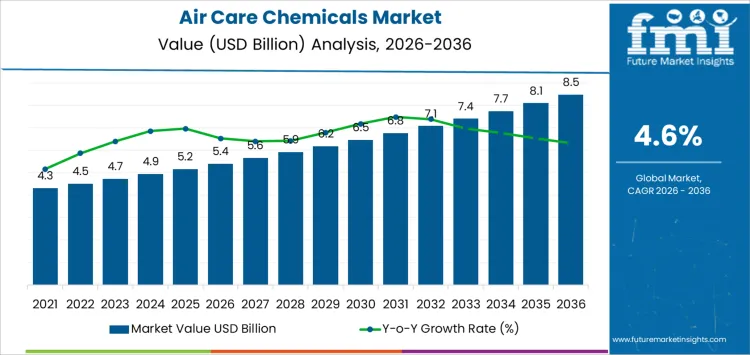
The Air Care Chemicals market is projected to be valued at USD 5.4 billion in 2025, and is expected to expand to USD 8.5 billion by 2035, driven by rising consumer awareness around indoor air quality, expanding application sectors, and ongoing innovation in air care technologies. This anticipated growth reflects a growing global emphasis on healthier living and work environments, alongside a shift toward eco-friendly and technologically advanced formulations that offer both performance and sustainability.
As air quality becomes a top priority across residential, commercial, and industrial settings, leading chemical producers and new market entrants are aligning their strategies to capitalize on this expanding opportunity. The market landscape is evolving rapidly, with traditional formulations like air fresheners still dominating demand, while next-generation products such as advanced odor neutralizers and HVAC chemical solutions are gaining traction among consumers seeking long-lasting freshness and improved indoor atmospheres.
Driving Forces Shape Market Growth
The fundamental drivers of the air care chemicals market include increased time spent indoors, heightened health consciousness, and the desire for comfortable living spaces. Air fresheners remain the dominant product category, appreciated for their ability to mask unwanted odors and introduce pleasant fragrances in homes, workplaces, hospitality venues, and other high-traffic areas. Innovations in delivery formats — from aerosols and plug-ins to gels and continuous release mechanisms — are enabling manufacturers to tailor products to specific consumer preferences and usage patterns.
In addition, odor neutralizers and absorbers are receiving greater attention for their ability to tackle persistent smells without relying solely on fragrance. These products appeal to health-focused consumers and businesses alike, particularly those sensitive to strong chemical scents. Meanwhile, specialized chemicals used in HVAC and indoor air treatment systems are becoming integral in large buildings and commercial facilities aiming to maintain air quality at scale.
To access the complete data tables and in-depth insights, request a sample report here
Innovation & Technology: Competitive Differentiators
Industry leaders are responding to shifting consumer expectations with a wave of new products and technologies. Enhanced fragrance formulations that offer longer-lasting scent experiences, eco-friendly ingredients sourced from renewable materials, and bio-enzymatic/microbial approaches are emerging as key differentiators. These technologies not only improve effectiveness, but also reduce reliance on volatile organic compounds (VOCs), aligning with sustainability goals and regulatory trends.
Established companies are leveraging extensive research and development capabilities to stay ahead of the curve, while newer players are entering the fray with disruptive ideas and agile product roadmaps. Smart scent diffusion systems, for instance, integrate sensor technology and programmable release schedules to deliver customized air care based on environmental conditions. Such advancements are attracting tech-savvy consumers and commercial clients looking for smart building solutions.
Regional and Sector Growth Highlights
Growth is being observed across multiple geographies, with Asia Pacific and North America emerging as major markets due to urbanization, rising disposable incomes, and an expanding awareness of indoor environmental health. Residential applications continue to dominate in many regions, as consumers seek comfort and freshness in their living spaces. However, commercial sectors like offices, retail outlets, hospitality venues, and healthcare facilities are also contributing robustly to market expansion as businesses prioritize air hygiene as part of their customer experience and safety protocols.
Emerging markets in Latin America and the Middle East are anticipated to grow at noteworthy rates, driven by rapid urban development and increasing investment in infrastructure and lifestyle enhancement products. In mature markets such as Europe and North America, the focus on sustainability and regulatory compliance is accelerating the adoption of greener, non-toxic air care solutions.
Competitive Landscape: Established and Emerging Players
The competitive environment in the air care chemicals market reflects both entrenched global brands and innovative new entrants. Leading multinational manufacturers continue to drive volume with well-known consumer brands and broad distribution networks. These companies are building on their reputations for quality and reliability, while expanding their portfolios to include products that appeal to modern preferences for natural and health-conscious formulations.
At the same time, smaller manufacturers and technology startups are carving out niches with specialized offerings that emphasize sustainability, high performance, and smart functionality. These players are often more agile in responding to consumer feedback and emerging trends, forging strategic partnerships and focusing on niche segments such as premium eco-friendly scents or advanced neutralization chemistry.
Outlook: A Market in Motion
Looking ahead, the air care chemicals market is expected to sustain its positive growth trajectory, shaped by ongoing innovation, shifting consumer behavior, and the integration of digital and sustainable technologies. Established manufacturers will continue to refine and expand their offerings, while new entrants will challenge conventional norms with bold product concepts and agile go-to-market strategies.
As indoor air quality continues to influence purchasing decisions around the world, all market participants — from legacy producers to disruptive innovators — are poised to benefit from the heightened emphasis on healthier, fresher indoor environments. The combination of technological advancement and consumer demand sets the stage for a dynamic decade of growth and transformation in the air care chemicals industry.