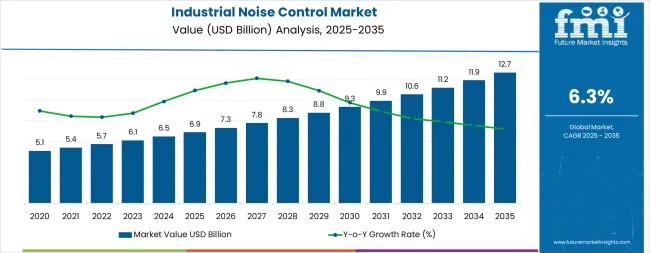
The Industrial Noise Control Market is entering a decisive growth phase as industries worldwide intensify their focus on worker safety, regulatory compliance, and productivity optimization. Valued at USD 6.9 billion in 2025, the market is projected to reach USD 12.7 billion by 2035, registering a steady CAGR of 6.3% over the forecast period. This expansion reflects the growing recognition that unmanaged industrial noise directly impacts employee health, operational efficiency, and compliance risk.
Between 2025 and 2030 alone, the market is expected to add USD 2.46 billion in value—accounting for over 42% of the decade’s total growth—driven by rising enforcement of occupational health regulations and accelerated industrial facility upgrades across manufacturing hubs.
Subscribe for Year-Round Insights → Stay ahead with quarterly and annual data updates
https://www.futuremarketinsights.com/reports/sample/rep-gb-3515
Safety Regulations and Industrial Modernization Fuel Demand
Industrial noise control solutions are increasingly seen as strategic infrastructure rather than auxiliary equipment. Governments across Asia Pacific, North America, and Europe are tightening workplace noise exposure limits, pushing manufacturers to adopt advanced acoustic systems. Heavy industries, power generation facilities, and large-scale construction sites are prioritizing noise reduction to meet compliance standards while enhancing workforce productivity.
From 2025 to 2035, the overall market is expected to grow nearly 1.8 times. This growth is underpinned by investments in smart manufacturing, expansion of industrial zones, and rising awareness of long-term occupational health costs associated with excessive noise exposure.
Rigid Systems Emerge as the Fastest-Growing Product Category
Among product types, rigid noise control systems are leading market expansion, growing at a projected CAGR of 7.2% through 2035. These systems—including acoustic enclosures, soundproof panels, silencers, and ceiling baffles—offer high durability and superior noise attenuation across industrial frequency ranges.
Key factors accelerating adoption of rigid systems include:
- Strong structural integrity suited for harsh industrial environments
- Customizable acoustic performance for application-specific requirements
- Longer service life with lower maintenance needs
- Consistent compliance with stringent noise regulations
Flexible systems continue to play a vital role in adaptable and temporary installations, while vibration isolation solutions address structure-borne noise in heavy machinery and equipment bases.
Internal Noise Control Dominates Application Demand
Internal noise control applications account for approximately 71.5% of the market share in 2025, highlighting the critical need to protect workers within manufacturing and processing facilities. Rising emphasis on employee well-being, coupled with productivity gains linked to acoustic comfort, reinforces the dominance of internal noise management solutions.
External noise control systems are also gaining traction as industries face increasing scrutiny over environmental noise pollution and community impact, particularly in urban-adjacent industrial zones.
Polymer and Composite Materials Lead Material Innovation
By material type, polymer and composite-based solutions are at the forefront, expanding at a CAGR of 6.9% through 2035. Their lightweight nature, excellent sound absorption properties, and adaptability across industries make them ideal for modern industrial noise control applications.
Glass and metal materials remain relevant for high-temperature and structurally demanding environments, while fabric-based solutions serve flexible and temporary acoustic needs.
Manufacturing and Heavy Industry Drive End-Use Adoption
Manufacturing and heavy industry represent the largest end-use segment, growing at a CAGR of 6.7% through 2035. Automotive, metal processing, cement, machinery, and textile manufacturers are investing heavily in noise control to meet safety mandates and reduce productivity losses caused by high-decibel environments.
Power generation and utilities maintain steady demand due to continuous equipment operation, while construction sites increasingly adopt noise mitigation measures as awareness of worker safety rises.
Regional Momentum Highlights Asia-Pacific Leadership:
- Asia Pacific is the fastest-growing region, driven by strong industrial expansion and safety compliance investments.
- Saudi Arabia leads regional growth with a 9.1% CAGR, supported by Vision 2030–backed industrial diversification.
- India follows closely at a 6.9% CAGR, fueled by “Make in India” manufacturing and infrastructure initiatives.
- China records a 6.8% CAGR, strengthening adoption through advanced manufacturing and industrial upgrades.
- North America remains stable due to strict occupational noise regulations and continuous facility modernization.
- Europe sustains steady demand, with Germany and the United States leading technology-driven noise control adoption.
North America and Europe continue to provide stability through stringent regulatory frameworks and ongoing modernization of existing industrial facilities, with Germany and the United States playing key roles in technology-driven adoption.
Competitive Landscape Focuses on Performance and Expertise
The market features moderate concentration, with leading players such as Sound Seal Inc., Sintesi PLC, Ventac Co. Ltd, Saint Gobain, and Pyrotek competing on acoustic performance, customization capabilities, and technical support rather than price alone. Regional players in India and China are strengthening competition through cost-effective, locally compliant solutions.
As industries balance growth with safety and sustainability, industrial noise control is evolving into a critical enabler of compliant, efficient operations.
Get data that aligns with your strategic priorities — ask for report customization today:
https://www.futuremarketinsights.com/customization-available/rep-gb-3515
Related Reports
Asphalt Mixing Plants Market- https://www.futuremarketinsights.com/reports/asphalt-mixing-plants-market
Clean Steam Separator Market- https://www.futuremarketinsights.com/reports/clean-steam-separator-market
Cooling Tower Fans Market- https://www.futuremarketinsights.com/reports/cooling-tower-fans-market
Have a specific Requirements and Need Assistant on Report Pricing or Limited Budget please contact us – sales@futuremarketinsights.com
About Future Market Insights (FMI)
Future Market Insights, Inc. (FMI) is an ESOMAR-certified, ISO 9001:2015 market research and consulting organization, trusted by Fortune 500 clients and global enterprises. With operations in the U.S., UK, India, and Dubai, FMI provides data-backed insights and strategic intelligence across 30+ industries and 1200 markets worldwide.
Contact Us:
Future Market Insights Inc.
Christiana Corporate, 200 Continental Drive,
Suite 401, Newark, Delaware – 19713, USA
T: +1-347-918-3531
Why FMI: https://www.futuremarketinsights.com/why-fmi
Website: https://www.futuremarketinsights.com
LinkedIn| Twitter| Blogs | YouTube