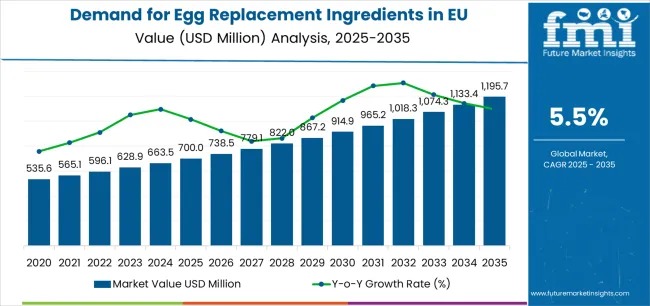
The European Union egg replacement ingredient market is entering a sustained growth phase, driven by shifting dietary preferences, rising allergy awareness, and rapid innovation in food formulation. According to Future Market Insights, the market is projected to expand from USD 700.0 million in 2025 to approximately USD 1,195.7 million by 2035, registering a compound annual growth rate (CAGR) of 5.5%. This growth reflects structural changes in Europe’s food ecosystem, where egg replacers are transitioning from niche solutions to mainstream ingredients across bakery, sauces, and ready meal categories.
Egg replacement ingredients are increasingly valued for their ability to deliver functional performance—binding, emulsification, aeration—while addressing concerns around allergens, sustainability, and clean-label compliance. Powdered formats currently dominate the market due to superior shelf life, formulation flexibility, and cost efficiency, while liquid egg replacers are gaining traction as convenience and functional performance improve, particularly in foodservice and industrial applications.
Explore trends before investing – request a sample report today! https://www.futuremarketinsights.com/reports/sample/rep-gb-27151
Strong Decade-Long Value Creation Outlook
Between 2025 and 2030, the EU egg replacement ingredient market is forecast to grow from USD 700.0 million to USD 914.6 million, adding USD 214.6 million in new value and accounting for nearly 31% of total decade growth. This phase is driven primarily by bakery manufacturers responding to demand for allergen-free, vegan, and clean-label baked goods, alongside rising adoption in foodservice and ready-to-eat meals.
From 2030 to 2035, market expansion is expected to accelerate further, increasing from USD 914.6 million to USD 1,195.7 million. This USD 281.1 million increment, representing 69% of total forecast growth, will be fueled by premiumization, organic certification, and integration of egg replacers into functional and fortified food formulations. Consumer willingness to pay for sustainable, high-quality alternatives is becoming a decisive growth lever.
Foundation Built on Pre-2025 Momentum
The market’s positive outlook builds on consistent historical performance. Between 2020 and 2025, EU egg replacement ingredient sales increased from approximately USD 535.6 million to USD 700.0 million, reflecting a CAGR of around 5%. This growth was underpinned by the rise of plant-based diets, stricter allergen labeling regulations, and steady innovation in protein blends, hydrocolloids, and specialty flours that improved taste and texture parity with eggs.
Rising Demand for Allergen-Free Solutions
Egg allergies remain among the most common food allergies in Europe, and improved diagnostics combined with heightened health awareness are expanding the addressable consumer base. Demand is driven not only by medically diagnosed consumers but also by health-conscious, vegan, and flexitarian populations seeking allergen-free diets.
Regulatory tightening around allergen management and cross-contamination has strengthened the competitive position of manufacturers offering certified allergen-free formulations. Scientific studies linking allergen avoidance with digestive health, inflammation management, and chronic disease prevention further reinforce consumer confidence and long-term demand.
Segmental Insights: Powder, Organic, and Bakery Lead
The market is segmented by ingredient type, form, application, and distribution channel. Key ingredient categories include plant proteins (soy, wheat, algal), hydrocolloids, emulsifiers, and functional seed-based flours such as flax and chia.
- Form: Powdered egg replacers hold the majority share due to stability and versatility, while liquid forms are gaining momentum.
- Application: Bakery remains the largest segment, accounting for around 45% of demand in 2025, followed by sauces & dressings and ready meals.
- Nature: The organic segment dominates, representing approximately 60% of sales in 2025 and projected to rise to 65% by 2035, supported by strong clean-label and sustainability preferences.
Technology and Nutrition Trends Reshaping the Market
Innovation is reshaping competitive dynamics. Precision fermentation and cellular agriculture technologies are enabling the production of egg-identical proteins without animal inputs, improving functional performance while eliminating allergen risks. At the same time, manufacturers are enhancing nutritional completeness by fortifying egg replacers with vitamins, minerals, and bioavailability enhancers.
Another emerging trend is the integration of gut health positioning, with formulations incorporating prebiotics and fermentation-derived components. These developments elevate egg replacers from simple substitutes to value-added functional ingredients.
Country-Level Growth Highlights
Growth varies across EU markets, reflecting differences in dietary habits, retail maturity, and innovation ecosystems.
- Germany leads in market share at approximately 24.3% in 2025, growing steadily at a 5.6% CAGR, supported by strong health food infrastructure.
- Netherlands is the fastest-growing market with a projected 6.5% CAGR, driven by advanced food technology capabilities and early adoption.
- Spain and Rest of Europe follow closely at around 6.2% CAGR, supported by rising allergy awareness and retail modernization.
- Italy grows at 5.8% CAGR, blending culinary tradition with allergen-free innovation.
- France expands at 5.2% CAGR, emphasizing quality and culinary performance.
Competitive Landscape
The EU egg replacement ingredient market is moderately fragmented, characterized by multinational food companies, ingredient specialists, and innovative startups. Leading players invest heavily in R&D, dedicated allergen-free facilities, and clinical validation to ensure safety, functionality, and consumer trust.
Key companies include Danone, Nestlé, Unilever, Kerry Group, Ingredion, Cargill, ADM, Tate & Lyle, Glanbia, Arla Foods, Bob’s Red Mill, and Ener-G Foods, among others. Strategic partnerships with retailers, healthcare stakeholders, and foodservice operators continue to shape competitive advantage.
As Europe’s food system prioritizes sustainability, health, and inclusivity, egg replacement ingredients are positioned as a long-term growth category with resilient demand and strong innovation potential through 2035.