

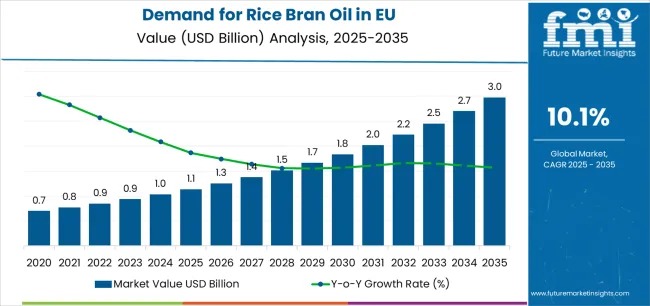
The European Union’s rice bran oil sector is entering a decisive growth phase, supported by shifting dietary preferences and a deeper focus on preventive health. Valued at USD 1.1 billion in 2025, the market is projected to reach USD 3.0 billion by 2035, expanding at a robust 10.1% CAGR. This acceleration reflects Europe’s transition toward oils that combine nutritional science, clean labeling, and sustainable sourcing.
Rice bran oil has moved beyond niche health stores to gain traction in mainstream households. Its balanced fatty acid profile, high smoke point, and naturally occurring antioxidants—particularly gamma-oryzanol and tocotrienols—are aligning strongly with consumer demand for heart-healthy, functional everyday foods. As wellness becomes embedded in daily cooking habits, rice bran oil is increasingly positioned alongside olive and sunflower oils across EU kitchens.
Explore trends before investing – request a sample report today! https://www.futuremarketinsights.com/reports/sample/rep-gb-27172
Between 2025 and 2030, EU sales are expected to rise from USD 1.1 billion to USD 1.8 billion, an absolute increase of USD 712.4 million. This first phase is driven by growing awareness of cholesterol management and the repositioning of rice bran oil as a reliable household staple. From 2030 to 2035, the market is forecast to add another USD 1.1 billion, fueled by premiumization, organic offerings, and cold-pressed variants that appeal to quality-focused buyers.
The shift from curiosity-led adoption to normalization marks a structural transformation. Early adopters were motivated by specific health needs, while the coming decade will see rice bran oil integrated into everyday cooking, packaged foods, and wellness formulations across Europe.
Health, Clean Labels, and Sustainability Reshape Demand
European consumers are increasingly prioritizing heart health, metabolic wellness, and plant-based nutrition. Rice bran oil’s clinically supported benefits—such as lowering LDL cholesterol and improving lipid profiles—are reinforcing trust among households and food manufacturers alike. Its neutral flavor and stability at high temperatures further strengthen its appeal for frying, baking, and ready-to-eat products.
Sustainability is another powerful growth lever. As a by-product of rice milling, rice bran oil supports circular economy principles by converting agricultural waste into a high-value nutritional ingredient. This aligns with EU consumer expectations around ethical sourcing, reduced waste, and lower carbon footprints. Producers emphasizing traceable supply chains, eco-friendly packaging, and energy-efficient refining are gaining a competitive edge.
Segmental Insights Highlight Food & Beverage Dominance
By nature, conventional rice bran oil leads the EU market, accounting for 72.0% share in 2025 (USD 818.2 million). Its affordability and wide availability make it the backbone of mass-market adoption, even as organic variants steadily gain traction among premium buyers.
Key advantages of conventional rice bran oil include:
- Broad distribution across hypermarkets and supermarkets
- Cost efficiency for households and food processors
- Consistent quality supported by improved refining technologies
By application, the food and beverage segment dominates with 82.0% share in 2025, equivalent to USD 931.8 million. The oil’s versatility supports its use across home cooking, snacks, bakery products, and plant-based formulations. Food manufacturers are increasingly blending rice bran oil into products to enhance nutritional claims without altering taste or performance.
Distribution Shifts and Digital Momentum
Hypermarkets and supermarkets remain the leading distribution channel, holding 44.0% market share in 2025, valued at approximately USD 500.0 million. However, online retail is emerging as a high-growth channel, particularly for organic and cold-pressed variants. Digital platforms enable brands to communicate certifications, origin transparency, and functional benefits—factors that significantly influence purchasing decisions among EU consumers.
Subscription models, wellness-focused e-commerce, and cross-border digital trade are further democratizing access, allowing smaller and specialized brands to compete alongside multinational players.
Country-Level Growth Reflects Diverse Adoption Patterns
Market expansion varies across the EU, shaped by income levels, dietary culture, and sustainability awareness. The Netherlands leads growth with an 11.4% CAGR, driven by strong nutritional literacy, plant-based adoption, and advanced e-commerce infrastructure. Demand there is forecast to rise from USD 90.9 million in 2025 to USD 267.1 million by 2035.
Germany remains the largest market by value, growing steadily at 9.1% CAGR, supported by a mature organic retail ecosystem and high trust in certifications. France and Italy demonstrate balanced growth as rice bran oil adapts seamlessly into established culinary traditions, while Spain benefits from retail modernization and affordability-led adoption.
The Rest of Europe, including Nordic and Eastern European countries, is projected to grow at 11.0% CAGR, reflecting a mix of premium organic demand and rising volume consumption in emerging markets.
Competitive Landscape Intensifies Around Quality and Transparency
The EU rice bran oil market is moderately concentrated, with competition intensifying around sustainability, refining technology, and brand differentiation. Leading players are investing in cold-press extraction, nutrition research, and traceability to meet evolving EU standards.
Key players shaping the market include:
- Cargill, Inc.
- Ricela Group
- Marico Ltd. (Saffola brand)
- Adani Wilmar Ltd.
- BCL Industries Ltd.
These companies leverage scale, global sourcing networks, and partnerships with European retailers to strengthen visibility and trust. At the same time, regional and organic brands are carving niches through premium positioning and clean-label storytelling.
Outlook: From Functional Choice to Everyday Essential
As health consciousness, sustainability, and functional nutrition converge, rice bran oil is emerging as a cornerstone of Europe’s evolving edible oil landscape. Its ability to deliver measurable health benefits, culinary versatility, and environmental value positions it for sustained, long-term growth. By 2035, rice bran oil is expected to be firmly established not just as an alternative—but as a mainstream essential within the EU’s wellness-driven food economy.




