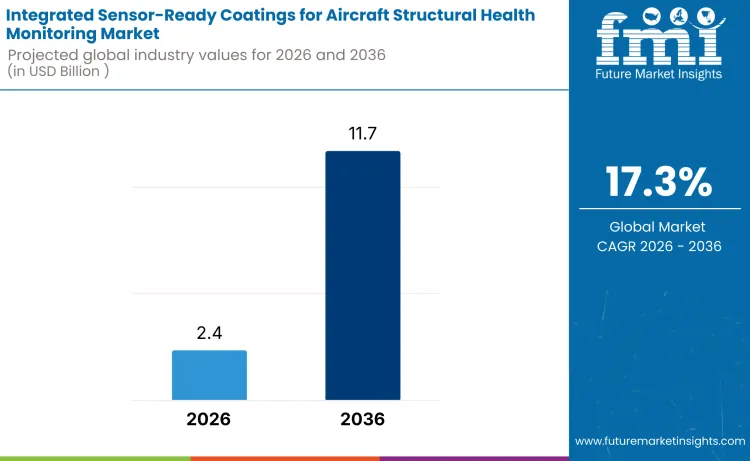
The global integrated sensor-ready coatings market for aircraft structural health monitoring is rapidly gaining momentum, with a projected valuation of USD 2.4 billion in 2026 and a substantial uptrend expected through the next decade. Fueled by rising demand for predictive maintenance, enhanced in-flight safety, and advanced diagnostic capabilities, both established aerospace coating manufacturers and innovative technology players are accelerating their efforts to redefine how aircraft structural health is managed across the world.
In an era where aviation reliability and operational efficiency are paramount, sensor-ready coatings represent a transformative leap in aircraft maintenance and safety. These advanced coating systems seamlessly integrate sensing capabilities into the protective layers of aircraft structures, enabling real-time monitoring of fatigue, strain, corrosion, and impact events. With aircraft fleets growing and airframes becoming increasingly complex, stakeholders from OEMs and MROs to defense specialists are actively seeking materials and technologies that reduce inspection cycles and extend service life.
Established Industry Leaders Set the Pace
Industry incumbents like PPG Aerospace, AkzoNobel, 3M, and Mankiewicz are recognized as trailblazers in formulating integrated coatings that marry robust protection with embedded sensing functions. These companies have long been synonymous with high-performance aircraft materials and are now channeling their deep expertise into multifunctional coatings that support continuous structural health monitoring.
PPG Aerospace has been at the forefront with sensor-ready systems that incorporate conductive pathways and piezoresistive elements into durable coatings. AkzoNobel continues to innovate by integrating smart functionalities that maintain performance in extreme environmental and operational conditions. 3M’s interdisciplinary approach brings together conductive polymers and advanced dielectric materials that form the backbone of reliable, data-rich coating solutions. Meanwhile, Mankiewicz leverages decades of aerospace coatings experience to design sensor-ready systems that ensure stable adhesion and signal transmission across composite and metallic airframes.
These established players are not just refining existing technologies; they are expanding their product portfolios and collaborating with airlines, airframers, and defense organizations to tailor sensor-ready coatings that align with specific aircraft architectures and maintenance frameworks.
To access the complete data tables and in-depth insights, request a sample report here
New Entrants and Emerging Technologies Expand the Competitive Landscape
Alongside traditional giants, a new wave of manufacturers and technology innovators is contributing to market expansion with fresh perspectives and next-generation solutions. Emerging companies are exploring multifunctional self-sensing polymers, microcapsule-based indicator coatings, and hybrid materials that can detect microdamage before it propagates into major structural issues.
These newer players emphasize agility and focused innovation. By leveraging advancements in smart materials and nano-engineered conductive networks, they are crafting coating systems capable of interfacing more effectively with the latest structural health monitoring (SHM) platforms. These solutions are particularly appealing to tier-1 aerospace suppliers and specialist MROs that require customizable, scalable sensor integration for both new aircraft builds and retrofit applications.
With digital twin frameworks and predictive analytics gaining traction, these innovative coatings are being designed to feed rich, actionable data into automated maintenance systems. The result is a growing ecosystem where traditional coatings companies and agile startups collaborate and compete, propelling the technology forward at an unprecedented pace.
Aviation Operators and OEMs Drive Adoption Worldwide
The adoption of integrated sensor-ready coatings is not limited to specific regions; global aerospace operators are rapidly recognizing the value of embedded monitoring capabilities. Aviation fleets in Asia, Europe, and North America are incorporating smart coatings into both commercial and defense aircraft to enhance performance, reduce downtime, and drive cost efficiencies.
Aircraft OEMs such as Boeing and Airbus are aligning their maintenance ecosystems with sensor-enabled coatings, embedding diagnostic intelligence early in the aircraft lifecycle. This approach supports advanced maintenance strategies where real-world data informs scheduling, repairs, and lifecycle planning, ultimately improving aircraft availability and safety.
Similarly, leading airlines and MRO service providers are integrating sensor-ready coatings into their operational paradigms. By reducing reliance on periodic manual inspections and offering continuous health insight into fuselage, wing, and control surface integrity, operators are improving turnaround times and reducing total cost of ownership.
Future Outlook: Expansion, Technology Convergence, and Sustainable Growth
As the market evolves, the focus is shifting toward more resilient and intelligent materials that not only withstand harsh environmental conditions but also support interoperable sensing networks. Collaboration between coatings manufacturers, sensor developers, and analytics platforms will be vital in creating integrated solutions that deliver reliability, efficiency, and actionable insights.
Looking ahead, the integrated sensor-ready coatings market is poised to expand significantly, driven by investment in predictive maintenance technologies, aerospace digital transformation initiatives, and the push towards safer, smarter aircraft operations. Both established manufacturers and emerging innovators are well positioned to capitalize on this growth, shaping the future of aircraft structural health monitoring with next-generation materials and technologies.