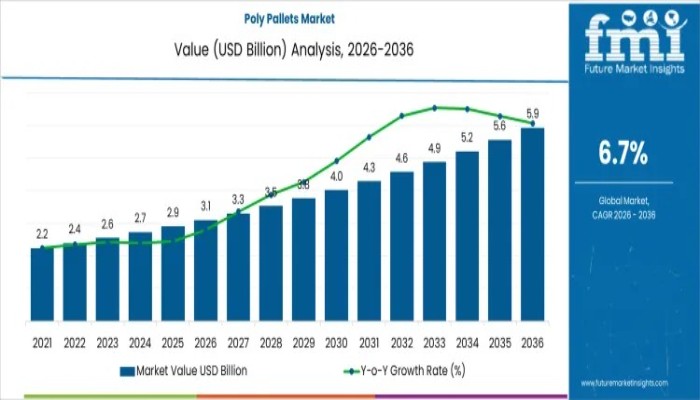
The global poly pallets market is on a strong growth trajectory, projected to reach USD 5.9 billion by 2036, up from USD 3.1 billion in 2026, representing a CAGR of 6.7%. The increasing demand for durable, hygienic, and efficient packaging solutions in sectors such as food, pharmaceuticals, and retail logistics is driving this expansion.
Poly pallets, primarily made from high-density polyethylene (HDPE) or polypropylene, are proving to be a superior alternative to traditional wood pallets, offering resistance to moisture, chemicals, pests, and simplifying sanitation processes—an essential factor for industries with stringent hygiene standards.
Discover Market Opportunities – Get Your Sample of Our Industry Overview Today!
Quick Stats for the Poly Pallets Market
- Market Value (2026): USD 3.1 billion
- Forecast Value (2036): USD 5.9 billion
- Forecast CAGR: 6.7%
- Leading End-Use: Food, pharma & retail logistics (42% share)
- Top Pallet Type: Rackable & nestable pallets (45% share)
- Key Growth Region: Asia Pacific
- Major Players: ORBIS, Rehrig Pacific, Schoeller Allibert, Qingdao Huading, Nilkamal, Mitsubishi Logistics
Market Drivers and Growth Dynamics
Poly pallets are increasingly adopted due to their durability, lightweight design, and long service life. Compared with traditional wood pallets, poly pallets offer several advantages:
- Moisture and chemical resistance, making them ideal for the food, pharmaceutical, and chemical industries.
- Pest resistance and easier sanitation, ensuring compliance with strict hygiene standards.
- Longer lifecycle, supporting reuse and cost savings over time.
- Compatibility with automation and logistics systems, improving warehouse efficiency.
Supply chain optimization, regulatory requirements for food safety, and growing interest in sustainable packaging solutions are accelerating market adoption. Moreover, innovations in pallet design and molding technology have enhanced load capacity, structural integrity, and safety features, making poly pallets increasingly competitive with wood and metal alternatives.
Challenges such as higher initial costs and limited recycling infrastructure in some regions may affect adoption, but the long-term benefits of hygiene, durability, and lifecycle cost-efficiency continue to drive demand.
Segment-Wise Analysis
The poly pallets market is segmented by application and pallet type:
- Applications:
- Food, pharma & retail logistics – 42% share
- Manufacturing, warehousing, FMCG, and more
- Pallet Types:
- Rackable & nestable pallets – 45% share
- Hygienic pallets
- Heavy-duty pallets
- Lightweight pallets
Rackable & nestable pallets dominate due to their versatility and space-saving design. They can be securely stacked for storage and nested when empty, optimizing warehouse and transport space. Their adaptability makes them the preferred choice across sectors that demand efficient logistics and storage solutions.
Regional Market Insights
The poly pallets market is witnessing notable growth across key regions:
- India: Leading the market with a 10.4% CAGR, fueled by rapid industrial growth, logistics expansion, and increasing demand for cost-effective storage solutions.
- China: Growing at 9.2%, supported by robust manufacturing and logistics infrastructure.
- USA: Expanding at 6.2%, driven by sustainability goals and hygienic packaging demand.
- Germany: Growing at 6%, spurred by regulatory standards and focus on quality.
- Brazil: Rising at 7.2%, fueled by industrial expansion and high-performance pallet requirements.
Why Food, Pharma & Retail Logistics Lead the Market
Industries handling perishable or regulated goods increasingly prefer poly pallets due to their durability, hygiene, and ease of handling. Maintaining product quality and safety is critical, and poly pallets enable compliance with industry standards, while reducing handling damage and improving operational efficiency.
Industry Trends Shaping the Market
- Rise of closed-loop pallet pooling and rental programs reducing total cost of ownership.
- Development of reinforced and lightweight pallet designs balancing strength and material efficiency.
- Adoption of smart pallets equipped with RFID or IoT sensors for real-time tracking and inventory management.
- Growing demand for recycled polymer pallets supporting sustainability initiatives.
- Integration with automated material handling systems and adherence to global pallet dimension standards.
Competitive Landscape
Major players in the poly pallets market focus on innovation, durability, and supply chain efficiency:
- ORBIS / Rehrig Pacific: Nestable and rackable pallets designed for high-throughput and reusable lifecycles.
- Schoeller Allibert: Modular, lightweight pallets with consistent quality and global service support.
- Qingdao Huading: Cost-effective pallets for industrial and export use with clear load and stacking specifications.
- Nilkamal: Durable pallets tailored to regional markets, emphasizing material quality and long service life.
- Mitsubishi Logistics: Pallets integrated into broader logistics solutions focusing on strength, traceability, and automation compatibility.
- Local OEMs: Customizable designs, flexible production, and just-in-time delivery for nearby manufacturers and distributors.
Why FMI: https://www.futuremarketinsights.com/why-fmi
About Future Market Insights (FMI)
Future Market Insights, Inc. (FMI) is an ESOMAR-certified, ISO 9001:2015 market research and consulting organization, trusted by Fortune 500 clients and global enterprises. With operations in the U.S., UK, India, and Dubai, FMI provides data-backed insights and strategic intelligence across 30+ industries and 1200 markets worldwide.
Contact Us:
Future Market Insights Inc.
Christiana Corporate, 200 Continental Drive,
Suite 401, Newark, Delaware – 19713, USA
T: +1-347-918-3531
For Sales Enquiries: sales@futuremarketinsights.com
Website: https://www.futuremarketinsights.com
LinkedIn| Twitter| Blogs | YouTube