

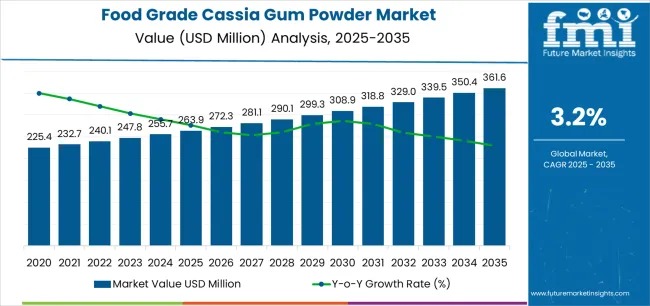
The global food grade cassia gum powder market is valued at USD 263.9 million in 2025 and is projected to reach USD 361.6 million by 2035, recording an absolute increase of USD 97.7 million over the forecast period. This represents a 37% total market expansion, with the industry growing at a compound annual growth rate (CAGR) of 3.2% between 2025 and 2035. Overall, the market is expected to scale by approximately 1.4X, reflecting sustained adoption across food processing segments.
Growth is being supported by the rising preference for natural food thickeners, expanding use of plant-based hydrocolloids, and increasing requirements for texture enhancement and stabilization in dairy, confectionery, meat processing, and frozen dessert applications. Food grade cassia gum powder continues to gain traction as manufacturers shift away from synthetic additives and respond to global clean-label expectations.
Explore trends before investing – request a sample report today! https://www.futuremarketinsights.com/reports/sample/rep-gb-27652
Derived from the endosperm of Cassia tora seeds, food grade cassia gum powder is widely used as a natural thickening, gelling, and stabilizing agent. Its classification as a Generally Recognized as Safe (GRAS) ingredient has reinforced its acceptance across regulated food markets. Ice cream formulations, frozen desserts, cheese, and processed meat products remain the largest application areas, where cassia gum delivers consistent viscosity control and improved product stability.
The market includes refined, unrefined, and specialty-processed cassia gum powders, each designed for distinct functional and viscosity requirements. Advances in purification technologies, particle size control, and standardized processing have enhanced product consistency and solubility, making cassia gum suitable for both artisanal formulations and large-scale industrial food manufacturing. Improved packaging and traceability systems are further strengthening confidence among global food processors.
Market Value Expansion Reflects Long-Term Stability
Between 2025 and 2030, the market is expected to expand from USD 263.9 million to USD 306.4 million, adding USD 42.5 million, which accounts for 43.5% of total decade growth. This phase will be shaped by increasing clean-label reformulations, broader adoption of natural stabilizers, and expanding access to standardized processing technologies.
From 2030 to 2035, market value is forecast to rise further to USD 361.6 million, contributing an additional USD 55.2 million, or 56.5% of total forecast growth. This later phase will be driven by premium-grade cassia gum development, automation in quality assurance, and growing demand for high-purity, specialty food applications.
Refined Cassia Gum Dominates Product Demand
By type, refined cassia gum is projected to account for 62.3% of total market share in 2025, reflecting its superior purity, predictable performance, and regulatory acceptance. Food manufacturers favor refined grades for applications requiring precise texture control, especially in dairy and frozen desserts where consistency is critical. Continued investment in refining technology and quality optimization is reinforcing this segment’s leadership.
Ice Cream Remains the Largest Application Segment
By application, ice cream and frozen desserts represent the single largest demand segment, accounting for 45.7% of market share in 2025. Cassia gum’s ability to prevent ice crystal formation, enhance mouthfeel, and stabilize emulsions makes it indispensable for premium frozen products. As frozen dessert innovation accelerates globally, this segment will remain a primary growth engine.
Regional Growth Patterns Highlight Asia Pacific Leadership
Asia Pacific continues to lead global expansion, supported by strong agricultural bases, rising food processing investments, and growing natural ingredient adoption.
- China leads with a 4.3% CAGR, driven by large-scale food manufacturing, export-oriented ingredient production, and supportive policies for agricultural value addition.
- India follows at 4.0% CAGR, benefiting from established cassia cultivation, expanding processing capacity, and growing domestic consumption.
- Germany grows at 3.7%, anchored by advanced food technology and strict quality standards.
- Brazil records 3.4%, reflecting agricultural processing growth.
- United States posts 3.0%, supported by precision food manufacturing and clean-label reformulation trends.
Europe’s market is forecast to grow from USD 67.8 million in 2025 to USD 89.5 million by 2035, with Germany maintaining regional leadership.
Competitive Landscape Focuses on Quality and Processing Excellence
The food grade cassia gum powder market is moderately consolidated, with players emphasizing processing efficiency, product standardization, and global distribution. Key companies include Lubi Gel, Bharat Agro Industries, Indian Hydrocolloids, Agro Gums, and Avlast Hydrocolloids, alongside a broader ecosystem of regional and international suppliers. Strategic investments in purification systems, particle optimization, and application-specific grades are shaping competitive differentiation.
Outlook: Natural Ingredients Drive Long-Term Opportunity
As food manufacturers prioritize clean labels, plant-based formulations, and functional reliability, food grade cassia gum powder is positioned as a stable, performance-driven ingredient. Ongoing innovation in processing technology, coupled with expanding global food production, is expected to sustain steady growth and reinforce cassia gum’s role within the natural hydrocolloid landscape through 2035.




