The global oil-in-water anionic emulsifier market is projected to grow from USD 1.7 billion in 2025 to USD 2.5 billion by 2035, representing a CAGR of 3.8%. This steady expansion is fueled by a broad spectrum of applications across food and beverages, cosmetics, pharmaceuticals, and industrial products, highlighting the critical role of emulsifiers in stabilizing oil droplets within water-based systems.
Emulsifiers have long been indispensable in food processing, ensuring texture, stability, and extended shelf life in dressings, sauces, bakery creams, and dairy alternatives. With processed and convenience food consumption rising across Europe, Asia, and North America, demand for oil-in-water anionic emulsifiers continues to strengthen. Plant-based and clean-label product trends further drive interest in high-purity and specialty emulsifiers that meet evolving consumer preferences.
Explore trends before investing – request a sample report today! https://www.futuremarketinsights.com/reports/sample/rep-gb-27244
In personal care and cosmetics, emulsifiers maintain uniform texture, blend oils and fragrances, and ensure product stability. Growth in skincare and haircare spending, particularly in emerging markets, supports sustained demand. Premium brands increasingly rely on multifunctional emulsifiers offering hydration, mildness, or conditioning benefits alongside conventional emulsification.
The pharmaceutical sector leverages emulsifiers in oral suspensions, ointments, and injectables, where functionality extends beyond texture to therapeutic reliability. Anionic emulsifiers enhance solubility, improve bioavailability, and ensure uniform dosage, with regulatory compliance serving as a key barrier to entry. Advanced drug delivery systems, including lipid-based and nano-emulsions, are expected to further boost demand.
Industrial applications offer additional growth avenues. Emulsifiers stabilize active ingredients in agrochemicals, ensure uniform coatings and paints, and enhance cleaning product performance. Demand here is closely tied to agricultural cycles, construction activity, and manufacturing output, producing steady, if cyclical, growth.
Quick Stats – Oil-in-Water Anionic Emulsifier Market
- Market Value (2025): USD 1.7 billion
- Forecast Value (2035): USD 2.5 billion
- CAGR: 3.8%
- Leading Technology: Sulfate Ester Systems
- Primary Application: Food & Beverages
- Key Growth Regions: East Asia, North America, Western Europe
Market Segmentation Highlights
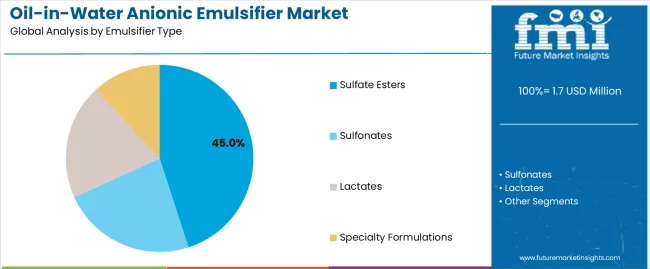
- By Emulsifier Type:
- Sulfate Esters: 45% market share, dominant in food and cosmetic applications
- Sulfonate Systems: 32%, industrial and heavy-duty applications
- Lactate-Based Systems: 15%, natural and bio-compatible formulations
- Specialty Blended Products: 8%, niche and custom applications
- By Application:
- Food & Beverages: 25% market share, fastest growth (CAGR 4.2%)
- Cosmetics: 28%, stable premium demand
- Pharmaceuticals: 22%, regulatory-driven growth
- Industrial Applications: 25%, linked to agrochemicals, paints, and cleaning products
- By Geography:
- China: Fastest growth at 5.1%, driven by industrial modernization
- India: 4.8% growth, supported by government infrastructure initiatives
- Germany: 4.4%, technology leadership and chemical innovation
- Brazil: 4.0%, industrial expansion and modernization
- United States: 3.6%, mature market with high adoption of advanced emulsification systems
- UK: 3.2%, integration with industrial modernization programs
- Japan: 2.9%, precision manufacturing requirements
Sulfate ester emulsifiers remain the most widely used technology, offering superior stability, regulatory compliance, and integration with automated manufacturing systems. Sulfonates continue to support industrial applications, lactates grow in natural and eco-friendly formulations, and specialty solutions meet customized manufacturing requirements.
Drivers & Trends
- Key Drivers: Expanding food processing and convenience food demand, cosmetic innovation, pharmaceutical sector growth.
- Market Restraints: Raw material volatility, supply chain issues, alternative emulsification technologies.
- Emerging Trends: Smart manufacturing integration (IoT, automated control), increasing demand for bio-based and clean-label emulsifiers.
Regional Insights
East Asia, led by China, dominates market expansion with strong industrial support and cost-effective domestic production. India follows as a high-growth market with urban manufacturing centers adopting advanced emulsifier systems. Mature markets in North America and Europe focus on technology integration, regulatory compliance, and premium product adoption.
Competitive Landscape
The market features 18–22 credible players, with top companies controlling approximately 65–70% of revenue. Leadership is achieved through technical support, formulation validation, and product innovation. Key players include DSM, Croda, Shah Patil & Company, Clariant, Shree Vallabh Chemical, CIDOLS, Spectra Specialities, Hielscher Ultrasonics, Lansen, Lubrizol, and BASF.
Conclusion
The oil-in-water anionic emulsifier market demonstrates strong fundamentals, driven by diversified applications, technological advancement, and regional industrial growth. With sustained demand from food, cosmetic, pharmaceutical, and industrial sectors, the market is poised for steady expansion, emphasizing regulatory compliance, digital integration, and innovation in formulation systems.