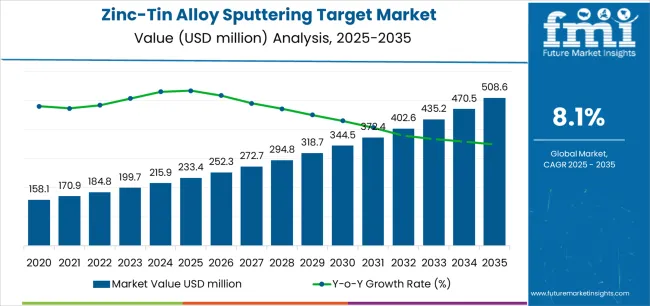
The global zinc-tin alloy sputtering target market is poised for robust growth, with a market value estimated at USD 233.4 million in 2025 and expected to more than double by 2035, reflecting strong demand across multiple high-performance industries. This projected expansion underscores the material’s increasing importance in advanced manufacturing processes, as both established suppliers and emerging producers invest in capability building, technological innovation, and strategic partnerships to capture growth opportunities worldwide.
Zinc-tin alloy sputtering targets play a vital role in thin-film deposition for semiconductor fabrication, optical coatings, and next-generation electronics applications. The material’s unique combination of electrical, optical, and mechanical properties makes it indispensable in markets where precision and reliability directly influence product performance. With rapid adoption of miniaturized electronics, high-resolution displays, and advanced optical systems, manufacturers are intensifying their focus on providing high-purity, consistent, and customizable sputtering solutions to meet the evolving needs of electronics, display, and coating industries.
Market Growth Drivers and Industry Dynamics
The surge in demand for zinc-tin alloy sputtering targets is being driven primarily by the accelerated growth of the global semiconductor industry, where these targets support integrated circuit production, memory devices, and microprocessor manufacturing. As semiconductor fabs scale up and new facilities come online across key regions such as Asia Pacific, North America, and Europe, material suppliers are expanding capacity and refining processes to deliver high-performance targets that meet exacting manufacturing requirements.
Display technology advancements — including OLED, LCD, and emerging flexible screens — are further propelling the market. Zinc-tin targets are increasingly used in depositions that require superior film uniformity and conductive properties, essential for vibrant displays with enhanced touch-sensitivity and energy efficiency.
Optical device manufacturing is another major growth segment, with precision anti-reflective coatings, photonic components, and specialized lenses demanding targets with exceptional purity and performance consistency. Decorative and industrial coating applications also contribute to market expansion, offering steady demand from sectors that require aesthetic finishes and protective surfaces.
Industry innovation is advancing rapidly, with breakthroughs in powder metallurgy, vacuum melting, and material purification techniques enabling manufacturers to meet higher performance and quality standards. These technological strides not only enhance target performance but also open doors to customized compositions and specialized target geometries optimized for specific applications.
To access the complete data tables and in-depth insights, request a sample report here
Established Players and Emerging Innovators Shape Competitive Landscape
The competitive landscape is defined by a blend of long-standing materials specialists and newer entrants seeking to expand their footprint in this dynamic market. Traditional leaders with extensive experience in alloy production and high-precision manufacturing are defending their positions by investing in next-generation technologies, expanding global footprints, and enhancing quality assurance capabilities to support large-scale production requirements.
At the same time, newer manufacturers are entering the space with fresh perspectives and agility, focusing on niche segments and custom solutions that address specific industrial and research needs. These emerging players leverage advanced production techniques and strategic collaborations to deliver value-added products and expand their influence beyond local markets.
Manufacturers are also engaging in targeted partnerships with electronics OEMs, research institutions, and equipment suppliers to co-develop tailored sputtering materials that align with unique process specifications. Such collaborations not only accelerate product development cycles but also offer deeper integration with customer manufacturing workflows, strengthening long-term commercial relationships.
Strategic Expansion and Technological Advancements
Across the market, companies are adopting multi-pronged growth strategies, including capacity expansions, R&D investments, and joint ventures that bridge material innovations with application-specific needs. As demand grows in high-growth regions — particularly in China, India, and other parts of the Asia Pacific — manufacturers are scaling operations to reduce lead times, optimize cost structures, and ensure robust supply chains.
Increasing emphasis on product purity and performance reliability is pushing firms to implement advanced quality control systems and rigorous validation protocols. This focus on material excellence supports customer expectations in critical applications such as semiconductor fabrication, where even minor deviations in target properties can impact production yields and device functionality.
Emerging technologies in process automation, robotics-assisted target handling, and real-time process monitoring are further elevating manufacturing efficiency, while also enabling precise control over deposition characteristics. These innovations are expected to help suppliers offer more consistent performance outcomes, reduce production variability, and enhance overall product quality.
Outlook: A Future Built on Collaboration and Innovation
Looking forward, the zinc-tin alloy sputtering target market is on track to become increasingly sophisticated, with expanding opportunities across electronics, optics, and industrial sectors. The integration of new technologies and manufacturing techniques will continue to support demand for high-performance materials, while established and emerging manufacturers alike pursue strategic growth initiatives to capture market share and drive innovation.
With the global electronics and coating industries continuously evolving, the zinc-tin alloy sputtering target market stands at the forefront of enabling technologies that deliver precision, reliability, and enhanced performance across a wide range of applications.