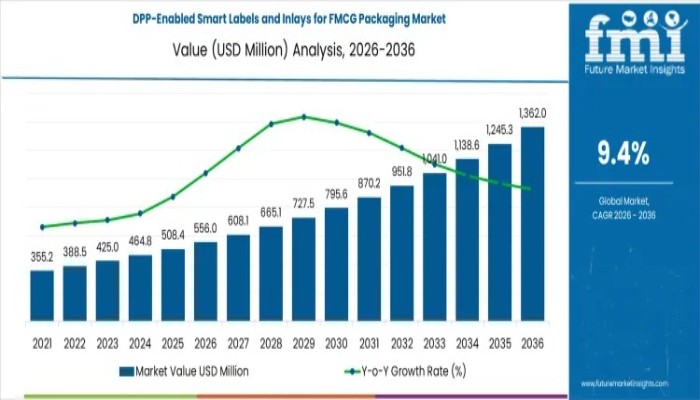
The global DPP-enabled smart labels and inlays for FMCG packaging market is poised for remarkable growth, with its market value estimated at USD 556 million in 2026 and projected to reach USD 1,362 million by 2036, reflecting a robust CAGR of 9.4%.
The adoption of digital product passports (DPP) within smart labels is transforming FMCG packaging by enhancing traceability, anti-counterfeiting measures, and sustainability reporting. This surge in adoption is being driven by both established manufacturers aiming to expand their market presence and new entrants leveraging emerging technologies to capture growth opportunities.
Unlock Growth Potential – Request Your Sample Now and Explore Market Opportunities!
Early Adoption and Market Outlook
Between 2026 and 2031, the market is expected to grow from USD 556 million to approximately USD 837 million. This early adoption phase is primarily driven by personal care, food, and beverage sectors, where premium brands are piloting DPP-enabled smart labels and inlays to validate benefits in traceability, consumer engagement, and supply chain transparency.
From 2031 to 2036, market expansion accelerates to USD 1,362 million as DPP-enabled smart labeling becomes standard across mass-market FMCG products. Growth during this period is supported by:
- Increasing regulatory mandates for product transparency and sustainability reporting.
- Rising e-commerce penetration demanding verifiable product authenticity.
- Technological improvements in NFC, RFID, and QR-enabled inlays, ensuring seamless integration into high-speed packaging lines.
This growth trajectory reflects steady value accumulation, driven by technological innovation and regulatory alignment across the FMCG sector.
Quick Market Stats
- Market Value (2026): USD 556 million
- Forecast Value (2036): USD 1,362 million
- Forecast CAGR (2026–2036): 9.4%
- Leading Packaging Format: Smart barcode + RFID-enabled labels (45%)
- Key Growth Regions: India, China, USA, Brazil, Germany
- Top Players: Avery Dennison, Smartrac, Zebra, Schreiner ProTech, Shenzhen RZX, Invengo, UFlex, Local converters, Toppan
Drivers of Demand
Historically, the demand for DPP-enabled smart labels and inlays emerged from the limitations of static barcodes and traditional tracking systems. Globalized production and multi-tier distribution networks exposed FMCG supply chains to risks like counterfeiting and quality control failures. DPP-enabled smart labels provided machine-readable data that went beyond basic identification, offering provenance records and conditional alerts, particularly in high-value segments like pharmaceuticals, premium beverages, and infant nutrition.
Looking ahead, demand is being driven by:
- Regulatory compliance for product lifecycle transparency.
- Data-driven supply chain control, including recycling instructions and material disclosure.
- Advances in printed electronics and cloud-linked systems, lowering unit costs and enabling real-time consumer and retail interaction.
Application Segmentation
Demand is primarily segmented by end-use application and packaging format:
- FMCG and Retail Traceability: 40% of total demand; driven by high SKU volumes and regulatory reporting obligations.
- Food & Beverage Packaging: Smart labels support batch tracking, product information access, and anti-counterfeiting measures.
- E-commerce & Logistics: Labels provide parcel-level visibility, routing accuracy, and operational efficiency.
- Retail & Distribution: Scannable data improves inventory management, recall management, and consumer verification.
Packaging Format Insights
- Smart barcode + RFID labels (45%): Leading format due to compatibility with existing scanning infrastructure and high-speed production lines.
- RFID inlays and QR labels: Support logistics, parcel tracking, and consumer access to product data.
- Other formats: Address niche applications requiring specialized integration.
Regional Market Dynamics
- India (CAGR 12%): Expansion driven by organized FMCG production and regulatory push for packaging security.
- China (CAGR 11%): Growth fueled by large-scale FMCG manufacturing, retail expansion, and e-commerce adoption.
- USA (CAGR 8.8%): Adoption in beverages, packaged foods, and personal care products across retail and e-commerce channels.
- Brazil (CAGR 8%): Growth driven by traceability initiatives and organized retail distribution.
- Germany (CAGR 7.5%): Steady uptake supported by regulatory compliance and brand protection standards.
Competitive Landscape
Leading global players such as Avery Dennison, Smartrac, Zebra, and Schreiner ProTech dominate through high-precision RFID, NFC, and QR-enabled inlays, optimized for automated packaging lines. Regional players like Shenzhen RZX, Invengo, and UFlex, along with local converters, contribute to competitive depth through customization and localized production. Toppan leverages expertise in printing, security, and information management for serialized packaging, further enriching market dynamics.
Key Considerations for Adoption:
- Integration with automated filling and labeling systems.
- Ensuring adhesion, readability, and durability across packaging materials and storage conditions.
- Managing cost per unit and infrastructure requirements for data security and DPP functionality.
Why FMI: https://www.futuremarketinsights.com/why-fmi
About Future Market Insights (FMI)
Future Market Insights, Inc. (FMI) is an ESOMAR-certified, ISO 9001:2015 market research and consulting organization, trusted by Fortune 500 clients and global enterprises. With operations in the U.S., UK, India, and Dubai, FMI provides data-backed insights and strategic intelligence across 30+ industries and 1200 markets worldwide.
Contact Us:
Future Market Insights Inc.
Christiana Corporate, 200 Continental Drive,
Suite 401, Newark, Delaware – 19713, USA
T: +1-347-918-3531
For Sales Enquiries: sales@futuremarketinsights.com
Website: https://www.futuremarketinsights.com
LinkedIn| Twitter| Blogs | YouTube