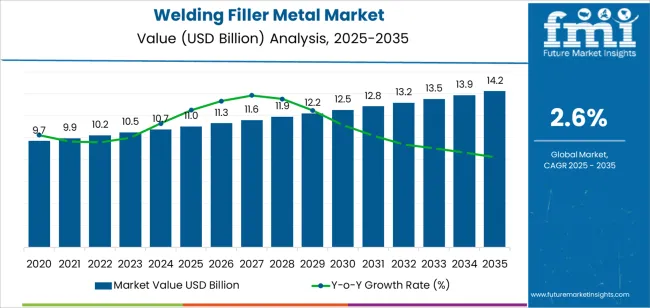
The global welding filler metal market is projected to reach approximately USD 14.24 billion by 2035, up from an estimated USD 11.02 billion in 2025, driven by sustained demand across key industrial sectors and growing adoption of advanced metallurgical solutions. This robust growth outlook underscores the importance of welding consumables in automotive, construction, aerospace, and heavy fabrication industries, creating attractive opportunities for both long-standing industry leaders and emerging players seeking to expand their market footprint with innovative technologies.
As industrial production scales worldwide, and infrastructure initiatives continue to surge, welding filler metals remain a critical component of manufacturing and fabrication workflows. Solid wires currently dominate the market due to their versatility and proven performance across diverse welding applications, while other formats such as flux cored wires, stick electrodes, and submerged arc welding (SAW) wires are gaining importance in high-productivity and specialized settings.
Market Dynamics Fueling Growth and Innovation
Manufacturing modernization and infrastructure development programs across Asia Pacific, North America, and Western Europe are key growth drivers. These regions are experiencing high consumption of filler metals as fabrication facilities increasingly integrate automated welding systems and advanced filler technologies. In Asia Pacific, especially in industrial hubs within China and India, government-backed infrastructure programs have accelerated adoption of high-performance filler metals, offering significant market potential for both global brands and regional innovators.
North America’s welding market benefits from strong investment in energy infrastructure, aerospace component fabrication, and industrial refurbishment, while Western Europe’s focus on renewable energy and lightweight assembly methods fuels demand for specialized filler metals tailored to precision applications.
Within these regional dynamics, new manufacturers are emerging to challenge traditional players by offering localized solutions that combine competitive pricing with advanced material properties. These up-and-coming companies are expanding their offerings through strategic partnerships and technology collaborations that enhance their ability to compete in global supply chains.
Established Leaders and New Entrants Shaping the Competitive Landscape
At the forefront of the welding filler metal market are well-established global manufacturers known for their broad product portfolios, deep technical expertise, and extensive distribution networks. These industry veterans have built reputations based on consistent quality, performance reliability, and comprehensive support services. In parallel, a growing cohort of new manufacturers and specialized producers is entering the market with differentiated alloy formulations, agility in product development, and customer-centric innovation.
Together, these established and emerging players are redefining industry expectations around weld quality, process efficiency, and compatibility with automated and robotic welding environments. This competitive ecosystem not only drives technology advancement but also supports more efficient production environments and customizable welding solutions for end-use industries.
To access the complete data tables and in-depth insights, request a sample report here
Technological Innovations Advancing Market Capabilities
Technological progress remains central to the welding filler metal market’s evolution. Manufacturers are investing in advanced metallurgical research to improve alloy compositions, refine flux chemistries, and enhance wire drawing techniques that boost weld quality, productivity, and consistency. These innovations are increasingly aligned with the needs of automated welding and robotic fabrication systems, enabling real-time quality monitoring and integration with smart manufacturing platforms.
Beyond material innovation, companies are developing comprehensive welding system solutions that bundle filler metals with process guidance, technical support, and quality assurance protocols. This holistic approach helps end users optimize welding procedures, reduce production variability, and accelerate adoption of advanced welding technologies.
New entrants are particularly focused on flexible solutions that tailor filler metal properties for niche applications, such as electric vehicle assembly, lightweight aerospace materials, and construction structures requiring high structural integrity. By addressing specific performance requirements, these manufacturers are carving out competitive advantages and tapping into high-growth segments.
Strategic Regional Growth Highlights
Asia Pacific is anticipated to maintain strong momentum due to large-scale infrastructure projects and automotive production expansion. In China and India, local manufacturers are scaling operations to meet domestic demand while partnering with global firms to enhance technology capabilities. Meanwhile, in North America and Western Europe, demand is supported by manufacturing modernization, energy infrastructure upgrades, and compliance with stringent quality standards across industrial sectors.
Emerging markets in Latin America, the Middle East, and Africa are also showing increased consumption of welding filler metals as construction activity rebounds and industrial fabrication grows. These regions present attractive opportunities for new manufacturers to establish regional supply networks and introduce advanced filler solutions.
Outlook and Opportunities
With sustained industrial growth, ongoing infrastructure investment, and the shift toward automated and high-precision welding systems, the welding filler metal market is poised for continued expansion. Both established manufacturers and innovative new entrants are expected to benefit from a dynamic and competitive landscape that values technological differentiation, quality assurance, and responsive market strategies. As demand for reliable and high-performance welding consumables accelerates, the industry is set to enter a new era of growth and technological advancement.