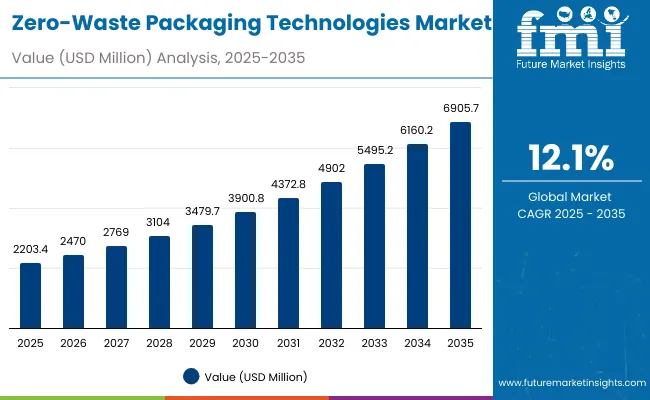
The Zero-Waste Packaging Technologies Market is entering a transformative decade, as sustainability shifts from a niche preference to a mainstream business imperative. According to the latest industry analysis, the market is projected to grow from USD 2,203.4 million in 2025 to USD 6,905.7 million by 2035, registering a robust CAGR of 12.1%. This remarkable expansion of 212% over ten years highlights how zero-waste packaging is redefining product delivery, consumer engagement, and supply-chain design across industries.
Market Overview: A Decade of Accelerated Growth
Between 2025 and 2030, the market is expected to add nearly USD 1.7 billion, accounting for 36% of total decade growth. This early momentum is fueled by the rapid adoption of refill pods, dissolvable sachets, reusable containers, and compostable systems in personal care, household products, and food & beverages.
From 2030 to 2035, growth is forecast to accelerate further, contributing USD 3.0 billion, or 64% of total expansion. Regulatory pressure on single-use plastics, combined with large-scale deployment of loop and mail-back systems, is expected to push zero-waste solutions firmly into the mainstream.
To access the complete data tables and in-depth insights — Request Your Sample Report Now
Why the Zero-Waste Packaging Technologies Market Is Growing
The market’s strong outlook is being shaped by several converging forces:
- Rising consumer demand for sustainable, plastic-free alternatives
- Regulatory convergence around circular economy and Extended Producer Responsibility (EPR) frameworks
- Brand-driven innovation, as companies integrate refill, reuse, and compostable models into core portfolios
- Infrastructure investments such as in-store refill stations, reverse logistics, and digital traceability platforms
Together, these drivers are encouraging both established manufacturers and new entrants to expand operations and invest in next-generation zero-waste technologies.
Regional Outlook: Asia-Pacific Leads, Innovation Hubs Remain Strong
- Asia-Pacific is projected to be the fastest-growing region, led by India (22.9% CAGR) and China (19.9% CAGR). Rapid urbanization, policy support, and digital commerce integration are accelerating adoption.
- North America and Europe continue to act as innovation hubs, where multinational brands pilot scalable closed-loop systems and advanced materials.
- Countries such as Japan, the UK, and Germany are benefiting from strong recycling infrastructure, premium consumer demand, and strict regulatory compliance.
Competitive Landscape: Collaboration Over Consolidation
The Zero-Waste Packaging Technologies Market remains moderately fragmented. TerraCycle Loop leads with an 8.8% global share, while over 90% of the market is distributed among diversified players and innovators.
- Global leaders like Unilever, L’Oréal, and Procter & Gamble are leveraging scale to mainstream refill and reuse systems.
- Mid-sized innovators such as Ethique, Lush, Albéa, and AptarGroup are gaining traction through dissolvable packaging, refill pods, and reusable designs.
- Specialist players including Ecologic Brands and Beauty Kitchen are focusing on niche, compostable, and refill-based models, often supported by strong regional partnerships.
Competitive differentiation is increasingly defined by closed-loop ecosystems, digital traceability, and consumer engagement platforms, rather than packaging formats alone.
Key Segments of the Zero-Waste Packaging Technologies Market
- By Format
- Refill pods/cartridges
- Solid bars & powders
- Concentrates & drops
- Returnable & reusable containers
- By Material
- PCR & biopolymers
- Paper-composite
- Aluminum
- Glass
- By System
- In-store refill stations
- Mail-back / Loop systems
- Home-compostable packs
- Dissolvable sachets
- By Customer Type
- Mass brands
- Indie brands
- Premium brands
- Hotel & travel amenities
- By Channel
- Direct-to-consumer (D2C)
- Retail chains
- Salon & spa
- Travel & hospitality
- By Region
- North America
- Europe
- East Asia
- South Asia & Pacific
- Latin America
- Middle East & Africa
Technology, Regulation, and the Road Ahead
Recent policy developments, including the EU Packaging and Packaging Waste Regulation (PPWR 2025/40), are accelerating adoption by mandating measurable waste reduction. At the same time, infrastructure gaps in refill and reuse systems remain a challenge, particularly in emerging markets. Industry collaboration between manufacturers, retailers, and municipalities is expected to be critical in overcoming these barriers.
Outlook for Manufacturers and Innovators
For established manufacturers, zero-waste packaging represents a pathway to regulatory compliance, brand trust, and long-term cost efficiency. For new and emerging players, it offers an opportunity to leapfrog traditional packaging models with agile, sustainability-first innovations.
As circular economy principles become central to purchasing decisions, the Zero-Waste Packaging Technologies Market is poised to become a cornerstone of sustainable manufacturing worldwide—balancing scale, innovation, and measurable environmental impact through 2035 and beyond.
Why FMI: https://www.futuremarketinsights.com/why-fmi
About Future Market Insights (FMI)
Future Market Insights, Inc. (FMI) is an ESOMAR-certified, ISO 9001:2015 market research and consulting organization, trusted by Fortune 500 clients and global enterprises. With operations in the U.S., UK, India, and Dubai, FMI provides data-backed insights and strategic intelligence across 30+ industries and 1200 markets worldwide.
Contact Us:
Future Market Insights Inc.
Christiana Corporate, 200 Continental Drive,
Suite 401, Newark, Delaware – 19713, USA
T: +1-347-918-3531
For Sales Enquiries: sales@futuremarketinsights.com
Website: https://www.futuremarketinsights.com
LinkedIn| Twitter| Blogs | YouTube