

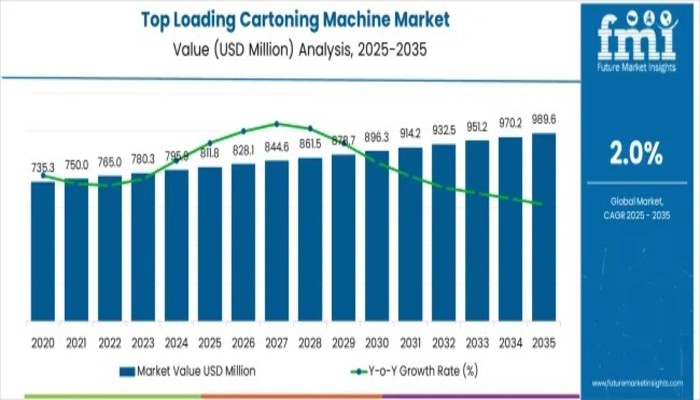
The global top loading cartoning machine market is poised for steady growth, expanding from USD 811.8 million in 2025 to USD 989.6 million by 2035, reflecting a CAGR of 2.0% and an absolute increase of USD 177.8 million. This growth trajectory underscores the rising adoption of automation, precision engineering, and sustainable packaging solutions across key industries such as food, pharmaceuticals, and personal care.
Automation and Adaptability at the Core of Market Expansion
The market’s momentum is driven by accelerating demand for efficient, high-speed packaging systems capable of handling diverse product dimensions with minimal downtime. Manufacturers are increasingly integrating servo-driven systems, modular configurations, and smart control interfaces to improve operational flexibility and productivity.
Modern top loading cartoning machines are designed for rapid changeovers, enabling producers to adapt quickly to changing packaging requirements a key advantage in industries where short production cycles and customized product runs have become the norm. As packaging becomes more complex and sustainability-driven, these intelligent machines offer energy efficiency, eco-friendly material compatibility, and precision control that align with both operational and environmental goals.
Discover Growth Opportunities in the Market – Get Your Sample Report Now
Regional Insights: Established Markets Steady, Emerging Markets Accelerate
North America and Europe remain strongholds for the top loading cartoning machine industry, driven by their well-established packaging infrastructures, regulatory focus on safety and labeling, and consistent innovation in automation technology. The United States, in particular, is witnessing sustained growth as industries upgrade to smarter, digitally integrated packaging systems — progressing at a CAGR of 0.7% through 2035.
In Europe, countries like Italy (1.2%) and Spain (2.3%) demonstrate notable advances. Italy’s market strength lies in its precision engineering and compliance with stringent packaging standards, while Spain benefits from government investments in Industry 4.0 manufacturing systems, reinforcing its leadership in Western Europe’s automation sector.
The Asia-Pacific region represents the most promising growth hub. China (3.3%) and India (4.1%) are spearheading regional expansion, fueled by surging packaged food consumption, rapid industrial automation, and rising pharmaceutical output. India’s fast-growing middle class, combined with heightened demand for hygienic and convenient food packaging, is positioning the country as a key contributor to global market growth.
Meanwhile, Latin America and the Middle East & Africa are entering modernization phases, where automation is gradually being adopted to enhance supply chain efficiency and retail readiness, particularly within consumer goods and food processing sectors.
Segmental Highlights: Horizontal Orientation and Food Industry Dominate
By Orientation, the horizontal segment leads the market, capturing 86.1% of total revenue in 2025. Its widespread adoption stems from its superior speed, flexibility, and reliability in handling various product sizes. Horizontal cartoning machines offer precise carton alignment, minimal product damage, and seamless integration with other packaging systems essential features for high-output operations.
By Capacity, machines within the 70 to 150 CPM range command 32.4% of the market share in 2025, striking a balance between throughput and versatility. These machines are widely preferred across food and personal care sectors due to their programmable logic controls (PLC), servo automation, and adaptability to varying production scales.
By End Use, the food segment dominates with 35.9% of the market value in 2025. This dominance is attributed to the rising global appetite for packaged food products and stringent hygiene standards. Food manufacturers are increasingly adopting top loading cartoners for their ability to maintain product integrity, consistent packaging quality, and reduced contamination risk all while supporting high-speed, automated operations.
Market Drivers and Emerging Trends
- Integration of Robotics and Smart Controls – The adoption of AI-driven vision systems, robotics, and IoT-enabled monitoring is enhancing precision and efficiency across packaging lines.
- Sustainability-Centric Design – Manufacturers are introducing machines compatible with biodegradable and recyclable materials, aligning with global sustainability goals.
- E-Commerce and Consumer Goods Expansion – The e-commerce boom is fueling demand for versatile packaging machines that can efficiently process varied carton sizes and configurations.
- Customization and Flexibility – Shorter product lifecycles and personalized packaging trends are pushing manufacturers toward equipment that supports frequent adjustments without performance loss.
Key Regional Growth Drivers
- United States: Automation upgrades to enhance packaging line productivity and meet digital compliance standards.
- Italy: High-precision packaging for food, pharmaceutical, and cosmetic industries under stringent quality norms.
- Spain: Government-driven industrial digitization supporting manufacturing innovation.
- China: Technological infrastructure and skilled labor supporting mass-scale automated production.
- India: Rising disposable income and packaged food consumption stimulating new investments in packaging automation.
Competitive Landscape
The market is moderately consolidated, with leading players including Syntegon Technology GmbH, Omori Machinery Co. Ltd., Mpac Group plc, R.A Jones, Tetra Pak International S.A., Rovema GmbH, Cama Group, Econocorp Inc., PMI Cartoning, Inc., Bradman Lake Group Ltd., and ADCO Manufacturing.
Recent strategic developments highlight a shift toward innovation and regional expansion:
- Syntegon Technology GmbH (2025) introduced new SBM line sterilizers, expanding its pharmaceutical packaging portfolio.
- Tetra Pak International S.A. (2025) partnered with Absolicon to develop renewable thermal-powered UHT systems.
- Mpac Group plc (2025) collaborated with Freyr Battery to integrate smart assembly systems in the U.S.
- Omori Machinery Co. Ltd. (2024) expanded its North American operations to strengthen its automation capabilities.
Why FMI: https://www.futuremarketinsights.com/why-fmi
About Future Market Insights (FMI)
Future Market Insights, Inc. (FMI) is an ESOMAR-certified, ISO 9001:2015 market research and consulting organization, trusted by Fortune 500 clients and global enterprises. With operations in the U.S., UK, India, and Dubai, FMI provides data-backed insights and strategic intelligence across 30+ industries and 1200 markets worldwide.
Contact Us:
Future Market Insights Inc.
Christiana Corporate, 200 Continental Drive,
Suite 401, Newark, Delaware – 19713, USA
T: +1-347-918-3531
For Sales Enquiries: sales@futuremarketinsights.com
Website: https://www.futuremarketinsights.com
LinkedIn| Twitter| Blogs | YouTube




