

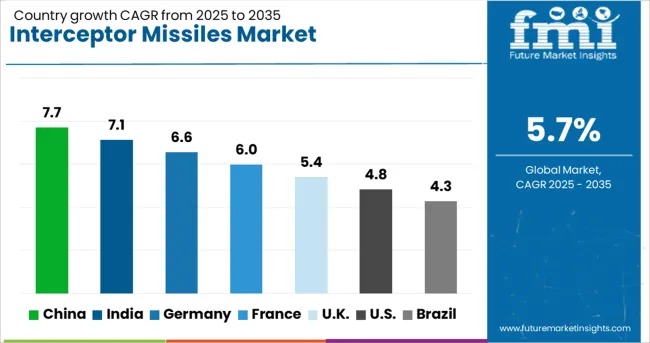
The global Interceptor Missiles Market is entering a sustained growth phase as nations intensify investments in layered air and missile defense architectures. The market is estimated to be valued at USD 11.8 billion in 2025 and is forecast to reach USD 20.6 billion by 2035, expanding at a compound annual growth rate (CAGR) of 5.7% over the forecast period.
Market trajectory analysis reveals a clearly defined adoption curve. Between 2025 and 2028, the market is projected to expand by USD 2.2 billion, rising from USD 11.8 billion to USD 14.0 billion and accounting for 25.6% of the total decade-long growth. This phase reflects accelerated procurement cycles, early-stage fleet modernization, and capacity expansion across national defense establishments.
The mid-period from 2028 to 2031 adds an incremental USD 2.5 billion, highlighting a transition toward more deliberate, strategically paced deployments. From 2031 to 2035, the market expands by USD 3.1 billion; however, annual value gains taper from USD 1.0 billion in 2031–2032 to a combined USD 1.1 billion during the final three years, signaling an approaching saturation point as high-priority acquisition targets are largely achieved by 2033.
Layered Missile Defense Becomes a Central Pillar of National Security
The primary driver behind market expansion is the global shift toward multi-layered missile defense systems capable of countering ballistic, cruise, hypersonic, and unmanned aerial threats. Defense planners are increasingly prioritizing integrated radar, command-and-control, and interceptor kill-chain architectures to establish real-time threat detection and rapid response capabilities.
Technological convergence across precision guidance, propulsion engineering, and sensor fusion has significantly improved interception accuracy and reduced reaction times. Nations are moving beyond single-layer air defenses and are now deploying tiered interception strategies that protect airspace at low, medium, and exo-atmospheric altitudes.
Subscribe for Year-Round Insights → Stay ahead with quarterly and annual data updates
https://www.futuremarketinsights.com/reports/sample/rep-gb-23429
Surface-to-Air Interceptors Dominate Global Installations
By system type, surface-to-air interceptor missiles account for 67.0% of total market revenue in 2025, establishing themselves as the backbone of modern air defense grids. Their leadership position is supported by high deployment flexibility, rapid mobility, and seamless integration with land-based radar and command posts.
These systems are widely favored due to their ability to protect critical infrastructure, urban centers, military installations, and border regions under varied operational environments. Their compatibility with both fixed and mobile launcher configurations has strengthened their relevance across both developed and emerging defense economies.
Medium-Range Interceptors Set the Operational Standard
In terms of engagement range, medium-range interceptor missiles represent 49.0% of global market revenue in 2025, reflecting their strategic role in layered defense doctrines. These systems are optimized to engage threats in the mid-course and terminal phases, offering an efficient balance between reaction speed, interception altitude, and lifecycle cost.
The demand for medium-range systems continues to rise as defense agencies seek scalable solutions capable of rapid deployment around strategic assets, transport corridors, and population-dense regions. Mobile launch platforms and modular system architectures are further strengthening this segment’s adoption.
Supersonic Threats Drive R&D and System Enhancements
By threat category, supersonic missiles contribute 45.0% of total market demand in 2025, emerging as the primary focus area for interceptor system upgrades. The proliferation of high-speed cruise and anti-ship missile platforms has increased the urgency for rapid-launch, high-G maneuverability, and advanced seeker technologies.
Research investments are accelerating in dual-pulse propulsion, real-time sensor fusion, and AI-supported tracking algorithms, enabling defense systems to neutralize fast-moving, low-altitude threats with greater precision and reliability.
Regional Growth Anchored in Strategic Defense Complexity
Regional expansion patterns reflect varying geopolitical pressures and national modernization priorities:
- China is projected to advance at a 7.7% CAGR, supported by vertical integration of aerospace manufacturing and accelerated missile defense deployments.
- India follows closely with a 7.1% CAGR, driven by indigenous system development and dual-layer air defense expansion.
- Germany is forecast to grow at 6.6% CAGR, anchored in NATO-aligned modernization programs and integrated European defense initiatives.
- France is projected to expand at 6.0% CAGR, while the United Kingdom advances at 5.4% CAGR, reflecting growing naval and land-based interceptor upgrades.
- The United States, growing at 4.8% CAGR, remains a global technology leader and a major exporter of interceptor systems.
North America, Asia-Pacific, and Europe continue to represent the primary centers of demand, innovation, and system deployment.
Competitive Landscape Defined by System-Level Innovation
The market features a consolidated network of global defense primes and specialized manufacturers. Key participants include Lockheed Martin, Raytheon Technologies, MBDA, Northrop Grumman, Rafael Advanced Defense Systems, Israel Aerospace Industries, BAE Systems, Bharat Dynamics, Mitsubishi Heavy Industries, Hanwha, Kongsberg Defence & Aerospace, General Dynamics, and China Aerospace Science and Industry Corporation.
Recent industry momentum underscores the pace of innovation. In July 2025, Israel Aerospace Industries finalized development of the Arrow 4 interceptor, enhancing its “shoot-look-shoot” engagement capability. In June 2025, India advanced toward the first operational testing phase of its M1 interceptor missile under Project Kusha, strengthening domestic air defense readiness.
Outlook
The Interceptor Missiles Market is transitioning toward a more mature growth environment characterized by incremental fleet upgrades, software-driven enhancements, and modular system architectures. While growth rates are moderating due to approaching saturation levels, technological evolution in hypersonic interception, AI-assisted guidance, and networked fire-control systems continues to generate sustained strategic relevance.
The comprehensive market report provides detailed insights into country-level investments, technology roadmaps, competitive positioning, and long-term procurement strategies shaping the future of global missile defense capabilities.
About Future Market Insights (FMI)
Future Market Insights, Inc. (FMI) is an ESOMAR-certified, ISO 9001:2015 market research and consulting organization, trusted by Fortune 500 clients and global enterprises. With operations in the U.S., UK, India, and Dubai, FMI provides data-backed insights and strategic intelligence across 30+ industries and 1200 markets worldwide.




