

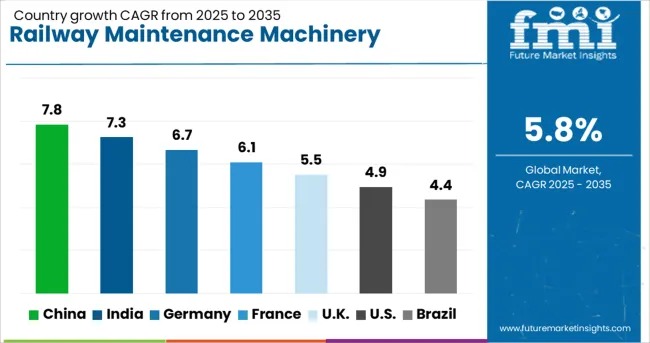
The global Railway Maintenance Machinery Market is entering a high-growth phase, supported by large-scale rail infrastructure investments, safety-driven modernization, and rapid adoption of intelligent maintenance technologies. The market is estimated to be valued at USD 5.9 billion in 2025 and is projected to reach USD 10.4 billion by 2035, expanding at a compound annual growth rate (CAGR) of 5.8% over the forecast period.
This growth reflects a clear structural shift in how railway networks are being maintained worldwide. While Europe and North America collectively hold nearly 57% of global market share in 2025, their combined contribution is expected to decline to 48% by 2035 as Asia-Pacific accelerates from 31% to 41% market share, driven by rapid rail expansion across India, China, and Southeast Asia. The increasing focus on high-speed rail lines, heavy-haul freight corridors, and urban transit systems is significantly raising demand for advanced tamping, track alignment, ballast handling, and digital diagnostic machinery.
Automation and Autonomous Technologies Reshape Competitive Dynamics
A defining trend is the swift rise of autonomous and semi-autonomous maintenance equipment. Between 2027 and 2032, these systems are expected to account for 18% of total machinery sales, up sharply from 6% in 2025. These machines leverage AI-driven diagnostics, machine vision, and GPS-based positioning to enable predictive maintenance and reduce dependence on manual labor, helping rail operators minimize downtime and operational risk.
Subscribe for Year-Round Insights → Stay ahead with quarterly and annual data updates
https://www.futuremarketinsights.com/reports/sample/rep-gb-23428
This technology shift is expected to disrupt traditional competitive hierarchies. Established OEMs are facing mounting pressure from local and regional manufacturers in emerging markets, which are offering cost-competitive alternatives tailored to price-sensitive government tenders. As a result, global incumbents are being compelled to accelerate innovation, regionalize manufacturing, and expand service-based business models to preserve market positioning.
Tamping Machines and Ballast Track Applications Anchor Market Growth
By product type, tamping machines account for 33.0% of total market revenue in 2025, making them the single largest segment. Their critical role in restoring and maintaining track geometry by compacting ballast ensures stable rail alignment and passenger safety. As train speeds and axle loads continue to rise, tamping systems are becoming increasingly sophisticated, integrating automation and real-time monitoring.
From a distribution perspective, OEM channels dominate with a 67.0% revenue share in 2025, reflecting rising demand for certified, warranty-backed equipment with embedded telemetry and regulatory compliance. OEMs’ ability to provide integrated service contracts and post-installation support continues to be a decisive factor in procurement decisions.
Application-wise, ballast track maintenance represents 61.0% of the market in 2025, as the majority of long-distance and freight networks globally continue to rely on traditional ballast systems. These tracks require frequent compaction, cleaning, and realignment, making them heavily dependent on specialized maintenance machinery.
Global Rail Expansion Drives Strong Country-Level Performance
China is projected to record a 7.8% CAGR through 2035, underpinned by the world’s largest high-speed rail network and continuous modernization programs. India follows with a 7.3% CAGR, supported by new freight corridors, metro expansions, and a strong push for domestic manufacturing under national infrastructure initiatives.
In Europe, Germany is expected to grow at 6.7% CAGR, driven by precision maintenance standards and advanced inspection technologies such as laser-based monitoring and GPS-guided alignment tools. The United Kingdom, at 5.5% CAGR, is benefiting from upgrades of aging rail corridors and a strong focus on predictive maintenance systems. The United States is projected to expand at a 4.9% CAGR, led by freight rail modernization and growing adoption of hybrid-powered maintenance machinery.
Technology Integration Redefines Maintenance Standards
Innovations in hydraulics, machine vision, IoT sensors, and digital twins are transforming railway maintenance from reactive to predictive models. Real-time monitoring of track conditions, ultrasonic flaw detection, and AI-driven scheduling are enabling operators to extend asset lifecycles and significantly reduce unplanned service disruptions.
A notable industry milestone was achieved on March 19, 2025, when L&T Technology Services introduced TrackEi™, an AI-powered track inspection system built on NVIDIA Jetson™ platforms. The solution enables real-time defect detection at the edge, enhancing railway safety and operational efficiency through predictive maintenance workflows.
Competitive Landscape Intensifies
The market is moderately consolidated, with leading players including Plasser and Theurer, China Railway Construction Corporation, Loram Rail Maintenance India Pvt Ltd., Harsco (Enviri Corporation), Strukton Rail, Robel, and Geatch Srl. These companies are increasingly focusing on modular designs, automation-ready platforms, and environmentally friendly machinery to align with global sustainability mandates.
Competitive differentiation is now being defined by digital capability, predictive diagnostics, and life-cycle service offerings rather than purely mechanical performance. Meanwhile, the emergence of strong regional players in Asia and Latin America is reshaping price structures and procurement strategies globally.
Outlook
As governments prioritize rail as a sustainable backbone of national transportation strategies, railway maintenance machinery is becoming mission-critical infrastructure. The convergence of infrastructure expansion, digitalization, automation, and sustainability is expected to sustain strong growth through 2035.
The full industry report provides in-depth competitive benchmarking, regional forecasts, technology mapping, and strategic opportunity analysis to support informed investment and procurement decisions in this rapidly evolving market.
About Future Market Insights (FMI)
Future Market Insights, Inc. (FMI) is an ESOMAR-certified, ISO 9001:2015 market research and consulting organization, trusted by Fortune 500 clients and global enterprises. With operations in the U.S., UK, India, and Dubai, FMI provides data-backed insights and strategic intelligence across 30+ industries and 1200 markets worldwide.




