

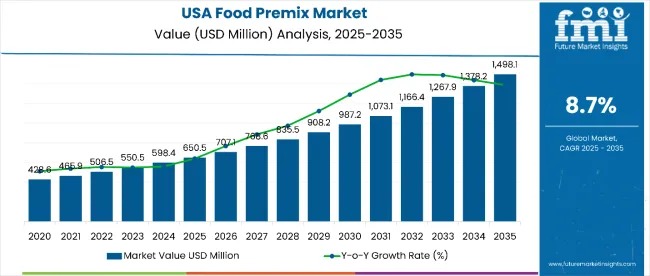
The USA food premix market is entering a high-growth phase, supported by rising health consciousness, regulatory-driven fortification, and expanding functional food applications. Valued at USD 650.5 million in 2025, the market is projected to reach USD 1,498.1 million by 2035, registering a robust CAGR of 8.7% over the forecast period. This growth trajectory represents an absolute dollar opportunity of USD 847.6 million, underscoring the strategic importance of premixes across the U.S. food and nutrition ecosystem.
Food premixes—standardized blends of vitamins, minerals, amino acids, and functional ingredients—are increasingly favored for their ability to deliver precise nutrient dosing, streamline manufacturing, and ensure regulatory compliance. Their role has expanded beyond basic fortification into sports nutrition, early-life nutrition, medical foods, and OTC pharmaceutical applications, positioning premixes as a core input in preventive healthcare-oriented food systems.
Get Exclusive Access To Data Tables, Market Sizing Dashboards, And Analyst Insights. Request Sample Report! https://www.futuremarketinsights.com/reports/sample/rep-gb-16651
By 2030, the USA food premix market is expected to reach approximately USD 1,050 million, generating nearly USD 330 million in incremental value during the first half of the decade. The remaining USD 480 million is anticipated in the latter half, indicating a moderately back-loaded growth pattern. Adoption is being driven by the convenience, cost efficiency, and scalability of premixes, particularly as manufacturers respond to micronutrient deficiency concerns and demand for fortified everyday foods.
The USA accounts for nearly 52% of the North American food premix market and approximately 38% of the global functional food ingredients market, supported by its advanced food processing infrastructure and strong nutritional awareness. Food premixes contribute around 44% of the U.S. fortified foods market, especially in bread, cereals, and dairy, while holding 31% of the nutraceutical ingredients market and 29% of the specialty food ingredients segment.
Liquid Premixes Dominate with 64% Market Share
By form, liquid premixes lead the market with a 64% share in 2025, driven by superior solubility, faster absorption, and ease of integration into production lines. Liquid formats are increasingly preferred in beverage fortification, clinical nutrition, and ready-to-drink functional products, where uniform dispersion and bioavailability are critical. Advancements in encapsulation, flavor masking, and emulsion stability are further accelerating adoption.
Food & Beverages Remain the Largest Application Segment
By application, food and beverages account for 50% of total market demand, fueled by consumer preference for functional dairy, fortified beverages, snacks, and meal replacements. Manufacturers rely on premixes to ensure accurate micronutrient delivery, reduce formulation complexity, and meet FDA labeling requirements across large-scale operations.
Structural Shift Toward Clean-Label and Plant-Based Formulations
The market is undergoing a structural transformation driven by clean-label expectations and plant-based nutrition trends. Manufacturers are introducing organic, non-GMO, allergen-free, and plant-derived premix formulations, targeting infants, elderly consumers, athletes, and vegan populations. Technologies such as spray drying and micro-encapsulation are enhancing nutrient stability and bioavailability, enabling broader application scope.
Micronutrient Deficiency Awareness as a Core Growth Catalyst
Rising awareness of micronutrient deficiencies is a key demand driver. In 2024, health authorities reported that nearly 70% of elderly Americans were vitamin D deficient, prompting food and supplement manufacturers to increase fortification efforts. This has reinforced demand for scientifically formulated, regulatory-compliant premixes with proven efficacy rather than trend-driven nutrition claims.
State-Level Growth Anchored in Manufacturing and Demographics
Growth is led by California (8.4% CAGR), supported by over 6,500 food manufacturing establishments and a strong functional beverage innovation culture. Texas (8.1%) follows, driven by sports nutrition demand and ethnic nutrition blends, while New York (7.9%) benefits from premium nutraceutical development and demographic diversity. Florida and Illinois round out the top five, supported by aging populations, tourism-driven wellness demand, and centralized ingredient logistics.
Competitive Landscape and Strategic Focus
The market is moderately consolidated, with Glanbia plc holding a leading 14.2% share, followed by players such as Prinova, Archer Daniels Midland Company, Cargill Incorporated, General Mills, Watson Inc., Danone, Bunge Limited, Corbion N.V., Jubilant Life Sciences, SternVitamin GmbH, and LycoRed Ltd. Competitive differentiation is increasingly based on customized formulations, plant-based innovation, regulatory expertise, and quality assurance.
Outlook
With expanding applications in functional foods, dietary supplements, and preventive nutrition, the USA food premix market is positioned for sustained long-term growth. Investments in science-backed formulations, clean-label positioning, and advanced delivery technologies are expected to define competitive success as manufacturers align nutrition with convenience, compliance, and consumer trust.




