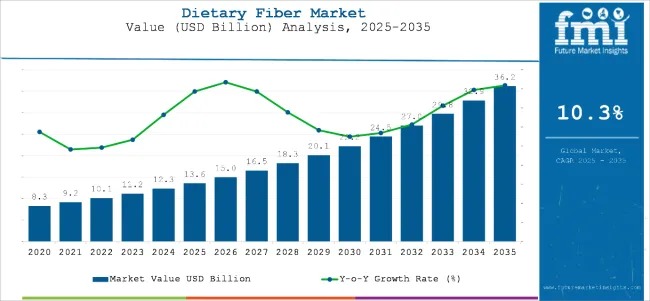
The global dietary fiber market is entering a decisive growth phase, projected to expand from USD 13.6 billion in 2025 to USD 36.2 billion by 2035, registering a strong CAGR of 10.3% over the forecast period. This growth reflects a structural shift in global nutrition priorities, with consumers increasingly associating dietary fiber intake with digestive health, weight management, metabolic balance, and long-term disease prevention.
Dietary fiber has evolved from a niche functional ingredient into a mainstream nutritional component across food, beverage, and nutraceutical formulations. Rising awareness of gut health, supported by medical research and public health campaigns, is accelerating demand for fiber-enriched products across both developed and emerging economies. Manufacturers are responding by reformulating everyday foods with functional fiber blends that deliver measurable health benefits without compromising taste or texture.
Get Exclusive Access To Data Tables, Market Sizing Dashboards, And Analyst Insights. Request Sample Report! https://www.futuremarketinsights.com/reports/sample/rep-gb-3376
Market Size, Structure, and Strategic Importance
In 2025, dietary fiber represents nearly 15% of the functional food ingredients market, around 8% of the nutraceutical ingredients market, and close to 10% of the broader health and wellness ingredients segment. Within the specialty carbohydrates and fibers market, dietary fiber commands a dominant 40–50% share, highlighting its central role in functional nutrition. Despite contributing less than 0.5% of the total food and beverage market, its influence continues to expand through fortification and premiumization strategies.
Technological advancements in fiber extraction, purification, and formulation are further widening application potential. Improved solubility, stability, and sensory performance are enabling fibers to be incorporated into beverages, bakery products, dairy alternatives, sports nutrition, and clinical nutrition formulations.
Consumption Patterns Reveal Untapped Growth Potential
Per capita intake data underscores both maturity and opportunity within the dietary fiber market. High-income regions demonstrate stronger alignment with recommended intake levels, while emerging markets signal substantial headroom for growth.
- Canada leads global consumption at 21.5 grams per person per day, reflecting effective public health alignment.
- The United Kingdom averages 18.5 grams, supported by food reformulation and consumer awareness.
- The United States follows closely at 18.4 grams, driven by fortified food availability and large-scale nutrition campaigns.
In contrast, emerging economies report significantly lower intake levels. India averages just 7 grams per day, while Brazil (11 grams), China (12 grams), and Japan (10.8 grams) remain below global recommendations. These gaps highlight strong growth potential for fiber-enriched staples, snacks, and institutional food programs across Asia and Latin America.
Regulatory Frameworks Shape Market Quality and Compliance
The dietary fiber market is governed by strict regulatory oversight focused on food safety, health claims, and nutritional labeling. In the United States, FDA regulations define eligible fiber types and require clear declaration of fiber content, with “high fiber” claims permitted only above 5 grams per serving. China mandates accurate labeling under GB/T standards, while Japan allows digestive and cardiovascular claims under its Health Promotion Law, subject to precise reporting.
In Europe, EU Regulation 1169/2011 sets labeling thresholds, including 6 grams per 100 grams for “high fiber” claims. Germany’s nutritional guidelines recommend 30 grams of daily fiber, reinforcing market demand for compliant, science-backed formulations. India’s FSSAI regulations similarly mandate substantiated fiber claims, aligning market growth with national nutrition objectives.
Soluble Fiber and Cereals Lead Core Segments
By type, soluble dietary fiber dominates with a 72% market share in 2025, driven by its clinically supported benefits for gut health, cholesterol reduction, and blood sugar management. Ingredients such as inulin, polydextrose, and beta-glucan are increasingly favored in functional foods and beverages due to their prebiotic properties and formulation flexibility.
From a sourcing perspective, cereals and grains account for 55% of total market share, supported by high availability, cost efficiency, and widespread consumer acceptance. Wheat, rice, and bran remain primary sources, particularly for large-scale food processing applications.
Functional Foods Drive Application Demand
Functional food and beverages represent the largest application segment, capturing 39% of market share in 2025. Rising consumer preference for fortified products that support satiety, digestive balance, and nutrient absorption is driving fiber integration across cereals, bakery, dairy, beverages, and plant-based alternatives.
Emerging trends include the incorporation of dietary fiber into sports nutrition, protein beverages, and plant-based foods, while demand for soluble fibers continues to rise due to their heart health and microbiome benefits. However, high production costs of specialty fibers and varying global regulations remain key challenges for multinational manufacturers.
Regional Growth Led by Germany and OECD Markets
Germany is the fastest-growing market, expanding at a 7.7% CAGR, driven by clean-label trends, preventive healthcare policies, and strong regulatory alignment. The UK (7.1%), USA (6%), France (5.5%), and Japan (5.4%) continue to grow steadily, reflecting regulation-led adoption rather than volume-driven expansion.
Competitive Landscape and Recent Developments
The market is moderately consolidated, with leading players including DIC Corporation, Church & Dwight Co Inc, Hero Nutritionals LLC, Nutranext, and Herbaland Naturals Inc. These companies focus on innovation across gummies, supplements, and clean-label fiber formulations. In July 2024, Ingredion strengthened its portfolio with the launch of FIBERTEX CF 100 and CF 500 citrus fibers in EMEA, reinforcing clean-label and texturizing capabilities across global markets.
As preventive nutrition moves to the center of global health strategies, dietary fiber is set to remain a cornerstone ingredient, driving sustained innovation, regulation-led quality, and long-term market expansion.